|
|
 |
|
|
|
|
Weekly Torah Reading
|
|
|
|
Parashat Vayigash ("and he drew near")
|
|
|
Click on the links to display the Scriptures:
|
|
|
|
|
|
|
|
Torah Reading Overview
|
|
|
Last week's parashah (Miketz) related how Joseph's imprisonment finally ended after he interpreted Pharaoh's dreams and advised him to prepare for seven years of coming famine. Greatly impressed by Joseph, Pharaoh then appointed him to be Viceroy over all of Egypt. The famine then spread throughout the region, and Jacob sent ten of his sons to Egypt to buy grain (but kept Benjamin at home for fear of his safety). Joseph recognized his brothers, but they did not recognize him, and accused them of being spies.
|
|
|
|
|
|
|
When his brothers protested their innocence and gave account of their origin, Joseph demanded that they confirm their story by bringing Benjamin to Egypt - and then imprisoned Simeon as a hostage. When they returned to Canaan, a distressed Jacob finally agreed to send his youngest son, but only upon the sworn promise of Judah for his welfare. When the brothers went back to Egypt the second time, Joseph received them with a feast and released Simeon; but when they left for home the following day, Joseph sent his steward to arrest Benjamin, who had been framed for stealing a planted divination goblet. Judah then appealed to Joseph to be made a slave in place of Benjamin.
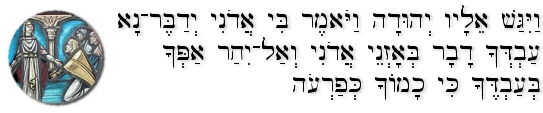
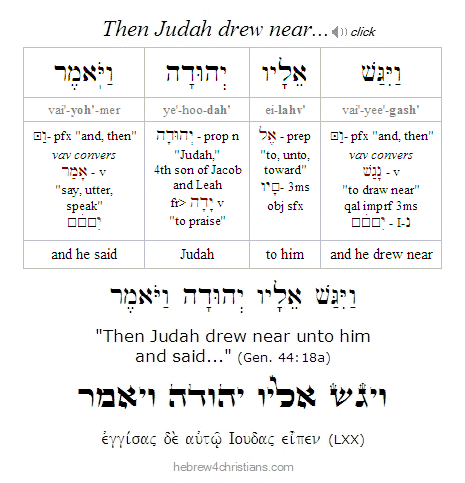
The parashah begins with Judah's intercession before Joseph:
|
|
|
|
Judah began to plead for Benjamin's freedom, explaining that his father deeply loved the boy and that returning to Canaan without him would surely be the cause of his father's death. Moreover, since he had personally pledged for his safe return from Egypt, Judah asked to remain in Egypt as Joseph's slave in Benjamin's place. (As a result of this act of selflessness, Joseph was convinced that his brothers were different people from the ones who had cast him into the pit.)
Upon hearing Judah's poignant and heartfelt plea, Joseph ordered everyone except his brothers out of the room and then wept aloud. He then revealed himself to his brothers saying, ani Yosef! ha'od avi chai? - "I am Joseph! Is my father still alive?" His brothers were dumbfounded and could not answer him, for they were dismayed at his presence. Joseph asked his brothers to draw closer to him as he repeated that he was indeed their long lost brother, "whom you sold" into Egypt. He then comforted them, explaining that the famine was to last for five more years, but God (Elohim) had "sent me before you to preserve a remnant on earth" (she'erit ba'aretz) and that "it was not you who sent me here, but God." He then urged them to return home and bring Jacob to Egypt, where they would live in the land of Goshen and be provided for by Joseph.
Pharaoh learned of the brothers' arrival and instructed Joseph to tell them to bring Jacob and all members of his household to Egypt, to live in the "fat of the land." Pharaoh even offered wagons to assist their journey to Egypt. Joseph gave them sets of clothing (Benjamin received five sets plus 300 shekels of silver), additional provisions, and 20 donkeys laden with the finest things of Egypt as a gift for his father Jacob. The brothers then left for the return trip to Canaan.
Upon returning to Canaan, the sons of Israel told him all that had happened, who, after seeing the gifts sent from Egypt finally exclaimed, "it is enough; Joseph my son is yet alive: I will go and see him before I die." So Jacob (with the 66 members of his household) began the journey to Egypt. Along the way, he offered sacrifices to the LORD at Beersheva (where God first appeared to him in a vision) and there God reassured him about going to Egypt, and promised that He would make Israel into a great nation there.
The parashah then lists the names of the direct descendants of Jacob (not including his sons' wives), numbering 66 persons in all. Adding Jacob himself and Joseph with his two sons (Ephraim and Manasseh), we have a total of 70 who began the generation that lived in Egypt (this agrees with the MT in Gen 46:27, Ex. 1:5, Deut 10:22; but note that the LXX records the number as 75 in Gen 46:27 and Ex 1:5 (cp. Acts 7:14). The sages have sometimes said there were 69 who went into Egypt, but then added God Himself to the list, in fulfillment of what is written, "I will go down with you into Egypt" (Gen. 46:4).
Jacob and his household arrived in Egypt where Joseph went out to meet him upon his chariot. Israel wept when Joseph embraced him after their 22 years of separation and said, "Now I can die, having seen for myself that you are still alive" (note that Rashi said that Jacob was reading the Shema when Joseph first embraced him). Joseph then told his brothers to tell Pharaoh that they were shepherds (detested by the native Egyptians - an argument against the Pharaoh being from the Hykos dynasty), so that they would be sent to the fertile land of Goshen (the region of Goshen is located in northeastern Egypt, in the delta of the Nile River, where it empties into the Mediterranean Sea. The Sinai Peninsula is just to the east).
The parashah ends as Joseph continued to amass a fortune (including cattle and land) for the grain held in Egypt's storehouses, which he conferred to Pharaoh. Indeed, he set up a tax system in which a fifth of the land's produce would become property of the state (only the priests were exempted from this tax). The Israelites lived in Goshen, where they acquired more property and were fruitful and multiplied in number.
|
|
|
|
|
Haftarah Reading Overview
|
|
|
|
The Haftarah discusses the eventual reunification of the two houses of the Jewish people (Judah and Ephraim) in the coming millennial kingdom of Yeshua, Mashiach ben David.
When the ten northern tribes broke off from the kingdom of Rehoboam, son of King Solomon, and formed a separate kingdom under Jeroboam, the Ephraimite, the Jews lost their sense of being one people. The northern kingdom lapsed into apostasy until carried away into captivity in 722 BC by the Assyrians (the Ten Lost Tribes). Later Judah likewise fell into apostasy and was eventually carried away in Galut Bavel (the Babylonian Exile) in 586 BC. The prophet Ezekiel was called around the time of the destruction of the first Bet HaMikdash (Temple) and during the Babylonian exile to give hope to the people of God.
Ezekiel was instructed by the LORD to take two sticks, inscribed respectively "Judah" and "Ephraim," and to hold them together as one (echad) in his hand. When the people asked him the meaning of this symbolic act, he was to say that the LORD God (Adonai YHVH) would reunite the house of Judah with the house of Israel by regathering all the Jews the world over and bringing them back to the land of Israel. In that day, the two houses would become a united nation (goy echad), with King David as their king, and all the people would faithfully observe the mishpatim (judgments) and chukim (statutes) of the LORD. Moreover, the LORD would establish a covenant of peace (brit shalom) with them as an everlasting covenant (brit 'olam), and He would restore the Holy Temple in Jerusalem. The LORD would be their God, and they would again be His people. Then all the nations (hagoyim) will know that the LORD makes Israel holy, since the Temple of the LORD will be established among them forever.
Just as in Parashat Vayigash we see that Joseph was reconciled to his brothers by means of Judah's teshuvah (repentance), so in the acharit hayamim (end of days), the followers of Mashiach ben Yosef (Jesus as the Suffering Servant) will be reconciled with the Jewish people who are awaiting Mashiach ben David. In that day, Yeshua (who is both Mashiach ben Yosef and Mashiach ben David) will establish His Kingdom on earth, and all of Israel (both houses) will be reunited in Jerusalem.
|
|
|
Brit Chadashah Reading Overview
|
|
|
|
|
The excerpt from the book of Ephesians declares that despite the fact that we were once "dead in trespasses and sins" on account of our habitual idolatry and disobedience to the holy standards of righteousness as revealed in the Torah, Almighty God, who is rich in mercy and love for us, has made us alive together with the Mashiach Yeshua and raised us up with Him into newness of resurrection life, yea, even life of the "heavenly places," so that in the coming ages (acharit hayamim) He might show the immeasurable riches of His grace to us who are made partakers of His covenantal blessings by God's grace alone through faith alone in the Mashiach alone.
The gracious impartation of being declared righteous (tzaddik) is a gift from the LORD based on the sacrifice of Yeshua ben Yosef as the Suffering Servant (Isaiah 53) who fulfilled the Torah's demands on our behalf. It is not based on meritorious service (avodah) of any kind (i.e., "Torah Observance"). The heart of faith responds to such unmerited favor by surrendering itself to the love of God in one's daily walk of life (halakhah). The mark of the true Messianic believer is a life lived in ahavat HaShem (the love of God), showing chen v'chesed v'rachamim (grace and lovingkindness and compassion) to others in the profound awareness of infinite indebtedness incurred by the mercy and grace given by the LORD through the sacrifice of His Son.
Yeshua as Mashiach ben Yosef:
|
|
|
|
In this regard, it is interesting to note some of the parallels between Yeshua and Joseph as a "type" or foreshadowing of the coming Mashiach of Israel. Here is a partial list of 60 correspondences revealed in the Scriptures:
|
|
|
|
|

|
|
|
|
1
|
Joseph's mother Rachel was barren, and her pregnancy was the result of the direct intervention of God (Gen. 30:2).
|
|
Yeshua's mother Mary (Miriam) was a virgin and her pregnancy was the result of the direct intervention of God (Matt. 1:18).
|
|
2
|
The birth of Rachel's son would remove reproach from Israel (Gen. 30:23).
|
|
The birth of Yeshua was for the glory of the people of Israel (Luke 2:32). Yeshua would also be the Light to the nations...
|
|
3
|
The name Joseph (i.e., yosef: יוֹסֵף) means "may he add," a wordplay given by Rachel to express her hope for more children (Gen. 30:24).
|
|
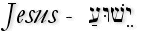
Jesus (Yeshua) means "YHVH saves" and denotes the deliverance of God's children. Through Yeshua God would add children to Israel...
|
|
4
|
Joseph was the firstborn son of Rachel, who is considered "the" matriarch of Israel (Gen. 30:23-24).
|
|
Yeshua was the firstborn son of Mary (Miriam), who is considered the matriarch of the church (Luke 2:7; John 19:26).
|
|
5
|
The birth of Joseph marked the end of Israel's exile from the land; after his birth his father Jacob left Laban for the Promised Land (Gen. 30:25).
|
|
The birth of Yeshua marked the end of Israel's spiritual exile (Luke 2:29-32).
|
|
6
|
In Jewish tradition, Joseph is regarded as the nemesis of Esau (who was considered the personification of Gentile power and oppression of Israel).
|
|
Yeshua overcame the powers of darkness by through the victory of the cross. He is the "Serpent Slayer," the ultimate nemesis of Satan and his servants...
|
|
7
|
Joseph was a precocious young man who was filled with dreams given to him from heaven (Gen. 37:5-ff).
|
|
Yeshua was at the Temple discussing Torah with the sages when he was just 12 years old (Luke 2:42-51). He was a precocious child who was filled with dreams of heaven.
|
|
8
|
Joseph was "beloved of his father" (Gen. 37:3). He was ben yachid (בֵּן יָחִיד) as Isaac was regarded by Abraham (see the Akedah).
|
|
"This is my beloved Son, in whom I am well pleased" (Matt. 3:17; 17:5). Yeshua is also described as ben yachid, "only begotten" of the Father (John 1:14).
|
|
9
|
Joseph was a shepherd (רוֹעֶה)
(Gen. 37:2).
|
|
Yeshua the Messiah is called the "Good Shepherd" (הָרעֶה הַטּוֹב) (John 10:11).
|
|
10
|
Joseph was raised in the Promised Land (Gen. 37:2).
|
|
Yeshua was raised in the Promised Land (Matt. 2:23; 21:11; John 1:45).
|
|
11
|
Joseph brought a bad report of his brothers to his father (Gen. 37:2).
|
|
Yeshua testified that the world hated Him because its works were evil (John 7:7).
|
|
12
|
Jacob loved Joseph more than his other sons (Gen. 37:3).
|
|
God loves Yeshua His Son in a unique way (John 3:35; 5:20; Matt. 17:5; Luke 9:35).
|
|
13
|
Joseph was "anointed" by his father with a tunic of many colors (i.e., ketonet passim: כְּתנֶת פַּסִּים). (Gen. 37:3)
|
|
Yeshua was anointed as Mashiach ben David (Heb 1:9; Psalm 45:7; see below).
|
|
14
|
Joseph prophetically foresaw himself as the deliverer of Israel and the savior of the world (Gen. 37:5-11).
|
|
Yeshua understood Himself to be the Savior of Israel and the world (John 6:35; 8:12).
|
|
15
|
Joseph's brothers hated him and could not speak kindly to him (Gen. 37:4).
|
|
Yeshua was hated without a cause and repeatedly "tested" by the religious authorities (John 1:11; 15:25).
|
|
16
|
Joseph was a dreamer and a prophet who was despised by his brothers (Gen. 37:5-10).
|
|
Yeshua preached the message of salvation through His vision of the kingdom - and was despised (John 5:18; 7:1; 8:6; Matt. 16:1, etc.).
|
|
17
|
Joseph's brothers refused his rule
(Gen. 37:8).
|
|
Yeshua likened His rejection by the religious leaders to mean, "We do not want this man to rule over us" (Luke 19:14).
|
|
18
|
Joseph's brothers envied him
(Gen. 37:11).
|
|
It was out of envy (קִנְאָה) that the chief priests handed him over to be killed (Mark 15:10).
|
|
19
|
Joseph was "sent forth by his father" (Gen. 37:12-14).
|
|
Yeshua sent forth by His Father
(John 5:30-36; 6:57; 8:18,42; Gal. 4:4; 1 John 4:9, etc.).
|
|
20
|
Joseph's brothers conspired to kill him (Gen. 37:18).
|
|
The chief priests and the elders of the people conferred together against Yeshua in order to bring about his death (Matt. 27:1).
|
|
21
|
Joseph's brothers disbelieved in him (Gen. 37:19-20).
|
|
Yeshua's brothers did not believe in Him
(John 1:11; 3:18, John 3:36, etc.).
|
|
22
|
Joseph's brothers stripped him of his tunic and mocked him (Gen. 37:19,23).
|
|
They stripped him and put a scarlet robe on him (Matt. 27:28).
|
|
23
|
Joseph's brothers cast him into a pit, a symbol of the tomb (Gen. 37:24).
|
|
Yeshua was cast into a pit (Zech. 9:11; Matt. 12:40; Matt. 27:59-60).
|
|
24
|
Joseph's brothers callously ate a meal while he was suffering in the pit (Gen. 37:25).
|
|
Israel ate the Pascal meal while Yeshua was in the pit (John 13:1).
|
|
25
|
Judah promoted the idea that Joseph's life should be ransomed (Gen. 37:26-27).
|
|
Yeshua was born of the tribe of Judah and became the Redeemer of the world.
|
|
26
|
Joseph's brothers sold him for shekels of silver (Gen. 37:28).
|
|
"They paid him (Judas) thirty pieces of silver" (Matt. 26:15).
|
|
27
|
Joseph was raised from the pit
(Gen. 37:28).
|
|
Yeshua was raised from the dead
(Matt. 28:6; Mark 16:16; Luke 24:6; John 20:1-17; etc.).
|
|
28
|
Joseph was sold as a slave before he was promoted to glory (Gen. 37:28).
|
|
Yeshua took upon Himself the form of a suffering servant before His exaltation
(John 13:12-17; Matt. 20:25-26; Mark 10:43; Phil. 2:6-9, etc.).
|
|
29
|
Joseph was taken into Egypt to avoid being killed (Gen. 37:28).
|
|
Yeshua was taken into Egypt to avoid the insane wrath of "Herod the Great" (Matt. 2:13-14).
|
|
30
|
Joseph's tunic was covered with blood (Gen. 37:31)
|
|
Yeshua's robe was covered with blood.
(Mark 15:17-20; Matt. 27:28-31). Yeshua redeemed us from judgment by shedding His blood for our sins (1 Cor. 6:19-20; Acts 5:31; 1 Pet. 3:18; Rom. 5:6-8, 2 Cor. 5:21; Gal. 3:13, etc.).
|
|
31
|
Joseph became a slave in Potiphar's house (Gen. 39:1)
|
|
Yeshua took upon Himself the form of a suffering servant before His exaltation
(John 13:12-17; Matt. 20:25-26; Mark 10:43; Phil. 2:6-9, etc.)
|
|
32
|
The LORD was with Joseph in his humiliation and prospered him (Gen. 39:2).
|
|
Yeshua grew in wisdom and favor (Luke 2:40); He always did those things that pleased the Father (John 8:29).
|
|
33
|
Joseph was made an overseer
(Gen. 39:4).
|
|
Yeshua is the Shepherd and Overseer (מַשְׁגִּיחַ) of our souls (1 Pet. 2:25; John 3:35; Matt 28:18).
|
|
34
|
Joseph was tempted but did not sin (Gen. 39:7-10).
|
|
Yeshua was tempted in every way yet was without sin (Heb. 2:18; 4:15; 2 Cor. 5:21; 1 John 3:5).
|
|
35
|
Joseph was falsely accused and indeed the Torah does not attribute any sin to him (Gen. 39:11-20; 40:15).
|
|
Yeshua was falsely accused by the religious authorities (Luke 23:4;14-15; John 18:38; 19:4; Heb. 7:26; 1 Pet. 2:22; 1 Pet. 3:18).
|
|
36
|
Joseph's legal accuser (Potiphar) likely believed in his innocence, but perverted justice to "save face."
|
|
Yeshua was unjustly condemned by the Roman procurator Pilate, who believed in his innocence but sentenced him to death to "save face."
|
|
37
|
Joseph made no defense before the Gentile authorities (Gen. 39:19-20).
|
|
"He questioned him at some length, but he made no answer" (Luke 23:9; Matt. 27:14; Acts 8:32; Isa 53:7; etc.).
|
|
38
|
Joseph was imprisoned with two other criminals (Gen. 40:2-3).
|
|
"Two others also, who were criminals, were led away to be put to death with him."
(Luke 23:32; Matt. 27:38; Mark 15:27; John 19:18).
|
|
39
|
Joseph was a prophet who could interpret dreams (Gen. 40:5-41:32).
|
|
Yeshua was a prophet who could reveal what was hidden in the heart (John 4:19,29).
|
|
40
|
Joseph was filled with the Spirit of God (רוּחַ אֱלהִים) and great wisdom (Gen. 41:38-39).
|
|
God anointed Yeshua with the Holy Spirit and with power (Acts 10:38; Matt. 3:16-4:1; Luke 4:1; etc.). He was full of wisdom and truth.
|
|
41
|
Joseph was finally vindicated and exalted over the entire world (Gen. 41:40-42).
|
|
"The Son of Man is seated at the right hand of Power" (Matt. 26:64; Acts 7:56; 1 Pet. 3:22; Eph. 1:18-20, etc.).
|
|
42
|
Joseph was raised from the pit and given fine linen and gold (Gen. 41:42).
|
|
Yeshua was clothed with his preincarnate glory after the resurrection (Matt. 17:1; Rev. 1:13-17; Dan. 10:5-6).
|
|
43
|
Pharoah ordered the royal criers to walk in front of Joseph's chariot (merkavah) shouting, avrekh! (אַבְרֵךְ) - "bow the knee!" (from the root berekh, knee). (Gen. 41:43)
|
|
Every knee shall bow to Yeshua the Messiah (Isa. 45:23; Rom. 14:11; Phil. 2:9-11).
|
|
44
|
Joseph was given a foreign bride (אָסְנַת) (Gen. 41:45).
|
|
Yeshua's followers are called the "Bride of Messiah," and are taken from every tribe and tongue (John 6:37; Rev. 22:17, etc.).
|
|
45
|
Joseph was called Tzofnat Pane'ach (צָפְנַת פַּעְנֵחַ), i.e., "Decipherer of Secrets" according to Targum Onkelos (Gen. 41:45).
|
|
Yeshua revealed the Father (John 1:18); He is the revealer "hidden things" (Matt. 13:10-13;35). In Him are hidden all the treasures of wisdom (Col. 2:3).
|
|
46
|
Joseph was 30 years old when he began his public ministry in Egypt (Gen. 41:46).
|
|
Yeshua was 30 years old when He began His public ministry in Israel (Luke 3:23).
|
|
47
|
Joseph became the bread giver to the world (Gen. 41:55).
|
|
Yeshua is Lechem Ha-Chayim, the "Bread of Life" (John 6:35,48-58).
|
|
48
|
Joseph tested his brothers as a disguised Egyptian, and they did not recognize him (Gen. 42:8).
|
|
Yeshua is a disguished Egyptian - a stumbling block and rock of Offence (Isa. 8:14; Rom. 9:33). A "partial hardening" has come upon Israel (Rom. 11:25-26).
|
|
49
|
Judah interceded on behalf of Israel's son Benjamin before Joseph (Gen. 43:9; 44:16-34).
|
|
1) Yeshua will one day intercede (as Mashiach ben David) on behalf of Israel (the Yom Kippur connection of the End of Days); 2) The Jewish people will finally repent and turn to Yeshua as their Savior.
|
|
50
|
After testing his brothers to see if they underwent teshuvah, Joseph finally revealed himself (Gen. 45:1-4).
|
|
During the Great Tribulation, Yeshua will open the eyes of Israel so they finally recognize Him (Luke 13:35; Matt. 24-25).
|
|
51
|
Joseph was revealed to his brothers as Israel's savior (Gen. 45:1-15).
|
|
Yeshua is Israel's true Savior (Acts 13:23; 2 Tim. 1:10; Isa. 43:11). Israel will receive Yeshua at His Second coming (Zech. 12:10; John 19:37; Rom. 11:26; Isa. 59:20, etc.).
|
|
52
|
Joseph became the savior of the entire world (Gen. 45:7).
|
|
God sent his only Son into the world so that we might have life through him (John 4:42; 1 John 4:14). Salvation ultimately means redemption from the curse of sin and death.
|
|
53
|
Joseph was "alive from the dead" for Israel (Gen. 45:26-28).
|
|
"Why do you look for the living among the dead? He is not here, but has risen."
(Matt. 28:6; Mark 16:16; Luke 24:6; John 20:1-17; etc.).
|
|
54
|
Judah led the way of Israel back to the promised land of Goshen (Gen. 46:28).
|
|
Yeshua as Mashiach ben David will lead Israel to the renewed land of promise.
|
|
55
|
Joseph brought Israel before Pharaoh and Jacob blessed the Pharaoh (Gen. 47:7).
|
|
Yeshua will one day bring Israel before the Father - and Israel will then bless the Name of the LORD in the truth (1 Cor. 15:28).
|
|
56
|
Through his faith, Joseph conquered the entire world (Gen. 47:23).
|
|
In the Millennial Kingdom, Yeshua will be the undisputed LORD of the world (Rev. 20:2-6; Zech. 8:3; 14:8; Isa. 2:3; Micah 4:2; etc.).
|
|
57
|
Joseph was crowned with glory and honor (Gen. 41:39-45).
|
|
Yeshua was crowned with glory and honor because of the suffering of His death on behalf of His people (Heb. 2:9; Phil. 2:6-11, Matt. 28:18, etc.).
|
|
58
|
Jacob irrevocably adopted Joseph's two sons, Ephraim and Manasseh, into the family (Gen. 48:3-6). Joshua, Moses' successor, was a descendant of Ephraim...
|
|
Yeshua foretold that there would be one shepherd over one flock (John 10:16). Ultimately there will be one olive tree that represents the redeemed people of God, composed of both Jews and Gentiles (Rom. 11:17-26).
|
|
59
|
Joseph's (Gentile) descendants were incorporated into the commonwealth of ethnic Israel as two great tribes of Israel (Gen. 48:1-5).
|
|
Yeshua's followers are incorporated into the covenants and blessings of ethnic Israel (Eph. 2:12-14).
|
|
60
|
Joseph was given the blessing of the firstborn son (Gen. 49:22-26).
|
|
Yeshua is the "firstborn of creation" who has preeminence over all other prophets, priests, kings, angels (Heb. 1; Col. 1:16-18).
|
|
|
|
|
Just as Joseph was finally revealed to the Jewish people as a mashiach and savior (though they had initially betrayed him and rejected him), so will the Jewish people come to see that Yeshua is indeed the promised Jewish Mashiach and the Savior of the world. Then will come true the hope of Rav Sha'ul (the Apostle Paul) who wrote, "And so all Israel shall be saved: as it is written, There shall come out of Zion the Deliverer who shall turn away ungodliness from Jacob" (Rom. 11:30). For more on this, see "Mashiach ben Yosef."
Dual Aspect of Mashiach
The Tanakh contains seemingly conflicted views of the Mashiach as Israel's Deliverer. On the one hand, Messiah is portrayed as coming in great triumph "in the clouds" (Daniel 7:13), but on the other he comes riding a donkey, lowly and humble (Zechariah 9:9). This "dual aspect" of Messiah led to the idea that there would be two Messiahs:
Messiah ben Joseph and Messiah ben David.
Messiah son of Joseph
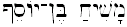
Mashiach ben Yosef.
The Suffering Messiah (Joseph [Gen. 37-50] prefigures). The Messiah from the house of Joseph. One of two Messianic figures which are described in the oral traditions of Judaism. Mashiach ben Yosef is considered to be a forerunner and harbinger of the final deliverer, Mashiach ben David. Mashiach ben Yosef suffers for the sins of Israel (Isaiah 53). Christians see Yeshua as the fulfillment of Mashiach ben Yosef in the Tanakh and the oral tradition. Yeshua the Messiah in His first coming is the Suffering Servant.
Quotes:
"Messiah son of Joseph was slain, as it is written, "They shall look unto me whom they have pierced; and they shall mourn for him as one mourneth for his only son" Zech. 12:10 (Suk. 52a)
The Talmud explains: "The Messiah---what is his name? Those of the house of Rabbi Yuda the saint say, the sick one, as it is said, 'Surely he had borne our sicknesses." (Sanhedrin 98b)
Referring to Zech. 12:10-12, "R. Dosa says: '(They will mourn) over the Messiah who will be slain.' " (B. Suk. 52a; also Y. Suk. 55b)
"But he was wounded . . . meaning that since the Messiah bears our iniquities which produce the effect of His being bruised, it follows that whosoever will not admit that Messiah thus suffers for our iniquities, must endure and suffer for them himself" (Rabbi Elijah de Vidas)
Messiah son of David
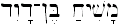
Mashiach ben David.
The ruling Messiah King (King David prefigures). The term Mashiach unqualified always refers to Mashiach ben David, a descendant of King David, of the tribe of Judah who will regather the exiles, set up the temple, and deliver Israel from all her enemies. Christians believe Yeshua the Messiah in His second coming will completely fulfill this description of Mashiach ben David.
Quote:
Today, we can see with our own eyes how the vision of the Prophet Ezekiel, describing the rebirth of the Jewish People and the ingathering of the exiles in Eretz Yisrael, is being fulfilled. It is true that we are now in mid-process. We are still at the stage of being crystallized as a nation....
Yet, our gaze must likewise be trained upon the future and the end of days, the age of Mashiach ben David. At that time, the issue of limited nationalism will pass, and we will turn as well to mankind in the aggregate, serving as a light unto the nations. Each day, in fact, we pray, "Speedily cause the offspring of your servant David to flourish." (Rabbi Dov Begon)
Yeshua is both Mashiach ben Yosef and Mashiach ben David
As Christians, we believe that Yeshua is both Mashiach Ben Yosef (the suffering servant - at His first coming) and Mashiach Ben David (the reigning King - at His second coming)
[see Isaiah 52:13-15 - 53:12, Psalm 22]). He is also the Anointed Prophet, Priest, and King as foreshadowed by other m'shichim in the Tanakh.
David Brown (of AMF International) writes:
It is very common for Jewish objectors to point that "Jesus has not fulfilled all the prophecies," and to scorn the suggestion that some prophecies are for a later time and are to be fulfilled at the "second coming." The fact is, however, that prophecies about Messiah are of two seemingly mutually-exclusive types, as though they were talking about two different Messiahs. Jewish scholarship refers to Messiah ben-David and Messiah ben-Yosef. One is the positive, victorious Messiah who ushers in a kingdom of peace, the other is a suffering servant (as in Isaiah 53). The popular tendency is to think only of ben-David and ignore ben-Yosef, but the Messianic/Christian view accounts for both in one person. Interestingly, these two prophetic strains are named for David and Joseph, both of which suffered first and emerged victorious in the end. Joseph is introduced to us with dreams of grandeur, but he was lost to Israel – actually considered dead – before his dreams came true. Eventually however, he had a "second coming" when he came back into the lives of his brothers who once rejected him. Then they bowed down to him and he became the savior of his people by providing for them in a time of famine. David also, though anointed as King in his youth as far as God was concerned, was rejected by the current King and lived as a fugitive for many years before he finally became the quintessential King of Israel. Both of these historic figures, which Jewish tradition has recognized as being prototypes of Messiah, arrive amid promises, are pushed down, and finally emerge in glory. Shouldn't the ultimate Messiah follow the same pattern?
Blessing:
|
|
|
|
 |
|
|
|
|
|
Hebrew Audio Files:
|
|
|
|
|
Click the following links to hear the desired chapters read from this week's Torah:
|
|