|
|
 |
|
|
The Festival of Chanukah
|
|
|
|
Dedicated against Assimilation
|
|
|
|
What is Chanukah?
|
|
|
|
The Hebrew word chanukah (חֲנוּכָּה) means "dedication" and marks an eight day winter celebration (from Kislev 25 - Tevet 3) that commemorates the rededication of the Second Temple after a small group of Jewish believers defeated the forces of assimilation at work in their world. As such, Chanukah represents the victory of faith over the ways of speculative reason, and demonstrates the power of the miracle in the face of mere humanism.
|
|
|
|
|
|
The Story of Chanukah
|
|
|
|
According to mainstream Jewish tradition, the story of Chanukah goes something like this. In 333 BCE, Alexander the Great conquered Syria, Egypt and Babylonia, and promoted a lenient form of Hellenistic culture, encouraging the study of the language, customs and dress of the Greeks. Alexander was not necessarily bad to the Jewish people, and a legend tells that when he marched through Jerusalem he asked the High Priest to erect a statue to his honor within the Temple. The High Priest told Alexander that such was forbidden, though the Jewish people would construct a "living memorial" by naming all their firstborn sons after the great king. Alexander agreed to this and things went fairly well for the Jews. Nevertheless, the encounter of the Jewish people and their Torah-based ethics with the worldview of ancient Greece proved to be a traumatic shock which ultimately threatened to undermine the very existence of Judaism.
Over a century later, in 167 BCE, the ripened fruit of Hellenization began to appear in the form of one of Alexander's successors, the Syrian king Antiochus IV ("Epiphanes"), who began to openly persecute the Jews. Among other atrocities, Antiochus appointed a Hellenistic "High Priest" to the Temple, prohibited the study of the Torah, and desecrated the altar by requiring pigs to be sacrificed on it (the Jews referred to Antiochus not as Epiphanes, "God (i.e., Zeus) made manifest," but rather as Epimanes - "the madman.")
These outrages finally incited rebellion, and by 165 BCE the Hasmonean family of Mattityahu the High Priest and his youngest son, Judah "Maccabee" (the "Hammer"), organized a revolt that eventually succeeded in evicting the Syrians from Israel. The Temple in Jerusalem was liberated but needed to be rededicated for Jewish worship.
According to later tradition (as recorded in the Talmud (Shabbat 21b)), at the time of the rededication (on Kislev 25), there was very little oil left that had not been defiled by the Syrians. Oil was needed for the menorah to burn continually in the Temple, but there was only enough to last for one day. Miraculously, the sanctified oil burned for eight days -- the time needed to prepare a fresh supply of oil for the menorah. An eight day festival was declared to commemorate this miracle.
A Wintertime Sukkot?
Interestingly, the story outlined above derives from extra-biblical literature, as well as from the Apocrypha (Books of the Maccabees), except that there is no mention of the oil nor of the miracle of the oil in these sources. Only until we reach the time of the Gemara (the later part of the Talmud that was commentary on the Mishnah, completed around 500 AD) do we hear anything about the miracle of the oil in connection with the rededication of the Temple.
This has led some Jewish scholars to suggest that perhaps Chanukah may originally have been intended to be a later celebration of Sukkot, generally considered to be the most important of all the Jewish holidays, which the Hasmoneans did not have a chance to celebrate during their warfare with the Syrians.
Customs of Chanukah (Minhagim)
Regardless of the relative obscurity of the origins of Chanukah, Rabbinic tradition has instituted various rules (mitzvot) and customs (minhagim) for the observance of this eight-day festival to commemorate the Jews victory over their enemies. Among these are:
- Celebrating Chanukah for eight days, from Kislev 25 to Tevet 3 on the Jewish calendar (Talmud: Shabbat 21b)
- Lighting the Chanukiah, a special form of menorah designed to recall the miracle of the eight days in which the sanctified oil burned in the temple. The nightly kindling of the Chanukiah with its increasingly brighter light is a symbol of godly resistance to both tyranny and the forces of assimilation (Talmud: Sukkah 46a).
- Be joyous on Chanukah and avoid signs of sadness (i.e., no mourning or fasting, except in the case of shiva [Talmud: Shabbat 21b]).
|
|
|
|
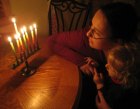
The procedures for lighting the chanukiah (Chanukah menorah) are as follows. On the first night (unless it is Friday), after the stars appear, the first candle is placed at the end of the menorah, facing the right hand. We light the shamash (i.e., the servant candle), recite the traditional blessings (lehadlik ner shel Chanukah, she'ash nissim, and the Shehecheyanu) and then light the rightmost candle. We return the shamash to its holder. We then recite the Ha-nerot ha-lalu statement and celebrate! We let the candles burn all the way down....

On the second night, we add one candle to the left (now we have two at the right end of the menorah). We light the shamash, recite the blessings (minus the Shehecheyanu), and light the candles left-to-right in the menorah (i.e., the newest candle is lit first). Again we recite the Ha-nerot ha-lalu statement and celebrate! And so on for each of the eight days of Chanukah.
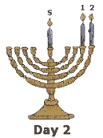
This procedure continues until the eighth night, when the entire chanukiah is lit up:
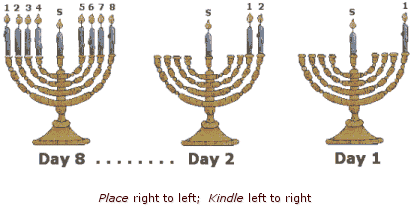
The last night of Chanukah is called Zot Chanukah, "This is Chanukah" (from the Chanukah Torah portion for the last day: זאת חֲנֻכַּת הַמִּזְבֵּחַ בְּיוֹם הִמָּשַׁח אתוֹ / "This is the dedication (chanukah) of the altar, in the day of its being anointed..." (Num. 7:84)). It marks the grand finale of the Chanukah celebration, when the supernatural light burns brightest!
Note: If a day of Chanukah occurs on a Shabbat (i.e., Friday night), you light the Chanukiah candles before lighting the Shabbat candles.
Displaying the Chanukiah
It is an old custom to display the chanukiah where its lights will be visible from the outside. Note that if you place the chanukiah near a window, the candles should appear lit right to left from the point of view of the one seeing them from outside. Many families have multiple chanukiahs, one for each child of the household, and perhaps a larger one for the entire family.
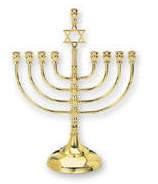
Here's a practical tip. To clean your chanukiah after Chanukah, use a hairdryer -- set on low -- and heat up the menorah wherever you see the wax drippings. Use a butter knife to peel away the warmed wax....
Playing the Dreidel Game
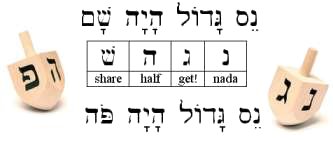
The playing of games has been associated with Chanukah. The most popular is a game cof chance called "dreidel" (i.e., teetotum) that was adopted by Yiddish Jews in the 16th century. On each side of a four-sided spinning top is written one of the Hebrew letters Nun, Gimmel, Hey, or Shin. Apparently these letters were selected to form an acronym for the phrase, Nes gadol hayah sham, "a great miracle happened there."
|
|
|
|
|
|
The rules are simple. Each player puts something into the pot - perhaps a penny or a couple nuts. Then the players take turns spinning the dreidel. If Nun comes up, nothing happens. For Gimmel, the player gets the whole pot. For Hey, the player takes half the pot. For Shin, the player has to share, or add to the pot.
|
|
|
|
|
Note: In Israel, the dreidel uses a Pey for poh ("here") instead of a Shin for sham ("there").
|
|
|
|
Other Chanukah Customs
In Israel, on erev Chanukah (just before the first night), marathon runners carry a torch from the flame of the menorah at the village of Modin to the Western Wall of the Temple to kindle a giant-sized menorah located there for the holiday. During the eight days, it is customary to eat potato latkes and jelly doughnuts (sufganiyot) while celebrating God's providential love and protection at this time. Playing the dreidel game helps us remember that "a great miracle happened there." Giving tzedakah ("charity") is also encouraged at this time. Many people also exchange gifts during Chanukah or give "gelt" (coins or small amounts of money) to children. Special music and traditional songs (such as Ma'oz Tzur, "Rock of Ages," Ner Rishon, Sevivon, etc.) are also sung during this time.
|
|
|
Chanukah Torah Readings
|
|
|
|
Because Chanukah is an eight-day holiday, and a week is only seven days, there has to be at least one day when Shabbat and Chanukah overlap (on years when Chanukah begins on a Shabbat, there are actually two overlapping Shabbats). For best results, always consult a good Jewish calendar. In general, however, an additional Chanukah Torah reading (Numbers 7:1-8:4) is divided over the eight days of the holiday as follows (remember that the day begins at sundown on the Jewish calendar):
|
|
|
|
|
|
|
|
|
Since Chanukah celebrates the victory of Maccabee forces over the Greeks and the re-dedication of the Holy Temple in Jerusalem, the additional Chanukah Torah readings are connected to the dedication of the Mishkan (Tabernacle) in the wilderness.
On the first seven days of Chanukah we read of the sacrifices and gifts offered by the first seven tribal leaders. On the eighth day we read of the offerings of the remaining five leaders, and we continue to the next Torah portion, reading about God's commandment to Aaron to kindle the Menorah in the Tabernacle. On the Shabbat of Chanukah we add the Haftorah reading (from the Book of Zechariah) that speaks of Zechariah's prophecy concerning a menorah. (On Rosh Chodesh Tevet, usually the 6th day of Chanukah, additional readings are performed.)
In the synagogue, on each of the eight days of Chanukah the full Hallel is recited. In addition, the Al Hanissim is included as part of the Hoda'ah blessing (of the Amidah) and Birkat Hamazon. Al HaNissim praises God for delivering the Jewish people at the time of the Maccabees. A portion is reproduced here:
"...You gave the mighty into the hands of the weak, and the many into the hands of the few, and the defiled into the hands of the pure, and the wicked into the hands of the righteous, and the malicious into the hands of those who engage in Your Torah. And You made a great and holy name for Yourself in Your universe; and to Your nation, Israel, did You grant a great salvation and liberation, as on this day. And subsequently Your children came to Your holy abode, and they cleared out Your Palace, and they purified Your Temple, and they kindled lights in the courtyards of Your holy place. And they established these eight days of Chanukah in order to give thanks and praise to Your great Name."
|
|
|
|
Yeshua and Chanukah
|
|
|
|
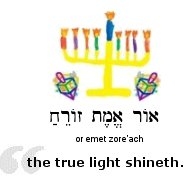
As mentioned above, for each of the days of Chanukah we light candles, kindling one for the first day, two for the second, and so on until we reach the climactic eighth day, when all shine together. Some of the early sages said the the Hebrew word "Messiah" (i.e., mashiach: מָשִׁיחַ) may be regarded as an acronym for the phrase "we light throughout the eight days of Chanukah," i.e., מַדְלִיקִין שְׁמוֹנָה יְמֵי חֲנוּכָּה: madlikin (מ) shemonah (שׁ) yemei (י) Chanukah (ח). Indeed, the central lamp of the Chanukah menorah is called the shamash (שַׁמָש), the "Servant" that bears the original flame that kindles all the others. The salvations, wonders, and solace that God performed for us "in those days, at this time" therefore prefigure the greater deliverance we have in Yeshua, the Suffering Servant and Light of the World...
It's somewhat ironic that the only reference to the festival of Chanukah occurs in the New Testament, not in the Tanakh. In the Gospel of John we read that the LORD Yeshua was at the Temple during the "Feast of Dedication," or Chanukah:
At that time the Feast of Dedication (Chanukah) took place at Jerusalem. It was winter, and Jesus was walking in the temple, in the colonnade of Solomon. So the Jews gathered around him and said to him, "How long will you keep us in suspense? If you are the Christ, tell us plainly. (John 10:22-24, ESV)
During a season of remembering miracles (nissim), Yeshua pointed out that the works that He did attested to His claim to be the long-awaited Mashiach of the Jewish people (John 10:37-38). His works and character clearly displayed the true Light of who He was, and these works still shine to us today. Yeshua was and forever shall be the greatest Jew who ever lived upon the earth.
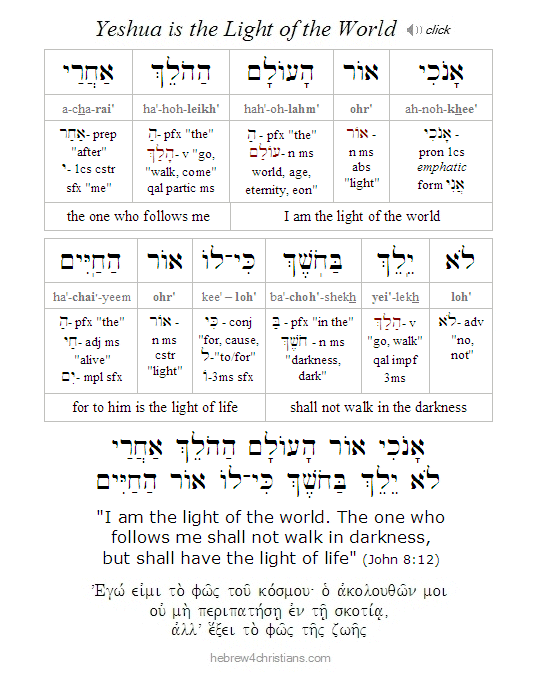
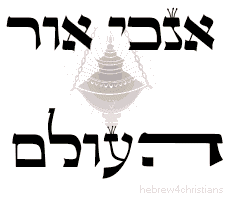
And of course, as Mashiach ben Yosef, our Suffering Servant, Yeshua is the Ultimate Shamash - He is our Light who enables us to shine a sacred fire of sacrificial love to the darkened outside world. Yeshua commanded "Let your light so shine before men, that they may see your good works, and glorify your Father which is in heaven" (Matt 5:16). He told us that He is the Light of the world, and that whoever follows Him will not have darkness, but the Light of Life:
|
|
|
|
 |
|
|
|
Yeshua our Messiah gives us light, the very "light of life." What does this mean to you who claim to know Him and His message? How does this impact you as His follower in this darkened age?
We are called to be part of His Temple, His Body, and at this time we should reflect on rededicating ourselves to the eradication of all that compromises us and tempts us to assimilate with the hell bound world around us.
It is only by the Light of Yeshua that we gain victory over the powers of darkness, since the darkness cannot comprehend the light. When we walk in the Light, we have fellowship, unity, echdut, with one another, and the gates of hell shall not prevail against such divinely sanctioned communion. May the LORD God of Israel, the Father of the Blessed One Yeshua, help us all to behold the glory of His Light by abiding in His love! And may we turn to Him now and rededicate our own lives as temples cleansed and readied by His Spirit to honor His abiding Presence. Amen.
Wishing you a joyful time of celebrating the overcoming victory of the Light of the World, chaverim (John 1:5).
 |
|
|