Last week's Torah portion (Vayechi) ended with the death of Joseph, who made the Israelites promise to take his bones with them when they would return to the land of Canaan. Joseph's faith in Israel's return to the Promised Land is summarized by his statement: pakod yifkodelohim etkhem ("God will surely remember you"), alluding to the great exodus of the descendants of Israel as promised to his great grandfather Abraham (Gen. 15:3).
[Note: It is likely that the "sojourn in Egypt" begins with the call of Abraham and God's promise to him (Genesis 12:1-3) and ends with the Exodus. That is, the fathers (Abraham, Isaac, and Jacob) sojourned in Canaan for 215 years and their descendants lived in Egyptian bondage for an additional 215 years. The total, then, would result in the 430-year number listed in Exodus 12:40-41 (and Galatians 3:17).]
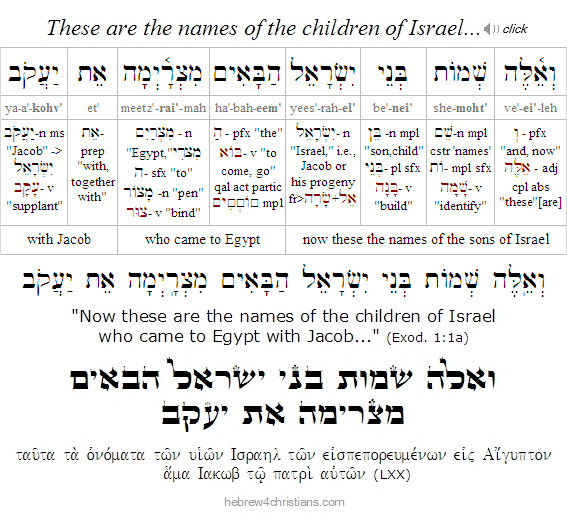
The second book of Torah is called "Exodus" ("going out"), a title derived from the Greek translation of the rabbinical name of the book, Sefer Yetziat Mitzraim ("the book of the going out from Egypt"). In the Hebrew Bible this book is called Shemot ("names"), following the custom of naming a book according to its first significant word. Parashat Shemot (the first portion of the book) begins directly where Genesis left off, by listing the "names" of the descendants of Jacob who came to Egypt to live in the land of Goshen:
These are the names of the children of Israel who came to Egypt with Jacob; every man coming with his household. (Exodus 1:1)
After the death of Joseph (at age 110) and the rest of his brothers (the last to die was Levi, at age 137 [Exodus 6:16]), there arose a "new pharaoh" over Egypt who did not acknowledge Joseph's contributions to the former regime. Threatened by their growing numbers and fearful that they would join his enemies in overthrowing him, this new Pharaoh instituted a policy of oppressive forced labor for the Israelites. Supervised by cruel taskmasters, the descendants of Jacob were conscripted to build the storage cities of Pithom and Rameses.
Despite the imposed hardships by the Egyptian government, the Israelite population steadily increased, which led Pharaoh to command the Hebrew midwives to kill all male infants at birth. The midwifes disobeyed Pharaoh, however, which then led Pharaoh to decree that every newborn Israelite male was to be drowned in the Nile river.
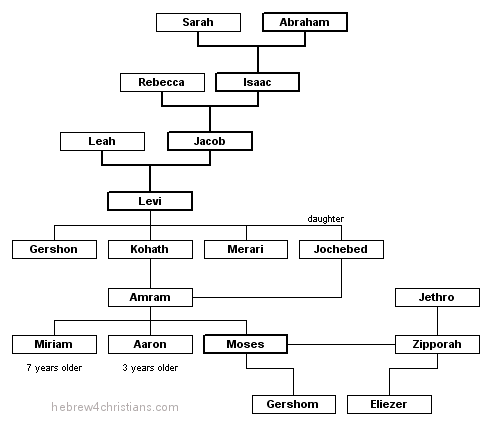
The parashah then turns to the story of the birth of Moses, the great deliverer of the people of Israel. Amram, the grandson of Levi, married his aunt Jochebed (the daughter of Levi), and together they had a daughter (Miriam) and a son (Aaron). However, at the time of Pharaoh's decree, Jochebed gave birth to Moses and attempted to hide him for a few months. After realizing that she could no longer keep his birth a secret, she placed her son in a basket among the reeds of the Nile before anyone could kill him. Her seven year old daughter Miriam stood by and watched to see what would happen to her brother.
Providentially, Pharaoh's daughter came to bathe in the Nile and discovered the ark among the reeds. Moved by pity, the princess decided to adopt the baby even though he was a "despised Hebrew." Miriam (who witnessed all this) then approached the princess and offered to find a nursemaid for the child - and cleverly arranged for Moses' own mother (Jochebed) to do the job!
When the child grew up, Jochebed brought him to Pharaoh's daughter, and he became her son,a prince of Egypt. She named him Moses (), "Because," she said, "I drew him out of the water" (a play on the word , which means "to draw out, to save").
According to midrash (Shemot Rabbah 1:31), as a very young lad Moses was once seen throwing Pharaoh's gold crown down to the ground. Upon learning of this apparent act of insolence, Pharaoh devised a test to see if the child understood the implications of his actions. He therefore commanded that a platter with a piece of gold and a glowing piece of coal be brought before Moses and ordered the little boy to choose one. If Moses chose the gold, it would imply that he understood its value, and therefore he would be killed. On the other hand, if Moses chose the burning coal, he would be spared since he was unable to differentiate between gold and a glowing piece of coal.
Moses began to reach out for the gold when an angel pushed his hand aside and he grabbed the coal instead. Moses then immediately put his hand in his mouth, but that burned his lips and tongue so badly that he had a permanent speech impediment as a consequence.
Who made you to be judge over us?
After he had matured, Moses went to be among his kinsmen and observed their suffering. One day, he noticed an Egyptian overseer beating an Israelite and (seeing no one else around) killed the man and hid the body in the sand. The following day, Moses attempted to mediate a quarrel between two Israelites, during which one of them asked him, mi samekha l'ish sar v'shofet aleinu? ("Who made you a prince and judge over us?") - and then further asked Moses if he intended to kill them as he had killed the Egyptian overseer the previous day. Moses then was afraid that his crime was known, and sure enough, Pharaoh heard the news and sought to have Moses killed.
Moses then fled from Egypt to Midian (in the Sinai's southeastern region), to the land of his distant cousins. There he came to a city well where he magnanimously defended the seven daughters of Jethro (also known as Reuel) from unfriendly shepherds. After learning of his kindness and bravery, Jethro rewarded Moses by employing him as a shepherd and giving his daughter Zipporah to him as a wife (Moses and Zipporah later had two sons, Gershom and Eliezer).
God saw the people of Israel- and God knew.
While Moses dwelt in Midian, the Pharaoh who wanted to kill him finally died, though his successor intensified the Israelites' oppression. The Israelites cried out to the LORD for help, and God heard their groaning, and remembered his covenant with Abraham, with Isaac, and with Jacob. "God saw the people of Israel - and God knew" (Exodus 2:25).
Malakh Adonai - the Angel of the LORD
One day, as Moses was tending Jethro's sheep in the west, near Mt. Horeb (Sinai), the Angel of the LORD (malakh Adonai) appeared to him in a flame of fire mitokh ha-seneh – "out of the midst of a bush." As Moses gazed in wonder, the LORD spoke to him and commanded him to remove his sandals, and informed him that he was selected to be the LORD's deliverer to take the Israelites from Egypt into Israel.
Ehyeh Asher Eheyeh
Moses was stunned and objected that he was unfit to the task, even despite God's promise to be with him and bring him (and all Israel) back to this very mountain. He protested to the LORD that he was kevad peh - "heavy of mouth" and kevad lashon, "heavy of tongue," and therefore unable to speak on behalf of the LORD (Ex. 4:10). God reminded him that He was the Creator of the mouth: "Who makes him mute, or deaf, or seeing, or blind? Is it not I, the LORD?" (Ex. 4:11).
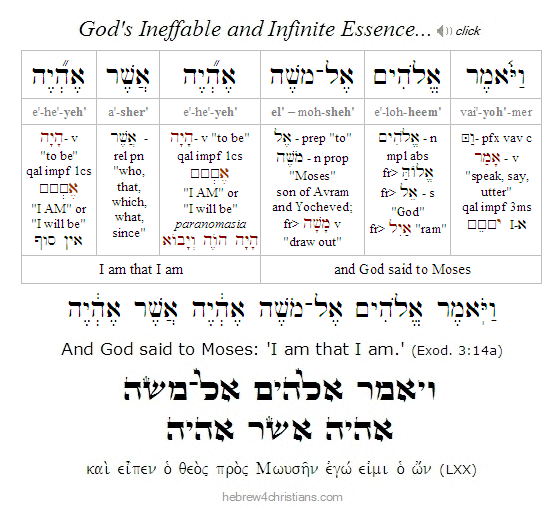
Moses then asked what reply he should give when the Israelites would ask for God's Name, to which the LORD replied, Ehyeh Asher Ehyeh ("I will be what I will be"). He was then instructed to go to the elders of Israel to deliver the message of their soon coming salvation, explaining that the LORD would mightily judge Egypt for their oppression. Moses protested that the Israelites would not believe him, whereupon he was given the power to perform three miracles to convince them: 1) his staff would turn into a snake and vice versa; 2) his hand would contract leprosy and then be cured; and 3) he would turn water from the Nile into blood. Still hesitant, Moses insisted that was not eloquent enough to be God's spokesman, and pled with the LORD to send someone else. The LORD was then angry with Moses for his reluctance and decreed that "because of your words" he would not be permitted to be a kohen (priest), but his brother Aaron would. Moses finally relented and accepted the will of God.
After this, Moses told his father in law that he wanted to return to Egypt (with his wife and sons) to see how his kinsmen were doing. Along the way back to Egypt, however, the LORD threatened to kill Moses on account of a delay in the circumcision of his son Eli-Ezer (Ex. 4:24). Moses reasoned that God's commandment to go to Egypt was more important than the commandment to perform brit milah on the 8th day of his son's life, and had he performed the circumcision, travel would have been impossible. However, when Moses failed to immediately perform the ritual at the lodging place along the way (affording the opportunity for healing for his son during the trip), the LORD came to kill him. Tzipporah (Moses' wife) then performed the circumcision but actually needed to do it twice, as indicated by the phrase: Chatan damim lamulot - You are a bridegroom of blood to me, because of the circumcisions(mulot, the plural form of mulah).
Afterward, Moses met with his brother Aaron at Sinai and told him about their mission. When they reached Egypt, Moses and Aaron assembled the elders of Israel and told them about God's coming deliverance. When the people heard Aaron's speech and saw the miracles Moses performed, they believed that the LORD answered their cry for help and bowed down to worship.
Let my people go!
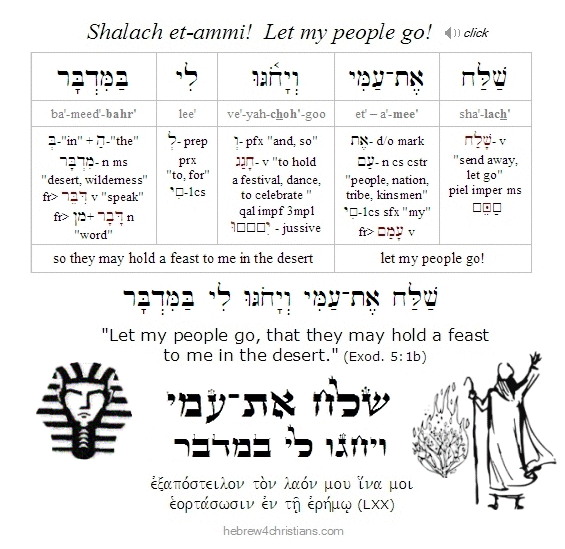
Some time later, Moses and Aaron appeared before Pharaoh to deliver the message from the LORD: "Let my people go, that they may hold a feast to me in the wilderness." To this the Pharaoh replied, mi Adonai asher eshma' b'kolo l'shalach et-Yisrael? (Who is the LORD, that I should obey his voice and let Israel go?). Not only did Pharaoh reject their request, but he imposed even harsher decrees against the Israelites -- commanding that they now deliver the same amount of bricks but without any straw supplied to them. The overseers then flogged the Hebrew foremen because they were unable to meet the impossible quotas. When the foremen appealed to Pharaoh for mercy, they were accused of being idle, since they listened to Moses and Aaron, and were told to keep the quota of bricks despite the lack of straw. The foremen then blamed Moses and Aaron for worsening their situation, and Moses then complained to the LORD that the mission was turning out quite badly. The parashah ends with God assuring Moses, "You shall soon see what I will do to Pharaoh: he shall let them go because of a greater might; indeed, because of a greater might he shall drive them from his land."
Haftarah Reading Snapshot:
The Haftarah from Isaiah refers to acharit hayamim (the end of days), when "Jacob shall take root, Israel shall blossom and put forth shoots and fill the whole world with fruit." In that day, the LORD will take each Jew, one by one, and bring them back to the land promised to Abraham ("from the river Euphrates to the Brook of Egypt").
Just as the book of Exodus speaks of the themes of redemption and homecoming, so these themes find expression in Isaiah's message: "And it shall come to pass on that day that a great shofar shall be sounded and those who were lost in the land of Assyria shall come and they who were dispersed in the land of Egypt; and they shall worship the Lord on the holy mountain in Jerusalem" (Isaiah 27:13).
But before this day, both Ephraim and Jerusalem will be judged, and the remnant of those who know the LORD will be considered a people of "strange lips" and a "foreign tongue," to those who are drunk in the pride of their flesh.
Brit Chadashah Snapshot:
The excerpt from Acts (chapter 7:17-35) provides Stephen's succinct summary of the events described in this week's parashah (Stephen will then proceed in his narrative to make the case that Moses himself foretold the coming of the Mashiach as a "Prophet like unto me.")
The passage from 1 Corinthians deals with the relative importance of the gift of "tongues" in relation to the gift of prophecy, as they pertain to the edification of the church of the Mashiach. Here the apostle alludes to a passage from the Haftarah (Isa. 28:11-12) to demonstrate that the phenomena of tongues are a sign - not for believers but for unbelievers - but the gift of prophecy is a sign not for unbelievers but for believers.
Addendum: The Advent of Moses
"And Joseph died, being 110 years old. They embalmed him, and he was put in a coffin in Egypt" (Gen. 50:26). So ends the Book of Genesis. Let me wish you Yasher Koach and Chazak! (said upon completing a book of the Torah).
As we proceed to read the "next page" in our chumashim (Bibles), we see that the Book of Exodus picks up right where the narrative of Genesis left off, by listing the "names" (shemot) of the descendants of Jacob who had come to Egypt to settle in the land of Goshen. This (abbreviated) list of names links the two books together by reminding us that while "Joseph died, and all his brothers and all that generation" (Exod. 1:6), embryonic Israel remained within the matrix of Egypt.
Recall that the Book of Genesis described how the "beautiful dreamer" Joseph was betrayed by his brothers, sold as a slave into Egypt, and later falsely accused and imprisoned for years. All this was by divine providence (הֶסְתֵר פָּנִים, "hiding of the face"), of course, since at "just the right time" Joseph correctly interpreted the dreams of Pharaoh, and this in turn led to his promotion as Egypt's chief administrative overseer. Joseph then revealed his identity to his brothers and brought his family to settle in the land of Goshen to escape the seven years of famine. After the famine had passed, Joseph was hailed as a great prince of Egypt who had delivered the nation from destruction. These were happy days for Israel in Egypt: the Israelites were fruitful and "multiplied so much that the land was filled with them" (Exod. 1:7).
Eventually, however, the memory of Joseph's salvation of Egypt faded, and then a "new king" arose over Egypt who "did not know Joseph" (לא־יָדַע אֶת־יוֹסֵף). There is a dispute in the Gemara as to whether this Pharaoh was an unnamed successor of the former regime or the same Pharaoh who knew Joseph but later decided to no longer acknowledge Egypt's indebtedness to the Israelites. Either way, the phrase is ominous. Indeed, whenever a "new king arises" it usually forebodes evil for the Jewish people. "Better the devil you know than the one you don't," says the old Yiddish proverb. Do you remember this scene from the Fiddler on the Roof? The young man Labish approaches the dear and wise old Rabbi and asks him, "Is there a proper blessing for the czar?" Everyone is astounded at the idea. A blessing for the czar? The gentle Rabbi responds that indeed there is indeed a proper blessing for the czar: "May God bless and keep the Czar -- far away from us!" (Amen!)
This "new king" grew wary over the population explosion of the Israelites and feared that they would become a "fifth column" against Egypt during a time of war. Since he "did not know Joseph" (i.e., mistrusted the very idea of "Israel"), this Pharaoh sought to put the Israelites firmly under his political foot by tricking them into becoming Egypt's slave class. In this connection, the statement, "the Egyptians made the children of Israel to serve with rigor," the sages say that the word b'farekh (בְּפָרֶךְ) could be understood as b'fah rekh, meaning, "with a soft mouth" or with gentle speech. This explains Pharaoh's phrase, "let us deal wisely (or shrewdly) with them" (Exod. 1:10). Pharaoh at first made stirring patriotic speeches asking for volunteers to help build new cities for the "glory of Egypt." He even molded bricks with his own hands and began to lay them as foundation stones. Thousands of people came forward asking to help with the new building projects -- including the Israelites. Indeed, the Israelites worked hard to demonstrate their fervent patriotism and strong work ethic. But soon the Pharaoh issued a proclamation requiring that each Israelite repeat the work he had done the day before. The bait had been set - and taken - and the Israelites soon found themselves seduced into slavery.
Slavery is an unspeakably ugly thing. Indeed, in our world today there are more people bought and sold into slavery than ever before in human history. Often it begins with seduction of some kind - cajoling words, false promises - and then comes the threat of force.... It is always dehumanizing and morally wrong to lie and manipulate others - and that statement applies equally to "respectable" political leaders, scientists, educators, as well as to religious hucksters, advertisers, propagandists, unscrupulous business executives, con-artists, panderers, extortionists, or other types of "pimps" found in the world. The Hebrew word shemot means "names," and reminds us that people are never to be considered objects to be exploited. God knows our names, chaverim, and therefore He knows the names of all those who enslaved by others (as well as the names of those who exploit and abuse others, too).
According to Midrash, some time later this "new king" (Pharaoh) had a nightmare. In it he saw an old man standing before him as he sat on his throne. The man held a balancing scale. All the elite of Egypt were placed on one side of the scale, and only a small lamb on the other. When Pharaoh looked, behold, the lamb outweighed all the others!
When he awoke, Pharaoh called his wise men and asked them to interpret his dream, but they could not do so. Only a magician named Balaam ben Beor had the explanation: "A child will be born to the Israelites who will destroy the land and kill all the people," he said. "Then he will lead the Israelites to freedom. You must stop this from happening!" Pharaoh's stargazers agreed with Balaam and informed Pharaoh that according to their calculations the child had been born on that very day! "But he is destined to die by water," they said, and an court advisor then recommended that a decree be issued that all newborn Israelite sons be thrown into the Nile river. Pharaoh agreed to idea, and immediately began scheming about how to implement his genocidal program.
When the Pharaoh summoned the Hebrew midwives and instructed them to kill all the Hebrew baby boys, they initially feigned compliance. However they heroically refused to submit to the Pharaoh's decree -- and even deceived him when they were accused of noncompliance later (Exod. 1:15-21). This is an example of the virtue of pikuach nefesh (פּיקוּח נפשׁ) - i.e., the principle that saving a human life is paramount, overriding virtually any other moral obligation or requirement (such blindly obeying governmental decrees or mindlessly telling the truth, regardless of the consequences to others). Note that the Torah states that God rewarded the midwives for their civil obedience to the Pharaoh -- even if that involved acts of deception on their part.
Undeterred, the Pharaoh then issued a new edict to the entire nation commanding all his subjects to spy on the Israelites. If an Israelite woman gave birth to a baby boy, they were to kill him at once; baby girls, however, were exempt from this decree (Exod. 1:22). (As an aside, it is astounding, is it not, how the complicity of "the people" often furthers the plans and designs of wicked rulers? Either by unthinking compliance or by turning a blind eye to the truth... Think of Nazi Germany, for example.) All this treachery is the prelude to the story of the birth of Moses, of course, who was the son of a Levite named Amram and his wife, Yocheved.
After Moses was born, his mother Yocheved attempted to hide him for a few months (again, in defiance of the Pharaoh's decree), but soon realized she could no longer do so. She then placed him in a basket among the reeds of the Nile before anyone could kill him. Her seven year old daughter Miriam stood by and watched to see what would happen to her brother.
Providentially, Pharaoh's daughter came to bathe in the Nile and discovered the basket among the reeds. Moved by pity, the princess decided to adopt the baby even though he was a "despised Hebrew." Miriam (who witnessed all this) then approached the princess and offered to find a nursemaid for the child - and cleverly arranged for Moses' own mother to do the job! (According to Midrash, as soon as Yocheved placed Moses' basket in the Nile, Pharaoh's advisers came and told him that the foreseen deliverer of the Israelites had drowned, and the decree was rescinded. Pharaoh's own daughter also appealed to Pharaoh to reverse the evil decree.)
When the child was weaned, Yocheved brought him to Pharaoh's daughter and he became her son, a prince of Egypt. She named him Moses (מֹשֶׁה), "Because," she said, "I drew him out of the water" (a play on the word מָֹשָׁה, which means "to draw out, to save"). Thus we see that Moses was actually named by an Egyptian princess.
Moses never forgot his identity as an Israelite, however. Doubtlessly this was something the Egyptian court reminded him of regularly, perhaps to show their "liberality" in treating a "despised Hebrew" as an honored Egyptian rather than as a slave. When he became a man, however, Moses went to see for himself what kind of life his relatives lived. It was then that he killed the Egyptian taskmaster who was abusing his cousin and was forced to flee to Midian for 40 years of "wandering" in the desert. His carnal haste at becoming Israel's deliverer led him into a life of exile from his people... In Midian, he married the daughter of a local priest (named Tzipporah) and had a son named Gershom (a name that comes from the word גֵּר, "a stranger" and שׁם, "there").
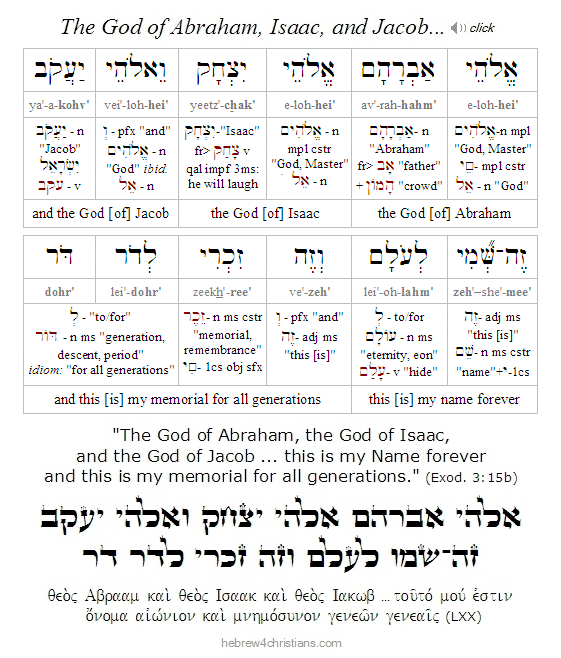
Later, perhaps when Moses was nearly 80 years old, he received the call of God to become Israel's deliverer. וַיַּרְא אֱלהִים אֶת־בְּנֵי יִשְׂרָאֵל וַיֵּדַע אֱלהִים - "God saw the people of Israel - and God knew" (Exod. 2:25). It was then that the Angel of the LORD (מַלְאַךְ יהוה) appeared to Moses in a flame of fire out of the midst of a bush saying, "I am the God of your father, the God of Abraham, the God of Isaac, and the God of Jacob" (אָנכִי אֱלהֵי אָבִיךָ אֱלהֵי אַבְרָהָם אֱלהֵי יִצְחָק וֵאלהֵי יַעֲקב).
When God instructed Moses to go to the people of Israel to announce their coming deliverance, he began to argue: "What if Israel refuses to believe that You have sent me?" God then gave Moses some "signs" to authenticate his message. Nonetheless, Moses was still reluctant to receive the commission. He protested to the LORD that he was kevad peh - "heavy of mouth" and kevad lashon, "heavy of tongue," and therefore unable to speak on behalf of the LORD (Exod. 4:10).
According to midrash (Shemot Rabbah 1:31), as a very young lad Moses was once seen throwing Pharaoh's gold crown down to the ground. Upon learning of this apparent act of insolence, Pharaoh devised a test to see if the child understood the implications of his actions. He therefore commanded that a platter with a piece of gold and a glowing piece of coal be brought before Moses and ordered the little boy to choose one. If Moses chose the gold, it would imply that he understood its value, and therefore he would be killed. On the other hand, if Moses chose the burning coal, he would be spared since he was unable to differentiate between gold and a glowing piece of coal. Moses began to reach out for the gold when an angel pushed his hand aside and he grabbed the coal instead. Moses then immediately put his hand in his mouth, but that burned his lips and tongue so badly that he had a permanent speech impediment as a consequence.
Despite God's assurances, however, Moses was unsure of his ability to persuade the royal court to let the Israelites go. God then reminded him that He was the Creator of the mouth: "Who makes him mute, or deaf, or seeing, or blind? Is it not I, the LORD? Now therefore go, and I will be with your mouth and teach you what you shall speak" (Exod. 4:11-12). When Moses begged to have someone else take his place, the LORD grew angry and decreed that "because of your words" he would not be permitted to be a kohen (priest), but his brother Aaron would (Exod. 4:14-16).
The parashah ends with the former "prince of Egypt" accepting his God-given mission and beginning the trek back to the land of his origin - this time as a "prince of God"! Along the way back, however, God threatened to kill Moses on account of a delay in the circumcision of his son Eliezer (Exod. 4:24). According to the sages, Moses reasoned that God's commandment to go to Egypt was more important than the commandment to perform brit milah on the 8th day of his son's life, and had he performed the circumcision, travel would have been impossible. Therefore Moses thought he was acting righteously. But when Moses failed to immediately perform the ritual at the lodging place along the way (affording the opportunity for healing for his son during the trip), the LORD came to kill him. Tzipporah (Moses' wife) then performed the circumcision but apparently needed to do it twice, as indicated by the phrase: Chatan damim lamulot - You are a bridegroom of blood to me, because of the circumcisions(mulot, the plural form of mulah).