|
|
 |
|
|
|
|
Weekly Torah Reading
|
|
|
|
Parashat Vayechi ("and he lived")
|
|
|
Click on the links to display the Scriptures:
|
|
|
|
|
|
|
Torah Reading Overview
|
|
|
|
In last week's parashah (Vayigash), Joseph continued to test his brothers to see if they were indeed different people from the ones who had cast him into the pit. After Judah offered to take the place of Benjamin as a slave, however, Joseph was convinced of their teshuvah and finally revealed his identity to them. With the sons of Israel finally reunited, Joseph then brought his father Jacob to dwell in the "fat of the land" of Egypt, where God had promised to make them into a great nation.
|
|
|
|
|
|
This final portion of sefer Bereshit (the book of Genesis) begins 17 years after Jacob's arrival in Egypt, when he was 147 years old:
|
|
|
|
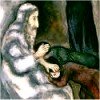
Knowing that he was nearing his last days on earth, Jacob sent for Joseph and asked him take an oath that he would bury him in the cave of Machpelah (the burial place of Adam and Eve, Abraham and Sarah, Isaac and Rebekah, and Leah) rather than in Egypt.
Sometime later, Joseph was told that Jacob was ill and went to visit him, bringing his two sons, Manasseh and Ephraim, with him. Jacob then declared that the two boys would be counted as his own sons, as "Reuben and Simeon they shall be to me" (i.e., as Jacob's first two sons). By so doing, Joseph was given a "double portion" of blessing which effectively removed the status of the bechor (first-born) from Reuben.
|
|
|
|
|
|
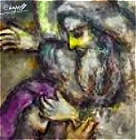
Joseph then brought his sons to Jacob's bedside to receive the blessing, with Ephraim to Jacob's left and Manasseh (the firstborn) to his right, but Jacob crossed his arms and laid his right hand upon Ephraim and left upon Manasseh.
|
|
|
|
|
Joseph thought that his father did not realize that the elder son was to his right, but Jacob reassured him that he knew what he was doing, and prophesied that though both sons would be great, Ephraim would be greater, and said v'zaro yihyeh melo-hagoyim ("his seed shall become a multitude of nations"). So he blessed them saying, "By you Israel will pronounce blessings, saying, yesimkha elohim k'efrayim v'khimnaseh ("God make you as Ephraim and as Manasseh"), and thus put Ephraim before Manasseh.
Moreover, as the bechor of Israel, Joseph was given an extra portion in the Promised Land, namely, Jacob's hometown area of Shechem near Hebron (where Joseph's bones were eventually buried [see Joshua 24:32]).
Sensing his impending death, Jacob next called his sons to his bedside, and blessed each one (see Gen. 49:28). He also prophesied about each shevet (tribe) in acharit hayamim (the end of days).
Jacob's Blessing of his sons...
|
|
|
|
|
#
|
Son
|
English
|
Tribe's attributes
|
|
1
|

|
Reuben
|
The bechor status was revoked for his interference in Jacob's marital life; despite being the firstborn, he will not be leader of Israel.
|
|
2
|

|
Simeon
|
Rebuked for the massacre of Shechem, Simeon will be scattered in Israel (the tribe ended up absorbed in Judah); he also will not be leader of Israel.
|
|
3
|

|
Levi
|
Rebuked for the massacre of Shechem; will be scattered in Israel (shevet Levi ended up in the Cities of Refuge); he also will not be leader of Israel.
|
|
4
|

|
Judah
|
Will be praised by all Israel; the kings of Israel will come from him, and from Judah the Mashiach (Shiloh) would eventually come.
|
|
5
|

|
Dan
|
Shall produce great judges and promote justice in Israel.
|
|
6
|

|
Naphtali
|
Shall produce beauty and praises in Israel.
|
|
7
|

|
Gad
|
Shall produce victorious warriors of Israel.
|
|
8
|

|
Asher
|
Shall be prosperous and full of olive oil.
|
|
9
|

|
Issachar
|
Shall persevere like a beast of burden.
|
|
10
|

|
Zebulon
|
Shall be prosperous seafaring merchants.
|
|
11
|

|
Joseph
|
Shall be blessed with fertility and prosperity.
|
|
12
|

|
Benjamin
|
Shall produce victorious warriors of Israel.
|
|
|
|
|
After giving these parting words to his sons, Jacob then said he was about to die, and (again) commanded them that he was to be buried in the land of Canaan, in the cave of Machpelah that his grandfather Abraham had purchased from Ephron the Hittite, and where he had buried Leah. When he finished with these final instructions, he died.
Joseph fell upon Jacob's face and wept, and then ordered the Egyptian physicians to embalm his father. The Egyptians mourned for Jacob for 70 days (Rashi states that upon Jacob's arrival in Egypt, the famine in Egypt ceased because of his merit, and this was the reason the Egyptians mourned his death).
With Pharaoh's permission, Joseph, along with his brothers and various dignitaries of Egypt, formed a funeral procession and returned to Canaan to bury Jacob in the Cave of Machpelah in Hebron. After the funeral, they returned to Egypt, but Joseph's brothers feared that he would now punish them for their former betrayal, and threw themselves on his mercy. Joseph reassured them, however, and promised to support them and their families in the days to come.
The parashah (and the book of Bereshit (Genesis)) ends with the account of the death of Joseph, who made the sons of Israel promise to take his bones with them when the LORD would bring them back to the land of Canaan (alluding to the great exodus to come). Joseph's faith in the Jewish people's return to the Promised Land is summarized by his statement: pakod yifkod elohim etkhem (God will surely remember you). He died at age 110, was embalmed and placed in a coffin in Egypt, full of faith that he would be raised from the dead in the land promised to Abraham, Isaac, and Jacob.
|
|
|
|
Vayechi Outline:
|
|
|
|
- First Aliyah (Gen. 47:28-48:9)
Jacob foretells his death.
Jacob lived his last seventeen years in Egypt. Near the end of his life he called Joseph and asked him to promise that he would bury him in the Cave of Machpelah in the promised land. Later Joseph visited Jacob again and brought his two sons, Manasseh and Ephraim, to be blessed by his father. Jacob elevated their status to be Jacob's own sons.
- Second Aliyah (Gen. 48:10-16)
Jacob blesses Ephraim and Manasseh.
Joseph presented his two sons to be blessed by Jacob, but his father crossed his hands and placed his right hand on Ephraim's head and then blessed them. "May the Angel who redeemed me from all harm bless the young men, and may they be called by my name and the name of my fathers, Abraham and Isaac, and may they multiply abundantly like fish in the midst of the land."
- Third Aliyah (Gen. 48:17-22)
Ephraim is given the greater blessing.
Joseph was upset that Jacob reversed the conventional order of blessing his sons and attempted to reverse his father's hands. Jacob replied to him: "I know, my son, I know," saying that the younger would be the greater and that his children would fill the nations." Jacob then added that all Israel will bless each other by saying: "May the LORD make you like Ephraim and Manasseh," putting Ephraim first.
- Fourth Aliyah (Gen. 49:1-18)
Jacob fortells the end of days.
Jacob summoned all his sons and gave each one a mysterious blessing. For example Reuben was reprimanded for trying to divide the family; Simeon and Levi were rebuked for killing the Shechemites; Judah was blessed with monarchy; while Zubulon, Issachar, and Dan were given special blessings.
- Fifth Aliyah (Gen. 49:19-26)
Joseph is honored by Jacob.
Jacob's sons Gad, Asher, and Naftali were then blessed, though the emphasis fell upon Joseph, Jacob's firstborn son of Rachel, who was honored for his beauty, his suffering, and his righteousness. A lavish litany of blessings were given to Joseph.
- Sixth Aliyah (Gen. 49:27-50:20)
The death of Jacob.
Last of all Benjamin, Jacob's youngest son, was blessed. Jacob then repeated his request to be buried in the Cave of Machpelah in Hebron, and he passed away at the age of 147. A great funeral procession of all the elders of Egypt and Jacob's family went to see Jacob buried. After returning to Egypt, Joseph's brothers were afraid that he would finally get his revenge upon them for their earlier betrayal, but Joseph was gracious and expressed complete forgiveness.
- Seventh Aliyah (Gen. 50:21-26)
The death of Joseph.
Before dying at the age of 110, Joseph prophesied to his brothers that the LORD would take them out of Egypt and bring them back to the Promised Land. Joseph then asked his brothers to swear that when God would lead them out, they would take his remains and bury him in the land of Canaan.
Yasher Koach and Chazak! (said upon completing a book of the Torah)
|
|
|
|
|
|
Haftarah Reading Overview
|
|
|
|
The Haftarah for parashat Vayechi is taken from the first book of Kings (chapter 2:1-12), which (according to Jewish tradition) was written by the prophet Jeremiah, who later witnessed the destruction the First Temple by the Babylonians in 586 B.C.
The portion begins with the deathbed scene of King David, who at age 70 is aged beyond his years; his fire is nearly extinguished and nothing can warm him (1 Kings 1:1-4). King David then gave his son Solomon his final instructions (a blend of religious admonition with real politik) before he died.
First of all, Solomon was instructed to be strong in faith and keep the Torah of the LORD. The success of the throne of Israel depended upon this! Then David proceeded to give Solomon specific instructions about various unfinished business, such as the execution of his nephew Joab (who had betrayed David by supporting Adonijah to be the next king of Israel); the pledge of care given to the sons of Barzillai the Gileadite (who had supported David during the time of his persecution), and the execution of Shimei the son of Gera, a Benjamite relative of King Saul, who had cursed David for Saul's demise.
The Haftarah ends with the account of David's death and Solomon's ascension.
|
|
|
|
Brit Chadashah Overview
|
|
|
|
The Brit Chadashah (New Testament) reading comes from 1 Peter 1:3-9, where the apostle encouraged us to walk in "living hope," that is, in the full assurance that God is going to ultimately do good to us in the future. This is not an empty wish for good things to come, but is based on the resurrection life of Yeshua the Mashiach from the dead.
By God's power we are being "guarded through faith" for a salvation ready to be revealed in acharit ha'yamim, even if at the present time we suffer afflictions on account of various trials and testings. Like a refiner's fire that is used to separate the impurities from precious metal, the purpose of such trials is to test our faith in order to purify our praise and yield honor and glory to the LORD. It takes the "merciful fire" of God to destroy the sin nature within our hearts. For the believer in Yeshua the Mashiach, the furnace of affliction is always for refinement and never for utter destruction. "I the Lord do not change; therefore you are not consumed, O sons of Jacob!"
|
|
|
|
Blessing:
|
|
|
|
|
|
For Further Study:
|
|
|