|
|
 |
|
|
The Hebrew word mitzvah (מִצְוָה) means "divine commandment" (mitzvot is the plural form). Although the word is sometimes used broadly to refer to Rabbinic (Talmudic) law or simply a good deed (e.g., "it would be a mitzvah to visit your sick cousin"), in its strictest sense the term refers to a divine commandment given by the LORD in the Torah. In Exodus 24:12 the Ten Commandments are collectively referred to as mitzvot.
|
|
|
|
The written Torah of Moses (often called the "Pentateuch" in Christian tradition) is filled with various imperatives of one kind or another. The Hebrew term mitzvah (מִצְוָה) is a general term used to refer to any commandment given by God. Mitzvot (מִצְוֹת) can be further divided into the subcategories called chukkim u'mishpatim (Deut. 4:5):
- Chukkim (חֻקִּים) are statutes given without a reason (i.e., fiats or divine decrees). As such they are sometimes called "supra-rational" decrees. The classic example is the chukkah (sing.) regarding the Red Heifer, which, legend has it, defied even the wisdom of King Solomon. Other examples include dietary law (kashrut), the prohibition of mixing seeds or fabrics (kilayim), or the laws concerning family purity (niddah). These laws can seem irrational to human reason.
Zot chukat haTorah (זאת חֻקַּת הַתּוֹרָה) - "this is the Torah's decree...." which we therefore accept as a commandment that transcends our abilities to rationally fathom. That is, when asked why we would do what is here commanded, we can only appeal to the fact that the LORD has commanded such - and that settles the issue.
- Mishpatim (מִשְׁפָּטִים) are laws given for a clearly specified reason (i.e., logical laws). An example would be the commandment to give charity or the prohibitions against theft and murder. These mitzvot are inherently rational and appeal to the need for ethical unity (civil and moral life) within the community.
- Note: eidot (עֵדוֹת) are testimonials (from the root 'ed, "witness") that commemorate or represent something -- e.g., the commandments to observe Shabbat and the holidays, to put on tefillin, wear tzitzit, eat matzah on Passover, blow a shofar, etc. Since they commemorate or symbolically represent something, the eidot occupy a sort of middle ground between the rationally understandable mishpatim and the supra-rational chukkim. Note further that a brit (בְּרִית) refers to a specific agreement or "covenant" made between the Sovereign LORD and his people. All the various commandments, statutes, decrees, and so on are contextualized in terms of the underlying covenant and are expressed as obligations of the covenant.
|
|
|
|
|
|
 |
|
|
|
The phrase chukkim u'mishpatim (חֻקִּים וּמִשְׁפָּטִים) is a synonym for the more general term "mitzvah," as can be seen in parashat Mishpatim, which lists over 50 mitzvot that are indeed logical laws (i.e., mishpatim), but also include a number of eidot and at least one chukkah (חֻקָּה), or supra-rational "decree."
Some Jewish scholars have attempted to count the various mitzvot (commandments) listed in the Torah. For example, the Jewish Aristotelian philosopher Maimonides (i.e., "Rambam") listed a total of 613 commandments in his book Sefer Ha-mitzvot ("Book of Commandments") and divided them into two basic groups: 248 positive ("Thou shalt...") and 365 negative ("Thou shalt not...") commandments. In Jewish theological tradition, positive commandments (obligations) are called mitzvot 'aseh (מִצְוֹת עֲשֵׂה), whereas the prohibitions are called mitzvot lo-ta'aseh (מִצְוֹת לא תַעֲשֵׂה). Some of the sages rather fancifully claim that the positive commandments equal the number of bones and significant organs of the body, whereas the negative commandments correspond to the number of days in the solar year.
 |
Note that the gematria (numerical value) for the word Torah is Tav (400) + Vav (6) + Resh (200) + Hey (5), which yields 611. According to Jewish tradition, Taryag (613) is equal to the word "Torah" plus the two commandments that existed before the Torah: "I am the Lord your God" and "you shall have no other gods before me."
|
|
|
|
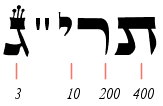
Since Hebrew letters are often used to express numbers, the number 613 can be represented using the word "Taryag" (pronounced tar-YAHG) as a numerical acronym:
|
|
|
|
|
|
You add the value for Tav (400) to the value for Resh (200) to get 600, and then you add the value of Yod (10) and Gimmel (3) to get 13. Adding these numbers together yields 613 (note the gerashayim is used to indicate that this is a non-standard Hebrew word).
|
|
|
|
|
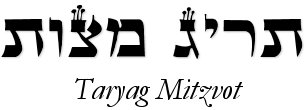
Collectively, the 613 commandments listed in the Torah are called "Taryag Mitzvot."
|
|
|
|
With the destruction of the Temple in 70 AD, many of the enumerated mitzvot that concern ritual and ceremony within the establishment of the Aaronic priesthood can no longer be obeyed (it has been estimated that only about 270 of them - less than 50 percent - are still applicable today). That is, ever since the Diaspara of the Jewish people, it has been literally impossible to fulfill all of the Torah's righteous demands. Nonetheless, the Rabbinic tradition has assumed the role of interpreting the applicability of Jewish law for the individual Jew, and certain qualifications in the idea of the mitzvot are therefore made.
|
|
|
|
|
|
|
|
|
|
|
|
|
|
|
 |
|
|
|
The Jewish Temple was destroyed in 70 AD and has never been restored.
Presently, the mitzvot pertaining to the priesthood cannot be fulfilled.
|
|
|
Rabbinical Legal Ruminations: Halakhah
|
|
|
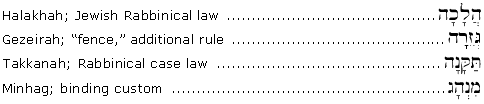
In addition to Taryag mitzvot (see the listing of the 613 commandments below), Rabbinical law has added a large body of rulings that are claimed to be just as binding as the divine mitzvot. Such rabbinical halakhah (from halakh: הָלַךְ, "to walk") refers to the various rules and regulations that are said to mark the Jew's 'walk' through life. Halakhah includes three (related) groups: gezeirah, takkanah, and minhag:
- Gezeirah (i.e., גְּזֵרָה, "fence") -- a rule instituted by the rabbis to prevent inadvertent violation of a mitzvah. For instance, it is a mitvah to refrain from work on the Sabbath, but it's a gezeirah to avoid even the handling of any work instruments on the Sabbath.
- Takkanah ("case law ordinance") -- a law instituted by rabbis that does not directly derive from the Torah (but is inferred from its interpretation). An example would be the lighting of candles on erev Shabbat. The ritual of public Torah recitation every Monday and Thursday is a takkanah instituted by Ezra the Scribe. Takkanot (pl.) can vary by region, based on the prevailing rabbinical authority. Ashkenazic Jews accept takkanot that Sephardic Jews might not recognize as binding.
- Minhag ("custom") are rabbinically approved conventions for a Jewish community (plural minhagim). An example of a minhag would be eating apples with honey on Rosh Hashanah. Like the takkanot, minhagim can vary by region, based on the prevailing rabbinical authority.
|
|
|
|
 |
|
|
 |
|
|
|
|
|
|
Torah and Jewish Tradition
|
|
|
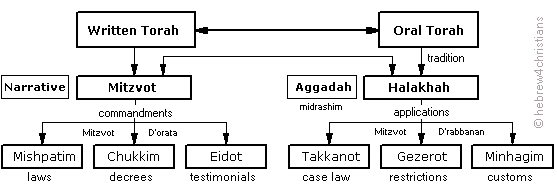
In Jewish thought, the word "Torah" (תּוֹרָה) is a general concept that implies a wide range of related ideas and concepts that focus on discerning God's will. A primary distinction is between the written Torah, on the one hand, and the oral Torah on the other. The written Torah, called shebichtav (שֶׁבִּכְתָב, "that which is written"), refers to the text that has been meticulously transmitted since the time of Moses in the form of a Sefer Torah (i.e., a kosher Torah scroll). The oral Torah, on the other hand, is called shebal peh (שֶׁבְּעַל פֶּה, "that which is oral"), and refers to legal and interpretative traditions handed down by word of mouth until these were codified in the Mishnah and Gemara (i.e., the Talmud). The Oral tradition further includes the Midrash (traditional exegesis), the Responsa (questions and answers given by "poskim," or legal scholars), the Shulchan Aruch (16th century codification of Jewish case law), and various other commentaries handed down over the centuries. Some people further claim that "Kabbalah" is also contained within oral tradition, though strictly speaking it is not regarded as part of the Oral Torah as understood in Jewish tradition.
Jewish thought maintains that the written Torah and the oral Torah are complementary, since Moses himself established the role of judges and law courts in the written Torah (Exod. 18:13-26; Num. 11:24-29; Deut. 16:18-20; 17:8-12), and ultimately the oral Torah derives its justification and substance from the written revelation. Indeed it is somewhat artificial to distinguish between the two in practice, since the written Torah was preserved through tradition (i.e., the scribal transmission, the books to be included in the canon, etc.), just as the oral Torah was validated by the written words of the Torah scroll itself. Moreover, within both of these "Torahs" we can make further distinctions. For example, in the written Torah there is both narrative (alilah) and Gods' explicit commandments (mitzvot), which roughly corresponds to the distinction between "aggadic" (homiletical) and "halakhic" (legal) literature found in the oral Torah. In addition, just as the 613 mitzvot of the written Torah can be subdivided into the categories of mishpatim (laws), chukkot (decrees), and eidot (testimonials), so the Jewish legal tradition discusses the corresponding ideas of takkanot (case laws), gezerot (rabbinical decrees), and minhagim (customs). In short, there is a sort of circular reasoning involved in the traditional Jewish idea of Torah: The written Torah was passed down (validated) by means of the oral Torah; but the oral Torah derives its authority from the written Torah:
 |
Interestingly enough, Jewish tradition seems to go two ways with the idea that Torah can be explicated by means of halakhah. On the one hand, it carefully enumerates every nuance of each of the various commandments of the Torah, creates various takkanot (case laws) and even multiplies the Torah's principles by building "fences" around the commandments, yet on the other hand it can (lucidly enough) distill the various commandments to more general principles that are fewer and fewer in number. For example, in Makkot 23b-24a the discussion goes from an enumeration of the 613 commandments identified in the Torah (see below), to David's reduction of the number to 11 (Psalm 15), to Isaiah's reduction of the number to six (Isaiah 33:15-16); to Micah's reduction to three (Micah 6:8); to Isaiah's further reduction to two (Isaiah 56:1); to the one essential commandment by Habakuk ("But the righteous shall live by his faith" - Habakuk 2:4). Obviously the Apostle Paul distilled the various mitzvot to this selfsame principle of faith (see Romans 1:17, Galatians 3:11, Hebrews 10:38).
Hebrew Lesson
Exodus 24:7 reading (click):
 |
|
|
|
|
 |
|
|
|
|
The list of 613 Commandments
|
|
|
|
|
|
|
|
|
|
|
|
|
In Judaism, there is no single definitive list of the 613 laws. In what follows, first I will present a list of 613 mitzvot according to their appearance in the Torah, and then I will provide the list given by Maimonides, the "St. Thomas Aquinas" of rabbinical Judaism.
|
|
|
|
Taryag Mitzvot (Textual Order)
|
|
|
|
- Genesis 1:28
You shall take a wife, be fruitful and multiply (פְּרוּ וּרְבוּ)
- Genesis 17:9,10
You shall circumcise your male children on the 8th day
- Genesis 32:32
You shall not eat the sinew of the thigh vein
- Exodus 12:2
You shall determine the appointed times by observing New Moon
- Exodus 12:7
You shall slaughter the Pesach at twilight 1of Nissan
- Exodus 12:8
You shall eat the Pesach with unleavened bread and bitter herbs
- Exodus 12:9
You shall not eat the Pesach unless it is roasted whole in fire
- Exodus 12:10
You shall not allow any of the Pesach to remain
- Exodus 12:15
You shall remove all Chametz from your home before Pesach
- Exodus 12:18
You shall eat only unleavened bread during Chag Matzah
- Exodus 12:19
You shall not possess any Chametz during Chag Matzah
- Exodus 12:20
You shall not eat anything with leaven during Chag Matzah
- Exodus 12:43
You shall not allow any uncircumcised alien to eat of the Pesach
- Exodus 12:45
You shall not allow any sojourner to eat of the Pesach
- Exodus 12:46a
You shall not remove the Pesach from your house until morning
- Exodus 12:46b
You shall not break any bone of the Pesach
- Exodus 12:48
You shall not allow any uncircumcised person eat of the Pesach
- Exodus 13:2
You shall sanctify the first born of man and animals
- Exodus 13:3
You shall not eat any leavened bread during Chag Matzah
- Exodus 13:7
You shall not have leavened bread in your home on Chag Matzah
- 21 Exodus 13:8
You shall teach the deliverance of Israel from Egypt during Pesach
- Exodus 13:12,13
You shall redeem the firstborn of animals with a lamb
- Exodus 13:13
You shall break the neck of the unredeemed firstborn animal
- Exodus 16:29
You shall not leave your home to work or for food on Shabbat
- Exodus 20:2
You shall know that HaShem is G-d
- Exodus 20:3
You shall not serve any G-d, but HaShem
- Exodus 20:4
You shall not make any idol of any likeness
- Exodus 20:5a
You shall not minister to an idol
- Exodus 20:5b
You shall not worship an idol
- Exodus 20:7
You shall not utter the Name of HaShem in vain
- Exodus 20:8
You shall remember the Shabbat day to keep it holy
- Exodus 20:10
You shall not perform melekhah on the Shabbat
- Exodus 20:12a
You shall show respect and honor your parents
- Exodus 20:12b
Judges shall put to death the rebellious son [Deuteronomy 21:18]
- Exodus 20:13
You shall not murder
- Exodus 20:14
You shall not commit adultery
- Exodus 20:15 [14]
You shall not steal
- Exodus 20:16[14]
You shall not speak a false testimony
- Exodus 20:17[14]
You shall not covet anything of your covenant brother's
- Exodus 20:23[20]
You shall not make idols of silver or gold and believe in them
- Exodus 20:25[22]
You shall not make an altar out of hewn stones
- Exodus 20:26[23]
You shall not ascend the altar by steps, only a ramp
- Exodus 21:2
You shall deal justly with a Hebrew bond-servant
- Exodus 21:8a
You shall redeem the Hebrew maid-servant
- Exodus 21:8,9b
You shall treat the Hebrew maid-servant as a daughter
- Exodus 21:8c
You shall not sell a Hebrew maid-servant you refused to marry
- Exodus 21:10
You shall not withhold food, clothing or relations from your wife
- Exodus 21:15
You shall not strike a parent
- Exodus 21:16,17
You shall put to death anyone who kidnaps or curses a parent
- Exodus 21:18
You shall pay for any loss you caused anyone to suffer
- Exodus 21:20
Judges and Courts shall punish any man who strikes to kill a servant
- Exodus 21:28
You shall pay for any damage your animals cause
- Exodus 21:28
You shall not eat any animal that has died as a result of stoning
- Exodus 22:1-3
You shall pay for any property you stole
- Exodus 21:33
You shall pay for any harm caused because of a pit you have dug
- Exodus 22:6
You shall pay for any property you destroyed with fire
- Exodus 22:7+
You shall pay double for anything stolen while under your care
- Exodus 22:8
You shall have to appear before a judge to determine your innocence
- Exodus 22:9
You shall pay for anything stolen while under your hire
- Exodus 22:14
You shall pay for anything borrowed and loss or stolen
- Exodus 22:15
You shall pay for and marry a virgin who is not engaged
- Exodus 22:17[
Judges and Courts shall not allow a sorceress or witch to live among you
- Exodus 22:20[21]
You shall not wrong a ger [convert]
- Exodus 22:20
You shall not oppress a ger [convert] with insulting words etc.
- Exodus 22:21[22]
You shall not afflict a widow or an orphan
- Exodus 22:24,25
You shall lend to the poor and needy
- Exodus 22:24,25
You shall not harass the poor and needy who have loans
- Exodus 22:25,26
You shall not charge the poor and needy interest on loans
- Exodus 22:27a
You shall not blaspheme the name of HaShem
- Exodus 22:27b
You shall not curse your judicial leaders or judges
- Exodus 22:27c
You shall not curse your political leader
- Exodus 22:28
You shall not delay in making your offerings
- Exodus 22:30
You shall not eat anything that is terafah, torn from a dead animal
- Exodus 23:1a
You shall not repeat a false or slanderous report
- Exodus 23:1b
You shall not lie to protect a wicked man or woman
- Exodus 23:2a
You shall not join a majority, multitude or mob to do evil
- Exodus 23:2b
You shall not lie to pervert justice
- Exodus 23:2c
You shall testify truthfully
- Exodus 23:3
Judges shall show no favor to a poor man in a lawsuit because he is poor
- Exodus 23:5
You shall assist anyone who has a legitimate need
- Exodus 23:6
You shall not show favoritism when giving testimony
- Exodus 23:7
Judges shall not condemn anyone based on circumstantial evidence
- Exodus 23:8
Judges shall not accept a bribe or gift while judging someone
- Exodus 23:11
You shall allow the land to have a Sabbath rest every 7 years
- Exodus 23:12
You shall cease from all work on the Shabbat
- Exodus 23:13a
You shall not call on the names of other gods
- Exodus 23:13b
You shall not even discusses matters pertaining to idolatry
- Exodus 23:14
You shall appear before HaShem 3 times a year
- Exodus 23:18a
You shall not offer up the Pesach without having removed all Chametz
- Exodus 23:18b
You shall not allow any of the fat of the Pesach to remain
- Exodus 23:19a
You shall bring the choice first fruits to the Lord
- Exodus 23:19b
You shall not offer up a kid unless he has been taken from his mother
- Exodus 23:32
You shall not make a covenant with any peoples living in the Land
- Exodus 23:33
You shall not allow idolaters dwell in the Land
- Exodus 25:8
The House of Israel build a Temple in the Land
- Exodus 25:15
The Priests shall not remove the staves from the rings of the golden ark
- Exodus 25:30
The Priests shall display the showbread on the table before the Lord
- Exodus 27:21
The Priests shall light the menorah and it shall burn continuously
- Exodus 28:4
The Priests shall wear special garments
- Exodus 28:28
The Priest shall not loosen the breastplate from the ephod
- Exodus 28:32
The Priest shall not wear a garment that is or can be torn
- Exodus 29:33
The Priests shall eat from the offerings that make atonement
- Exodus 30:7
The Priests shall burn incense upon the altar
- Exodus 30:9
The Priests shall not offer any strange incense upon the altar
- Exodus 30:13
You shall give one half shekel as a Temple tax each year
- Exodus 30:19
The Priests shall wash their hands and feet before ministering
- Exodus 30:25
The Priests shall make the holy anointing oil
- Exodus 30:32a
No one is anointed unless he is a priest
- Exodus 30:32b
No one shall try to mix or imitate the anointing oil
- Exodus 30:37
No one shall try to mix or imitate the anointing oil for personal use
- Exodus 34:12
You shall not eat and drink a covenant with idolaters
- Exodus 34:21
You shall work the land six years, but on the Sabbatical year
- Exodus 34:26
You shall not cook meat and milk products together [halakhah]
- Exodus 35:3
You shall not kindle a fire to cook in your dwellings on the Shabbat
- Leviticus 1:3
You shall offer a burnt offering as an act of total consecration
- Leviticus 2:1
You shall offer a meal offering for specific purposes
- Leviticus 2:11
You shall not offer leavened bread or honey with any fire offering
- Leviticus 2:13
You shall not offer any Grain offering without applying salt
- Leviticus 2:13
You shall offer salt with all of your offerings
- Leviticus 4:13, 14
The Priest offers a sin offering if the community errors in judgment
- Leviticus 4:27, 28
You shall bring a chatat offering if you sinned inadvertently [beshogag]
- Leviticus 5:1
You shall testify if you are aware of evidence
- Leviticus 5:6
You shall offer an Asham if you become aware of guilt being incurred
- Leviticus 5:8
You shall not sever the head of a bird offering
- Leviticus 5:11
You shall not add oil to a chatat offering to embellish it
- Leviticus 5:11
You shall not add incense to a chatat offering to embellish it
- Leviticus 5:16
You shall add 1/value to restitution of sacred property damaged
- Leviticus 5:18
You shall offer a guilt offering when in doubt of a inadvertent sin
- Leviticus 5:23
You shall add 1/value to restitution of anything stolen
- Leviticus 5:25
You shall bring an Asham offering for any conscious sin
- Leviticus 6:3
Priests shall remove the ashes from the altar at the proper times
- Leviticus 6:5a
Priests shall keep the fire burning on the altar continually
- Leviticus 6:5b
Priests shall not allow the fire of the altar to go out for any reason
- Leviticus 6:9
Priests shall eat of the meal offerings
- Leviticus 6:10
Priests shall not eat the meal offerings with leaven
- Leviticus 6:13 High
Priests shall offer a meal offerings each day
- Leviticus 6:16
You shall not eat of the meal offerings reserved for the kohanim
- Leviticus 6:18
You shall offer a chatat for any unintentional sin
- Leviticus 6:23
Priest shall not eat of a chatat that has been brought into the holy place
- Leviticus 7:1
You shall offer an Asham offering for restitution and indemnity
- Leviticus 7:11
You shall offer a Shalom offering for specific reasons
- Leviticus 7:15
Priests shall not leave any thanksgiving offering until the next day
- Leviticus 7:17
Priests shall burn any sacrifice that has remained until the next day
- Leviticus 7:18
Priests shall not eat of any sacrifice that has remained left over
- Leviticus 7:19a
Priests shall not eat of any sacrifice that has become defiled [tamei]
- Leviticus 7:19b
Priests shall burn any sacrifice that has become defiled [tamei]
- Leviticus 7:23
You shall not eat of the forbidden fat from any animal
- Leviticus 7:26
You shall not eat any blood of any kind
- Leviticus 10:6
Priests shall not wear long hair
- Leviticus 10:6
Priests shall not enter the Temple with torn garments
- Leviticus 10:7
Priests shall not leave the Temple during a service
- Leviticus 10:9
Priests shall not enter the Temple if he is drunk
- Leviticus 11:2
You shall only eat animals with both split hoofs and who chew the cud
- Leviticus 11:4
You shall not eat animals who only have split hoofs or only chews cud
- Leviticus 11:9
You shall eat only fish with fins and scales
- Leviticus 11:11
You shall not eat fish who only have fins or only have scales
- Leviticus 11:13
You shall not eat impure birds [scavengers and predators]
- Leviticus 11:21
You shall eat only insects with four jointed legs and that leap on earth
- Leviticus 11:29
You shall become defiled if you touch the carcass of any shratzim
- Leviticus 11:34
You shall become defiled if you eat food which has become tamei
- Leviticus 11:39
You shall become defiled if you eat or carry Carrion
- Leviticus 11:41
You shall not eat swarming things upon the earth
- Leviticus 11:42
You shall not eat swarming things that crawl on belly or on many feet
- Leviticus 11:43a
You shall not eat swarming things that swarm in the water making you tamei
- Leviticus 11:43b
You shall not become spiritually dull through tamei [Deuteronomy 14:3]
- Leviticus 11:44
You shall not eat swarming things that swarm in the air
- Leviticus 12:2-5
Women shall be impure after giving birth and are to make mikvah
- Leviticus 12:6
Women shall bring offering for purification
- Leviticus 13:2 Lepers shall be examined by the
Priests to determine status
- Leviticus 13:33
You shall not cut off hair that shows symptoms of mange [scurf]
- Leviticus 13:45
Lepers shall cry "Tamei, Tamei" when anyone approaches
- Leviticus 13:47
Lepers shall wear certain identifiable garments
- Leviticus 14:2
Lepers shall be must undergo purification after he has been healed
- Leviticus 14:8
Lepers shall shave off hair, mikvah, wash clothes and live outside the camp
- Leviticus 14:9
Lepers shall shave off all hair, beard, eyebrows on the seventh 7
- Leviticus 14:10
Lepers shall make offerings after he is declared taharah or pure
- Leviticus 14:35
Lepers homes shall be considered tamei
- Leviticus 15:3
Men shall be tamei if they have a discharge [zav]of any kind
- Leviticus 15:14
Men shall bring offering after being healed of the discharge [zav]
- Leviticus 15:16
Men shall be tamei if they have a seminal discharge and renders tamei
- Leviticus 15:19
Women shall be tamei during their menstruation and renders tamei
- Leviticus 15:25
Women shall be tamei with any kind of zavah discharge and renders tamei
- Leviticus 15:29
Women shall bring an offering after being healed of zavah discharge
- Leviticus 16:2
High Priest shall not enter holy of holies except on Yom Kippur
- Leviticus 16:3
The High Priest shall precisely perform the service on Yom Kippur
- Leviticus 17:4
You shall not offer a sacrifice outside the Temple complex
- Leviticus 17:13
You shall cover the blood of the sacrifice that is on the ground
- Leviticus 18:6
You shall not commit incest with any member of your family
- Leviticus 18:7a
You shall not commit homosexual acts with your father
- Leviticus 18:7b
You shall not commit incest with your mother
- Leviticus 18:8
You shall not commit incest with your step mother
- Leviticus 18:9
You shall not commit incest with your sister
- Leviticus 18:10a
You shall not commit incest with your son's daughter
- Leviticus 18:10b
You shall not commit incest with your daughter's daughter
- Leviticus 18:10c
You shall not commit incest with your daughter
- Leviticus 18:11
You shall not commit incest with the daughter of your father's wife
- Leviticus 18:12
You shall not commit incest with your paternal aunt
- Leviticus 18:13
You shall not commit incest with your maternal aunt
- Leviticus 18:14a
You shall not commit homosexual acts with your uncle
- Leviticus 18:14b
You shall not commit incest with the wife of your paternal uncle
- Leviticus 18:15
You shall not commit incest with your son's wife
- Leviticus 18:16
You shall not commit incest with your brother's wife
- Leviticus 18:17a
You shall not marry with both a woman and her daughter
- Leviticus 18:17b
You shall not commit incest with a woman and the daughter of her son
- Leviticus 18:17c
You shall not commit incest with a woman and the daughter of her daughter
- Leviticus 18:18
You shall not marry your wife's sister [while the wife is alive]
- Leviticus 18:19
You shall not have intercourse with a woman who is menstruant
- Leviticus 18:21
You shall not abort or put to death your child
- Leviticus 18:22
You shall not commit any homosexual or lesbian acts
- Leviticus 18:23a
Men shall not have sexual intercourse with an animal of any kind
- Leviticus 18:23b
Women shall not have sexual intercourse with an animal of any kind
- Leviticus 19:3
You shall honor, respect and obey your parents
- Leviticus 19:4a
You shall not regard an idol in speech, thought or touch
- Leviticus 19:4b
You shall not fashion any idol for others
- Leviticus 19:6
You shall not eat a offering after the fixed time
- Leviticus 19:9a
You shall not reap the corners of your fields
- Leviticus 19:9b
You shall leave the produce of the corner fields for the poor
- Leviticus 19:9c
You shall not pick up off produce that has fallen upon the ground
- Leviticus 19:10a
You shall leave the produce that has fallen for the poor
- Leviticus 19:10b
You shall not glean all of the grapes of the vines
- Leviticus 19:10c
You shall leave some of the grapes for the poor
- Leviticus 19:10d
You shall not pick up grapes that fall to the ground
- Leviticus 19:10e
You shall leave some of the grape on the ground for the poor
- Leviticus 19:11a
You shall not steal money for any reason or motivation
- Leviticus 19:11b
You shall not deny possessing anything that is not yours
- Leviticus 19:11c
You shall not swear falsely that you possess something
- Leviticus 19:12
You shall not make any false oaths
- Leviticus 19:13a
You shall not oppress someone by holding on to his money
- Leviticus 19:13b
You shall not take anything with the authorization to do so
- Leviticus 19:13c
You shall not withhold the wages of someone who has worked for you
- Leviticus 19:14b
You shall not curse a deaf person
- Leviticus 19:14c
You shall not put a stumbling block in front of the blind
- Leviticus 19:15a
You shall not corrupt justice
- Leviticus 19:15b
Judges shall not show partiality to the wealthy or influential
- Leviticus 19:15c
Judges and Courts shall dispense justice with fairness
- Leviticus 19:16a
You shall not be a talebearer
- Leviticus 19:16b
You shall not withhold aide to your neighbor
- Leviticus 19:17a
You shall not hate or despise your neighbor
- Leviticus 19:17b
You shall rebuke someone who has done evil regardless of age
- Leviticus 19:17c
You shall not shame your neighbor in public
- Leviticus 19:18a
You shall not take vengeance upon your neighbor
- Leviticus 19:18b
You shall not bear a grudge against the sons of your neighbor
- Leviticus 19:18c
You shall love your neighbor as yourself
- Leviticus 19:19a
You shall not cross breed animals or any kind
- Leviticus 19:19b
You shall not cross seeds to make hybrids
- Leviticus 19:23
You shall not eat the fruit of a new tree during its first 3 years
- Leviticus 19:24
You shall take the fruit of a new tree on the year to Jerusalem
- Leviticus 19:26a
You shall not be a drunkard, glutton or one who eats living flesh of animals
- Leviticus 19:26b
You shall not put faith in soothsaying, superstition or supernatural insight
- Leviticus 19:26c
You shall not have any regard for divination, astrology, fortune telling
- Leviticus 19:27a
You shall not shave the hair around your ears
- Leviticus 19:27b
You shall not shave the tips of your beard
- Leviticus 19:28
You shall not tattoo any part of your body
- Leviticus 19:31a
You shall not put faith in spiritualism necromancy, conjuration, magic, witchcraft
- Leviticus 19:31b
You shall not believe in ghosts, familiar spirits, enchantment, sorcery
- Leviticus 19:32
You shall show respect to the Torah and those who teach it
- Leviticus 19:35
You shall not use false measurements or false weights in order to deceive
- Leviticus 19:36
You shall adjust measurements and weights to reflect what is accurate
- Leviticus 20:9
You shall not curse your parents
- Leviticus 20:10
Judges and Courts shall put to death a man and woman committing adultery
- Leviticus 20:14
Judges shall put to death one who marries both the mother and her daughter
- Leviticus 20:23
You shall not practice the religious practice of any idolater
- Leviticus 21:1
Priests shall not defile themselves with a dead body
- Leviticus 21:3
Priests shall be able to defile themselves with the dead body of family
- Leviticus 21:6
A priest who underwent immersion during the day (i.e., was cleansed from ritual impurity in a mikveh) shall not serve in the Sanctuary until after sunset
- Leviticus 21:7a
Priests shall not marry a prostitute
- Leviticus 21:7b
Priests shall not marry a woman who has a defective heredity
- Leviticus 21:7c
Priests shall not marry a divorced woman
- Leviticus 21:8
Priests shall be shown honor and respect
- Leviticus 21:11a
Priests shall not enter a home where a dead body is laying
- Leviticus 21:11b
High Priest shall not touch any dead body under any circumstances
- Leviticus 21:13
High Priest shall be allowed to marry only a virgin
- Leviticus 21:14
High Priest shall not marry a woman who has a defective heredity
- Leviticus 21:15
High Priest shall not have intercourse with a widow
- Leviticus 21:17
Priests shall not minister to the sanctuary if they develop a permanent blemish
- Leviticus 21:18
Priests shall not minister to the sanctuary if they develop a temporary blemish
- Leviticus 21:23
Priests shall not enter Temple complex if they have a blemish
- Leviticus 22:2
Priests shall not enter the Temple complex in a state of tamei [impurity]
- Leviticus 22:4
Priests shall not eat the offerings if they are in a state of tamei [impurity]
- Leviticus 22:10a
You shall not eat the offerings if you are not a kohen
- Leviticus 22:10b
You shall not eat the offerings even if you are a hired servant to a kohen
- Leviticus 22:10c
No Uncircumcised Kohen shall eat of the offerings or sacrifices
- Leviticus 22:12
You shall not eat of the offerings if you are the daughter of a kohen
- Leviticus 22:15
You shall not eat what is tevel [separated from an offering or sacrifice]
- Leviticus 22:20
You shall not bring an animal with a blemish to be sacrificed or offered up
- Leviticus 22:21a
You shall bring only an animal without a defect to be sacrificed or offered up
- Leviticus 22:21b
You shall not bring an animal with a defect to be sacrificed or offered up
- Leviticus 22:22a
Priests shall not slaughter an animal with a defect
- Leviticus 22:22b
Priests shall not burn fat upon the altar of an animal with a defect
- Leviticus 22:24a
Priests shall not apply the blood to the altar of an animal with a defect
- Leviticus 22:24b
You shall not castrate any living thing
- Leviticus 22:25
Priests shall not offer up defective animals brought by gentiles
- Leviticus 22:27
You shall bring only animals as an offering who are at least 8 days old
- Leviticus 22:28
Priests shall not slaughter an animal and its offspring on the same day
- Leviticus 22:32a
You shall not profane the divine name
- Leviticus 22:32b
You shall suffer martyrdom rather than blaspheme, murder, idolatry
- Leviticus 23:7a
You shall rest on the day of Chag Matzah
- Leviticus 23:7b
You shall not do any form of melakhah on day of Chag Matzah
- Leviticus 23:8a
You shall bring offerings each day of Chag Matzah
- Leviticus 23:8b
You shall rest on the 7th day of Chag Matzah
- Leviticus 23:8b
You shall not engage in any work melakhah on the 7th day of Chag Matzah
- Leviticus 23:10
You shall offer the omer offering during Chag Matzah
- Leviticus 23:14a
You shall not eat of new grain until the appointed time
- Leviticus 23:14b
You shall not eat parched grain from new grain before the appointed time
- Leviticus 23:14c
You shall not eat fresh ears of grain from new grain before the appointed time
- Leviticus 23:16
You shall count the omer each day during the Feast of Weeks
- Leviticus 23:17
You shall celebrate the day of Shavuot with prescribed offerings
- Leviticus 23:21a
You shall rest on the day of Shavuot
- Leviticus 23:21b
You shall not do any form of melakhah on day of Shavuot
- Leviticus 23:24
You shall rest on the day of Rosh Hashanah
- Leviticus 23:25a
You shall not do any form of melakhah on Rosh Hashanah
- Leviticus 23:25b
You shall bring a double portion of offering on Rosh Hashanah
- Leviticus 23:27a
You shall fast on the day of Atonement Yom Kippur
- Leviticus 23:27b
You shall bring a double portion of offering on Yom Kippur
- Leviticus 23:28
You shall not do any form of melakhah on Yom Kippur
- Leviticus 23:29
You shall not eat or drink anything on Yom Kippur
- Leviticus 23:32
You shall rest completely on Yom Kippur
- Leviticus 23:34,35
You shall rest on the first day of Sukkot
- Leviticus 23:35
You shall not do any form of melakhah on first day of Sukkot
- Leviticus 23:36a
You shall bring double portion of offerings each day of Sukkot
- Leviticus 23:36b
You shall rest on the eight day of Sukkot
- Leviticus 23:36c
You shall bring an offering on the eighth day of Sukkot
- Leviticus 23:36d
You shall not work on the eighth day of Sukkot
- Leviticus 23:40
You shall celebrate Sukkot with lulav, etrog, aravoth and hadasim
- Leviticus 23:42
You shall dwell in the Sukkah each of the 7 days of Sukkot
- Leviticus 25:4a
You shall not work the land on the Sabbatical Year
- Leviticus 25:4b
You shall not do any form of arboriculture during the Sabbatical Year
- Leviticus 25:5a
You shall not harvest the after growth during the Sabbatical Year
- Leviticus 25:5b
You shall not gather nor glean the fruits from trees during the Sabbatical Year
- Leviticus 25:8
The Government shall keep track of the Jubilee year
- Leviticus 25:9
You shall blow the shofar on Yom Kippur of the Jubilee year
- Leviticus 25:10
You shall rest and allow the land to lay fallow during the Jubilee Year
- Leviticus 25:11a
You shall not perform arboriculture or agriculture during Jubilee Year
- Leviticus 25:11b
You shall not reap or harvest any fruit from aftergrowth during Jubilee year
- Leviticus 25:11c
You shall not reap or harvest any fruit from a vine during Jubilee year
- Leviticus 25:14a
You shall buy and sell land during Jubilee openly and fairly, without deception
- Leviticus 25:14b
You shall trade during Jubilee in a open and fair way, without deception
- Leviticus 25:17
You shall not cheat one another during the Jubilee Year
- Leviticus 25:23
You shall not sell the land permanently because it belongs to HaShem
- Leviticus 25:24
You shall restore all hereditary lands during Jubilee Year
- Leviticus 25:29
You shall be able to redeem a home within one year
- Leviticus 25:34
You shall not sell the open land around Levitical cities
- Leviticus 25:37
You shall not charge interest of a poor covenant brother
- Leviticus 25:39
You shall not humiliate a poor brother with oppressive or degrading tasks
- Leviticus 25:42
You shall not sell a Hebrew maid-servant in public
- Leviticus 25:43
You shall not humiliate a poor brother with unnecessary tasks
- Leviticus 25:46
You shall be able to transfer a gentile slave to your children
- Leviticus 25:53
You shall not allow a Canaanite [or gentile] to enslave a covenant brother
- Leviticus 26:1
You shall not bow, even to worship Ha Shem, before any idol or image
- Leviticus 27:2
You shall be able to avoid completion of a vow by paying an endowment
- Leviticus 27:10a
You shall not substitute for an animal committed for an endowment
- Leviticus 27:10b
You shall consecrate to HaShem both animals that you attempt to switch
- Leviticus 27:11-12
You shall add an additional 20 % if the endowment animal is defective
- Leviticus 27:14
You shall be able to offer your property or home as an endowment
- Leviticus 27:16
You shall be able to offer your fields as an endowment
- Leviticus 27:26
You shall not sacrifice a first born animal, it already belongs to HaShem
- Leviticus 27:28a
You shall determine what is taboo cherem to HaShem
- Leviticus 27:28b
You shall not sell fields or real estate that have been consecrated to HaShem
- Leviticus 27:28c
You shall not redeem fields or real estate that have been consecrated
- Leviticus 27:32
You shall consecrate one out of every ten of your herds to HaShem
- Leviticus 27:33
You shall not substitute, sell or redeem an animal that has been consecrated
- Numbers 5:2
You shall quarantine those in a state of impurity outside the camp
- Numbers 5:3
You shall not enter the presence of HaShem in a state of impurity
- Numbers 5:7
You shall agree with HaShem on your sin and repent of it
- Numbers 5:15
You shall bring the unfaithful wife before the Priests for judgment
- Numbers 5:15
You shall not add oil to a meal offering of a wife suspected of unfaithfulness
- Numbers 5:15
You shall not add frankincense to a meal offering of a wife suspected
- Numbers 6:3a
You shall not drink wine or strong drink during a Nazarite vow
- Numbers 6:3b
You shall not eat fresh grapes during a Nazarite vow
- Numbers 6:3c
You shall not eat raisins during a Nazarite vow
- Numbers 6:4a
You shall not eat grape seeds during a Nazarite vow
- Numbers 6:4b
You shall not eat grape skins during a Nazarite vow
- Numbers 6:5a
You shall not enter a house with a corpse during a Nazarite vow
- Numbers 6:5b
You shall allow your hair to grow long during a Nazarite vow
- Numbers 6:6c
You shall not enter any building with a corpse in it during a Nazarite vow
- Numbers 6:7
You shall not defile yourself by touching anything dead during a Nazarite vow
- Numbers 6:13, 18
You shall cut your hair and bring offerings when your Nazarite vow is ended
- Numbers 6:23
Priests shall recite the priestly blessings every day
- Numbers 7:9
Priests shall carry the ark on their shoulders
- Numbers 9:11a
You shall celebrate Pesach during Iyyar, if you did not in Nissan
- Numbers 9:11b
You shall eat Pesach with unleavened bread and bitter herbs during Iyyar
- Numbers 9:12a
You shall not leave any of the Pesach till the 1of Iyyar
- Numbers 9:12b
You shall not break a bone of the Pesach offered during Iyyar
- Numbers 10:10
You shall blow the shofar on all feasts and new moons
- Numbers 15:20, 21
You shall give the Priests his share of the dough
- Numbers 15:38
You shall wear tzitzit on the four corners of your garments
- Numbers 15:39
You shall not indulge in thoughts that lead to adultery or apostasy
- Numbers 18:3a
Priests and Levites shall guard and protect the sanctuary in Jerusalem
- Numbers 18:3b
A Priest or Levite shall not switch responsibilities with any other priest or Levite
- Numbers 18:4
You shall not serve as a Kohan or Levite if you are not one
- Numbers 18:5
Priests shall not neglect duties as watchmen over the sanctuary
- Numbers 18:15
You shall redeem the first born among humans
- Numbers 18:17
You shall not redeem the firstborn among animals because they are HaShem's
- Numbers 18:23
Levites shall control the gates and fill the choir during services
- Numbers 18:24
You shall separate the first tithe for the Levites
- Numbers 18:26
Levites shall separate a tenth of the first tithe for the Kohan
- Numbers 19:2
You shall burn the red heifer and collect its ashes
- Numbers 19:14
You shall treat the uncleanness of the dead in a special way
- Numbers 19:19, 21
You shall use the ashes of the red heifer for purifications
- Numbers 27:8
You shall pass down your inheritance according to certain laws
- Numbers 28:2, 3
Priests shall offer the morning and evening offerings
- Numbers 28:9
Priests shall offer the Sabbath offering in addition to the daily offering
- Numbers 28:11
Priests shall offer the New Moon offering in addition to the daily offering
- Numbers 28:26, 27
Priests shall offer the Shavuot offering in addition to the daily offerings
- Numbers 29:1
You shall sound and hear the shofar on Rosh Hashanah
- Numbers 30:3a
You shall cancel or annul vows according to your fathers instruction
- Numbers 30:3b
You shall not fail to fulfill or change and modify a vow to HaShem
- Numbers 35:2
You shall give the Levites cities to dwell in
- Numbers 35:12
You shall not put to death a murderer without a trial
- Numbers 35:25
You shall banish someone who committed murder unintentionally
- Numbers 35:30
You shall not convict of murder without two witness
- Numbers 35:31
You shall not redeem a murderer from the death penalty
- Numbers 35:32
You shall not accept a bribe from a murderer
- Deuteronomy 1:17a
Judges shall not give special consideration to anyone, but be fair
- Deuteronomy 1:17b
Judges shall not show fear in his judgment
- Deuteronomy 5:18
You shall not covet your covenant brother's wife
- Deuteronomy 6:4
To know that HaShem is ONE
- Deuteronomy 6:5
You shall love HaShem with all of your heart, strength, might
- Deuteronomy 6:7a
You shall study and teach the Torah to your children
- Deuteronomy 6:7b
You shall recite the Shema daily
- Deuteronomy 6:8a
You shall wear the tefillin on the arm
- Deuteronomy 6:8b
You shall wear the tefillin on the forehead
- Deuteronomy 6:9
You shall put a mezuzah on the doorpost of your home
- Deuteronomy 6:16
You shall not rebuke the prophet or teacher
- Deuteronomy 7:2a
You shall remove all non-Jews from the Holy Land
- Deuteronomy 7:2b
You shall not show pity or compassion when removing pagans from the Land
- Deuteronomy 7:3
You shall not intermarry with non-Jews
- Deuteronomy 7:25
You shall not derive any benefit from pagan objects of worship
- Deuteronomy 7:26
You shall not possess any idols of the pagans
- Deuteronomy 8:10
You shall bless HaShem after eating meals
- Deuteronomy 10:19
You shall treat the stranger humanely
- Deuteronomy 10:20a
You shall fear HaShem and not sin
- Deuteronomy 10:20b
You shall pray to HaShem daily
- Deuteronomy 10:20c
You shall associate and assemble with those who study Torah
- Deuteronomy 10:20d
You shall swear by the Name of HaShem in truth
- Deuteronomy 12:2
You shall destroy places of idolatry in the Land
- Deuteronomy 12:4
You shall not destroy anything that is sanctified to HaShem
- Deuteronomy 12:5, 6
You shall bring all your offerings and seeks HaShem's presence in Jerusalem
- Deuteronomy 12:13
You shall not offer burnt offerings anyplace you desire
- Deuteronomy 12:14
You shall slaughter animals for sacrifice only in Jerusalem
- Deuteronomy 12:15
You shall slaughter animals for meat in your settlements
- Deuteronomy 12:17a
You shall not eat of the second tithe grain in your own home
- Deuteronomy 12 17b
You shall not eat of the second tithe of wine in your own home
- Deuteronomy 12:17c
You shall not eat of the second tithe of oil in your own home
- Deuteronomy 12:17d
You shall not eat a firstlings of animal offering in your own home
- Deuteronomy 12:17e
You shall not eat meat of sin offering in your won home
- Deuteronomy 12:17f
You shall not eat the meat of a burnt offering in your own home
- Deuteronomy 12:17g
You shall not eat the meat of a thanksgiving offering in your own home
- Deuteronomy 12:17h
You shall not eat the firstfruits offering in your own home
- Deuteronomy 12:19
You shall not abandon the Levite
- Deuteronomy 12:21
You shall slaughter animals in a humane and ritual way
- Deuteronomy 12:23
You shall not eat flesh cut from a living animal
- Deuteronomy 12:26
You shall offer all offerings and sacrifices only in the Temple
- Deuteronomy 13:1a
You shall not add anything to Torah
- Deuteronomy 13:1b
You shall not take anything away from the Torah
- Deuteronomy 13:4
You shall not listen to the false prophet
- Deuteronomy 13:9a
You shall not consent to the false prophet
- Deuteronomy 13:9b
You shall not follow the false prophet
- Deuteronomy 13:9c
You shall not deliver the false prophet from death
- Deuteronomy 13:9d
You shall not plead for the life of the false prophet
- Deuteronomy 13:9e
You shall not withhold evidence to convict a false prophet
- Deuteronomy 13:12
You shall not entice someone else to idolatry
- Deuteronomy 13:15
You shall examine witnesses thoroughly concerning idolatry
- Deuteronomy 13:17a
You shall burn an apostate city and inhabitants killed
- Deuteronomy 13:17
You shall not rebuild an apostate city
- Deuteronomy 13:18
You shall not derive any benefit from the remains of an idolatrous city
- Deuteronomy 14:1
You shall not cut oneself or pierce the flesh
- Deuteronomy 14:1
You shall not shave the hair on your head
- Deuteronomy 14:3
You shall not eat any detestable thing [trumah]
- Deuteronomy 14:11
You shall eat only clean birds
- Deuteronomy 14:19
You shall not eat winged swarming things
- Deuteronomy 14:21
You shall not eat carrion, animals must be properly slaughtered
- Deuteronomy 14 :22
You shall separate the second tithe of seed crops and eat of it in Jerusalem
- Deuteronomy 14:28
You shall separate the poor man's tithe during the and year of every 7
- Deuteronomy 15:2
You shall not press for a debt during the sabbatical year
- Deuteronomy 15:3
You shall asked the gentile for payment during the Sabbatical year
- Deuteronomy 15:3
You shall release all debts in the Sabbatical year
- Deuteronomy 15:7
You shall not refrain from showing charity to your poor brother
- Deuteronomy 15:8
You shall extend credit as your poor brother has need of
- Deuteronomy 15:9
You shall not withhold credit because of the nearness of the Sabbatical year
- Deuteronomy 15:13
You shall not release a slave on the Sabbatical year empty handed
- Deuteronomy 15:14
You shall give a freed slave from your fields, vats and herds
- Deuteronomy 15:19a
You shall not work with animals that have been consecrated to HaShem
- Deuteronomy 15:19b
You shall not shear wool of animals that have been consecrated to HaShem
- Deuteronomy 16:3
You shall not eat leavened bread after Pesach has begun
- Deuteronomy 16:4
You shall not leave over night the Chagigah offering
- Deuteronomy 16:6
You shall offer the Pesach Zevach before twilight, the evening of 1
- Deuteronomy 16:14
You shall rejoice and celebrate during the 3 Pilgrim feasts
- Deuteronomy 16:16a
You shall appear before HaShem 3 times a year within the Temple complex
- Deuteronomy 16:16b
You shall not appear during the 3 Pilgrim feasts without an offering
- Deuteronomy 16:18
Judges shall be appointed in every town to carry out justice
- Deuteronomy 16:21
You shall not plant any trees on the Temple mount
- Deuteronomy 16:22
You shall not erect any sacred pillars since HaShem hates them
- Deuteronomy 17:1
You shall not offer up an animal that has a blemish or defect
- Deuteronomy 17:10
You shall obey any halakhic rulings handed down from the Sanhedrin
- Deuteronomy 17:11
You shall not ignore the interpretation of Torah or the rulings handed down
- Deuteronomy 17:15a
You shall elect a leader that will obey Torah
- Deuteronomy 17:15b
You shall not elect a non-Jew to lead the nation
- Deuteronomy 17:16
The King shall not have more property than necessary
- Deuteronomy 17:16
The King shall not return you to Egyptian bondage
- Deuteronomy 17:17a
The King shall not have many wives
- Deuteronomy 17:17
The King shall not accumulate gold and silver
- Deuteronomy 17:18
The King shall write the Torah and keep it always by his side
- Deuteronomy 18:1
The Levites and Kohanim shall not receive the spoils of war or territory
- Deuteronomy 18:2
The Levites and Kohanim shall not have any heritage among their brothers
- Deuteronomy 18:3
The Priests shall have the shoulder, cheeks and jaw of a sacrifice
- Deuteronomy 18:4
The Priests shall have the first portion of grain, wine and oil
- Deuteronomy 18:4
The Priests shall have the firs portion of the shearing
- Deuteronomy 18:7
The Levites shall serve as the Temple policemen [mishmaroth]
- Deuteronomy 18:10
You shall not allow enchanters live among the people
- Deuteronomy 18:10
You shall not allow magicians, witches or wizards to live among the people
- Deuteronomy 18:11a
You shall not allow charmers to live among the people
- Deuteronomy 18:11b
You shall not allow spiritualists to live among the people
- Deuteronomy 18:11c
You shall not allow conjurers of spirits, ghosts, live among your people
- Deuteronomy 18:11d
You shall not allow necromancers to exist among your people
- Deuteronomy 18:15
You shall listen diligently to the [Mashiach] anointed prophet
- Deuteronomy 18:20
You shall not tolerate a false prophet in your midst
- Deuteronomy 18:20
You shall not allow the false prophet to live
- Deuteronomy 18:22
You shall not fear putting a false prophet to death
- Deuteronomy 19:2, 3
You shall establish 3 cities of refuge in the West Bank
- Deuteronomy 19:13
Judges shall not have pity or compassion on a murderer
- Deuteronomy 19:14
You shall not move or remove your brothers boundary marker
- Deuteronomy 19:15
You shall not admit the testimony of only one person
- Deuteronomy 19:19
You shall punish the false witness with the same punishment of his accused
- Deuteronomy 20 :3
You shall not fear the enemy during the time of war
- Deuteronomy 20:2
Anointed Priest shall encourage the army before a battle
- Deuteronomy 20:11
You shall offer terms of peace before going to battle
- Deuteronomy 20:16
You shall utterly destroy all Canaanites from the Land
- Deuteronomy 20:19
You shall not destroy any fruit tree during the course of battle
- Deuteronomy 21:1, 4
Priests shall break the neck of a calf to purify the land
- Deuteronomy 21:4
You shall not plough or sow in the area where the calf's neck has been broken
- Deuteronomy 21:11
You shall be able to take for your wife a beautiful woman taken captive
- Deuteronomy 21:14a
You shall not sell the beautiful captive after you have married her
- Deuteronomy 21:14b
You shall not make the beautiful captive a slave after you have married her
- Deuteronomy 21:22
Judges shall hang a blasphemer and an idolater
- Deuteronomy 21:23a
Judges and Courts shall not allow a corpse remain exposed after nightfall
- Deuteronomy 21:23b
Judges and Courts shall bury anyone on the very day of their death
- Deuteronomy 22:1
You shall restore anything you found to its rightful owner
- Deuteronomy 22:3
You shall not ignore that a brother owns something you found or have
- Deuteronomy 22:4a
You shall not withhold help from a brother whose animal has fallen under a load
- Deuteronomy 22:4b
You shall help unload and load your brother's fallen animal
- Deuteronomy 22:5a
Women shall not wear men's garments
- Deuteronomy 22:5b
Men shall not wear the garments of women
- Deuteronomy 22:6
You shall not take a mother bird and her young from a nest
- Deuteronomy 22:7
You shall set free the mother bird before taking the young from the nest
- Deuteronomy 22:8a
You shall place a guard rail around a structure so that no one falls
- Deuteronomy 22:8b
You shall not leave anything lying around that might cause an accident
- Deuteronomy 22:9a
You shall not plant diverse types of species in one garden
- Deuteronomy 22:9b
You shall not benefit from the produce of diverse types of species
- Deuteronomy 22 :10
You shall not yoke together diverse kinds of animals
- Deuteronomy 22:11
You shall not wear mingled clothing of wool and linen
- Deuteronomy 22:13
You shall be married either by money, document or copulation
- Deuteronomy 22:19
You shall be punished if you false accuse your wife of not being a virgin
- Deuteronomy 22:19
Women falsely accused by their husband can never be divorced
- Deuteronomy 22:24
Judges shall stone a man and a betroth virgin who consented to intercourse
- Deuteronomy 22:26
Judges and Courts shall stone a man who rapes a unconsenting betroth virgin
- Deuteronomy 22:29
You shall marry and pay indemnity if you had sex with a man's virgin daughter
- Deuteronomy 22:29
You shall not ever divorce a virgin you had sex with while she was unbetrothed
- Deuteronomy 23:2
You shall not marry an Israelite if you have crushed testicles or no penis
- Deuteronomy 23:3
You shall not marry an Israelite if you had no father [bastard child]
- Deuteronomy 23:4
A gentile may not marry an Israelite unless they convert
- Deuteronomy 23:7
You shall never make peace with the inhabitants of the Land
- Deuteronomy 23:8
You shall not despise an Edomite [Jordanians]
- Deuteronomy 23:8
You shall not despise an Egyptian
- Deuteronomy 23:11
You shall not remain in the camp if you are in a state of tamei
- Deuteronomy 23:13
You shall establish a sewage plant outside the city for sanitary reasons
- Deuteronomy 23:14
You shall have a tool to cover your excrement with dirt
- Deuteronomy 23:16
You shall not return a fugitive to his native country if he makes it to the Land
- Deuteronomy 23:17
You shall not return a slave to his master if he escapes to the Land
- Deuteronomy 23:18
You shall not have premarital sex and thus prostitute yourself
- Deuteronomy 23:19
You shall not offer an offering purchased with the earnings of a prostitute
- Deuteronomy 23:21
You shall be able to earn interest on loans you made with gentiles
- Deuteronomy 23:20
You shall not receive interest earned on loans you made to Israelites
- Deuteronomy 23:22
You shall not delay in making payment of a vow [before the third pilgrim feasts]
- Deuteronomy 23:24
You shall keep your vows exactly as you made them
- Deuteronomy 23:25a
You shall allow a laborer to eat of the produce as he is harvesting
- Deuteronomy 23:25b
You shall not allow a laborer to fill a receptacle while he is harvesting
- Deuteronomy 23:26
You shall not harvest your neighbors field for your own benefit
- Deuteronomy 24:1
You shall divorce your wife only after giving her a "get" bill of divorcement
- Deuteronomy 24:4
You shall not remarry a wife you divorced after she has married another
- Deuteronomy 24:5a
You shall not enter military service during the first year of his marriage
- Deuteronomy 24:5b
You shall be free from any service during the first year of marriage
- Deuteronomy 24:6
You shall not take as a pledge, anything necessary for the preparation of food
- Deuteronomy 24:8
You shall not neglect the symptoms of leprosy
- Deuteronomy 24:10
You shall not take anything as security by force
- Deuteronomy 24:12
You shall not keep anything given as security by a poor man overnight
- Deuteronomy 24:13
You shall return a security at sundown if the debtor has need of it
- Deuteronomy 24:15
You shall pay a laborer his wage immediately when the work is finished
- Deuteronomy 24:16
Judges shall not hear evidence from an accused immediate family
- Deuteronomy 24:17a
You shall not hinder justice from the proselyte or the orphan
- Deuteronomy 24:17b
You shall not take evidence from a woman
- Deuteronomy 24:19
You shall leave the forgotten sheaf for the poor, widowed and orphaned
- Deuteronomy 24:19
You shall not go and get the forgotten sheaf for your self
- Deuteronomy 25:2
Judges shall be able to punish someone with 39 lashes [40 less one]
- Deuteronomy 25:3
Judges shall not punish anyone with more than 40 lashes
- Deuteronomy 25:4
You shall not muzzle the animal as it works for you
- Deuteronomy 25:5a
You shall marry your brother's wife when your brother dies childless
- Deuteronomy 25:5b
You shall name the first born son after the name of the dead brother
- Deuteronomy 25:9
You shall not refuse to marry your brother's wife less she performs chalitzah
- Deuteronomy 25:12a
You shall remove the hand of a woman who grabs a man's penis to crush it
- Deuteronomy 25:12b
You shall not have mercy for a woman who grabs a man's penis to crush it
- Deuteronomy 25:13
You shall not continue to use defective weights when you are aware of it
- Deuteronomy 25:17
You shall remember what the Amalekites did to the Hebrews in the wilderness
- Deuteronomy 25:19a
You shall utterly destroy the Amalekites from the Land
- Deuteronomy 25:19b
You shall never forget what the Amalekites did to the Hebrews in the wilderness
- Deuteronomy 26:5
You shall proclaim this when making aliyah and presenting your first offering
- Deuteronomy 26:13
You shall quote this passage when you have completed the "separated tithes"
- Deuteronomy 26:14a
You shall not eat of the second tithe when in mourning
- Deuteronomy 26:14b
You shall not eat of the second tithe when in a state of tamei
- Deuteronomy 26:14c
You shall not have used the second tithe money except on food and drink
- Deuteronomy 28:9
You shall always act according to Torah with tender mercy and lovingkindness
- Deuteronomy 31:12
You shall assemble all of Israel on the Festival of Sukkot
- Deuteronomy 31:19
You shall write and possess for yourselves the entire Torah.
|
|
|
|
Taryag Mitzvot (Rambam's List)
|
|
|
|
In Maimonides' list you will notice considerable overlap of the selected commandments, perhaps as the result of the gematria/superstition that there must be exactly 613 found in the Torah. Note also that Maimonides seems to regard Christians as "idolaters," whom he calls "missionaries," though the texts he uses from Torah against "missionaries" obviously have no historical reference to Christianity.
Next to each Scripture reference from the Torah, I have added one or more corresponding New Testament commandments (many others could be cited, but in the interests of brevity, I have kept the references to a minimum). Some laws simply do not apply to Christians at all (for example, laws concerning Temple practices, agricultural laws, civil laws, and so on), though clearly the NT contains ALL the principles of the Torah in superior form (in fact, Yeshua the Mashiach went beyond the letter of the Torah to expose its underlying principles. For example, see Matthew 5-7).
|
|
|
- To know there is a God
Ex. 20:2; John 14:1; 17:3, etc.
- Not to entertain thoughts of other gods besides Him
Ex. 20:3; Acts 15:29; 21:25; 1 Cor. 5:11; Eph. 5:5; 1 Cor. 10:7; Rev. 21:8; 22:15; 1 Peter 4:3; Gal 5:19-20; 1 John 5:21
- To know that God is One
Deut. 6:4; Matt. 22:37; Mark 12:30; Luke 10:27; 1 Cor. 2:9; Gal. 3:20; 1 Tim. 2:5
- To love God
Deut. 6:5; Matt. 22:37; Mark 12:30; Luke 10:27; 1 Cor. 2:9; Rom. 8:28; 1 Cor. 8:3
- To fear God
Deut. 10:20; 2 Cor 7:1; Heb. 12:28
- To sanctify His Name
Lev. 22:32; 1 Peter 1:16-17
- Not to profane His Name
Lev. 22:32; Heb. 9:13; Col. 3:8; 1 Peter 1:16-17
- Not to destroy objects associated with His Name
Deut. 12:4; 1 John 5:21
- To listen to the prophet speaking in His Name
Deut. 18:15; Matt. 3:17; 17:5; Mark 1:11; 9:7; Luke 3:22; 9:35; 20:13; 1 Cor. 4:17; 2 Tim. 1:2; 2 Pet. 1:17
- Not to test the prophet unduly
Deut. 6:16; Luke 4:12
- To emulate God's ways
Deut. 28:9; John 12:26; Eph. 5:1
- To cleave to those who know God
Deut. 10:20; Heb 10:25
- To love other Jews
Lev. 19:18; Luke 10:27; note NT extends this to all people
- To love converts (or believers)
Deut. 10:19; John 13:34f; 15:12, 17; Rom. 12:10; 13:8; Gal. 5:13; Eph. 4:2; 1 Thess. 3:12; 4:9; Heb. 10:24; 1 Pet. 1:22; 3:8; 1 John 3:11, 23; 4:7, 11f; 2 John 1:5
- Not to hate fellow Jews
Lev. 19:17; 1 John 2:9, 11; 3:15; 4:20
- To reprove a sinner
Lev. 19:17; John 16:8; Eph. 5:11; 2 Tim. 4:2
- Not to embarrass others
Lev. 19:17; Phil. 2:3; 1 Thess. 5:13
- Not to oppress the weak
Ex. 22:21; James 2:6
- Not to speak derogatorily of others
Lev. 19:16; 1 Tim 3:11; Eph. 4:29
- Not to take revenge
Lev. 19:18; Rom 12:19; 2 Thess. 1:8; Heb 10:30
- Not to bear a grudge
Lev. 19:18; James 5:9
- To learn Torah
Deut. 6:7; Matt. 28:19-20; Col 3:16; Titus 2:11-12; 2 Tim 3:15-1; 4:2-3; Titus 2:1
- To honor those who teach and know Torah
Lev. 19:32; 1 Tim 5:17
- Not to inquire into idolatry
Lev. 19:4; Acts 15:29; 21:25; 1 John 5:21
- Not to follow the whims of your heart or what your eyes see
Num. 15:39; James 4:1-4; 1 Pet 1:14
- Not to blaspheme
Ex. 22:28; 1 Tim. 1:20; Jam. 2:7; Rev. 13:6; Col 3:8
- Not to worship idols in the manner they are worshiped
Ex. 20:5; Acts 15:29; 21:25; 1 John 5:21
- Not to worship idols in the four ways we worship God
Ex. 20:5; Acts 15:29; 21:25; 1 John 5:21; John 4:24
- Not to make an idol for yourself
Ex. 20:4; 1 Cor. 5:11; Eph. 5:5; 1 Cor. 10:7; Rev. 21:8; 22:15; 1 Peter 4:3; Gal 5:19-20; 1 John 5:21
- Not to make an idol for others
Lev. 19:4; 1 Cor. 5:11; Eph. 5:5; 1 Cor. 10:7; Rev. 21:8; 22:15; 1 Peter 4:3; Gal 5:19-20; 1 John 5:21
- Not to make human forms even for decorative purposes
Ex. 20:23; 1 Cor. 5:11; Eph. 5:5; 1 Cor. 10:7; Rev. 21:8; 22:15; 1 Peter 4:3; Gal 5:19-20; 1 John 5:21
- Not to turn a city to idolatry
Ex. 23:13 (this is an unclear reference); 1 John 5:21
- To burn a city that has turned to idol worship
Deut. 13:17; None in NT: Heb 10:30
- Not to rebuild it as a city
Deut. 13:17; None in NT: Heb 10:30
- Not to derive benefit from it
Deut. 13:18; None in NT: Heb 10:30
- Not to convert an individual to idol worship
Deut. 13:12; Rev. 21:8; 22:15; 1 Peter 4:3; Gal 5:19-20; 1 John 5:21
- Not to love the idolater
Deut. 13:9; none in NT, though false teachers are condemned: 2 Peter 2:1
- Not to cease hating the idolater
Deut. 13:9; Rev 2:6; and false teachers are condemned: 2 Peter 2:1
- Not to save the idolater
Deut. 13:9; Rev 2:6; and false teachers are condemned: 2 Peter 2:1
- Not to say anything in the idolater's defense
Deut. 13:9; Rev 2:6; and false teachers are condemned: 2 Peter 2:1
- Not to refrain from incriminating him
Deut. 13:9 (note: Rambam really seems to get off on hating idolaters -- by which he had in mind Christians in particular; the LORD be the judge.)
- Not to prophesize in the name of idolatry
Deut. 13:14; 2 Peter 2:1
- Not to listen to a false prophet
Deut. 13:4; 2 Peter 2:1; 2 Tim 4:3
- Not to prophesize falsely in the name of God
Deut. 18:20; 2 Peter 2:1; 2 Tim 4:3
- Not to be afraid of killing the false prophet
Deut. 18:22; None - the NT does not endorse killing others
- Not to swear in the name of an idol
Ex. 23:13; 2 Peter 2:1
- Not to perform ov (medium)
Lev. 19:31; Gal 5:20; Rev. 21:8
- Not to perform yidoni ("magical seer")
Lev. 19:31; Gal 5:20; Rev. 21:8
- Not to pass your children through the fire to Molech
Lev. 18:21; 1 Cor. 5:11; Eph. 5:5; 1 Cor. 10:7; Rev. 21:8; 22:15; 1 Peter 4:3; Gal 5:19-20; 1 John 5:21
- Not to erect a pillar (i.e., Asherah pole) in a public place of worship
Deut. 16:22; Rom. 11:4; etc.
- Not to bow down to a smooth stone image
Lev. 26:1; 1 Cor. 5:11; Eph. 5:5; 1 Cor. 10:7; Rev. 21:8; 22:15; 1 Peter 4:3; Gal 5:19-20; 1 John 5:21
- Not to plant a tree in the Temple courtyard
Deut. 16:21; None in NT (no Temple worship commandments)
- To destroy idols and their accessories
Deut. 12:2; 1 John 5:21
- Not to derive benefit from idols and their accessories
Deut. 7:26; 1 John 5:21
- Not to derive benefit from ornaments of idols
Deut. 7:25; 1 John 5:21
- Not to make a covenant with idolaters
Deut. 7:2; 1 Cor. 5:11; Eph. 5:5
- Not to show favor to them
Deut. 7:2; 1 Cor. 5:11; Eph. 5:5
- Not to let them dwell in the Land of Israel
Ex. 23:33; None - No NT commands regarding dwelling places in eretz Israel
- Not to imitate them in customs and clothing
Lev. 20:23; 1 Cor. 5:11; Eph. 5:5
- Not to be superstitious
Lev. 19:26; Acts 16:16-19; 2 Tim 1:7
- Not to go into a trance to foresee events, etc.
Deut. 18:10; 2 Tim 1:7
- Not to engage in astrology
Lev. 19:26; Gal 5:20
- Not to mutter incantations
Deut. 18:11; Gal 5:20; Col 3:1-4
- Not to attempt to contact the dead
Deut. 18:11; Gal 5:20; Col 3:1-4
- Not to consult the ov
Deut. 18:11; Col 3:1-4
- Not to consult the yidoni
Deut. 18:11; Gal 5:20; Col 3:1-4
- Not to perform acts of magic
Deut. 18:10; Gal 5:20; Col 3:1-4
- Men must not shave the hair off the sides of their head
Lev. 19:27; 1 Cor 11:14
- Men must not shave their beards with a razor
Lev. 19:27; no explicit NT reference
- Men must not wear women's clothing
Deut. 22:5; Rom 1:27
- Women must not wear men's clothing
Deut. 22:5; Rom. 1:26; etc.
- Not to tattoo the skin
Lev. 19:28; 1 Corinthians 6:19-20
- Not to tear the skin in mourning
Deut. 14:1; 1 Corinthians 6:19-20
- Not to make a bald spot in mourning
Deut. 14:1; 1 Corinthians 6:19-20
- To repent and confess wrongdoings
Num. 5:7; Jam. 5:16; 1 John 1:9
- To say the Shema twice daily
Deut. 6:7; implied in Matt. 22:37; Mark 12:30; Luke 10:27
- To serve the Almighty with daily prayer
Ex. 23:25; Colossians 3:24; Jude 1:20; 1 Thess 5:17
- The Kohanim must bless the Jewish nation daily
Num. 6:23; Rev 1:16; 1 Peter 2:5,9
- To wear tefillin (phylacteries) on the head
Deut. 6:8; No NT reference; interpreted as symbolic / metaphorical, not literal
- To bind tefillin on the arm
Deut. 6:8; No NT reference; interpreted as symbolic / metaphorical, not literal
- To put a mezuzah on each door post
Deut. 6:9; No NT reference; interpreted as symbolic / metaphorical, not literal
- Each male must write a Torah scroll
Deut. 31:19; No NT reference; this interpretation by the Rabbis is suspect.
- The king must have a separate Sefer Torah for himself
Deut. 17:18; No NT reference; interpreted as symbolic / metaphorical, not literal.
- To have tzitzit on four-cornered garments
Num. 15:38; No NT reference; interpreted as symbolic / metaphorical, not literal.
- To bless the Almighty after eating
Deut. 8:10; 1 Cor. 10:31
- To circumcise all males on the eighth day after their birth
Lev. 12:3; No NT reference; interpreted as symbolic / metaphorical, not literal.
- To rest on the seventh day
Ex. 23:12; see my section on Shabbat.
- Not to do prohibited labor on the seventh day
Ex. 20:10; see my articles on Shabbat.
- The court must not inflict punishment on Shabbat
Ex. 35:3; see my articles on Shabbat.
- Not to walk outside the city boundary on Shabbat
Ex. 16:29; see my articles on Shabbat.
- To sanctify the day with Kiddush and Havdalah
Ex. 20:8; see my articles on Shabbat.
- To rest from prohibited labor
Lev. 23:32; see my section on Shabbat.
- Not to do prohibited labor on Yom Kippur
Lev. 23:32; see my article on Yom Kippur.
- To afflict yourself on Yom Kippur
Lev. 16:29; see my article on Yom Kippur.
- Not to eat or drink on Yom Kippur
Lev. 23:29; see my article on Yom Kippur.
- To rest on the first day of Passover
Lev. 23:7; see my article on Passover.
- Not to do prohibited labor on the first day of Passover
Lev. 23:8; see my article on Passover.
- To rest on the seventh day of Passover
Lev. 23:8; see my article on Passover.
- Not to do prohibited labor on the seventh day of Passover
Lev. 23:8; see my article on Passover.
- To rest on Shavuot
Lev. 23:21; see my article on Shavuot.
- Not to do prohibited labor on Shavuot
Lev. 23:21; see my article on Shavuot.
- To rest on Rosh Hashanah
Lev. 23:24; see my article on Rosh Hashanah.
- Not to do prohibited labor on Rosh Hashanah
Lev. 23:25; see my article on Rosh Hashanah.
- To rest on Sukkot
Lev. 23:35; see my article on Sukkot.
- Not to do prohibited labor on Sukkot
Lev. 23:35; see my article on Sukkot.
- To rest on Shemini Atzeret
Lev. 23:36; see my article on Shemini Atzeret.
- Not to do prohibited labor on Shemini Atzeret
Lev. 23:36; see my article on Shemini Atzeret.
- Not to eat chametz on the afternoon of the 14th day of Nissan
Deut. 16:3; see my article on preparing for Passover.
- To destroy all chametz on 14th day of Nissan
Ex. 12:15 ; see my article on preparing for Passover.
- Not to eat chametz all seven days of Passover
Ex. 13:3; see my article on preparing for Passover.
- Not to eat mixtures containing chametz all seven days of Passover
Ex. 12:20; see my article on preparing for Passover.
- Not to see chametz in your domain seven days
Ex. 13:7; see my article on preparing for Passover.
- Not to find chametz in your domain seven days
Ex. 12:19; see my article on preparing for Passover.
- To eat matzah on the first night of Passover
Ex. 12:18; see my article on Passover.
- To relate the Exodus from Egypt on that night
Ex. 13:8; see my article on Passover.
- To hear the Shofar on the first day of Tishrei (Rosh Hashanah)
Num. 9:1; see my article on Rosh Hashanah.
- To dwell in a Sukkah for the seven days of Sukkot
Lev. 23:42; see my article on Sukkot.
- To take up a Lulav and Etrog all seven days
Lev. 23:40; see my article on Sukkot.
- Each man must give a half shekel annually
Ex. 30:13; no NT requirement.
- Courts must calculate to determine when a new month begins
Ex. 12:2; no NT requirement.
- To afflict oneself and cry out before God in times of calamity
Num. 10:9; James 5:1
- To marry a wife by means of ketubah and kiddushin
Deut. 22:13; no NT requirement for these rituals
- Not to have sexual relations with women not thus married
Deut. 23:18; Gal 5:19-20; Eph 5:3; Col 3:5; 1 Thess 4:3; Jude 1:7, etc.
- Not to withhold food, clothing, and sexual relations from your wife
Ex. 21:10; 1 Cor 7:5
- To have children with one's wife
Gen 1:28; not explicitly commanded in NT
- To issue a divorce by means of a Get document
Deut. 24:1; divorce is forbidden by Yeshua
- A man must not remarry his ex-wife after she has married someone else
Deut. 24:4; Matt. 19:9; Matt. 19:19
- To perform yibbum (marry the widow of one's childless brother)
Deut. 25:5; not explicitly commanded in the NT
- To perform halizah (free the widow of one's childless brother from yibbum)
Deut. 25:9; not explicitly commanded in the NT
- The widow must not remarry until the ties with her brother-in-law are removed (by halizah)
Deut. 25:5; not explicitly commanded in the NT
- The court must fine one who sexually seduces a maiden
Ex. 22:15-16; not explicitly commanded in the NT
- The rapist must marry the maiden (if she chooses)
Deut. 22:29; not explicitly commanded in the NT
- He is never allowed to divorce her
Deut. 22:29; not explicitly commanded in the NT
- The slanderer must remain married to his wife
Deut. 22:19; not explicitly commanded in the NT
- He must not divorce her
Deut. 22:19; not explicitly commanded in the NT
- To fulfill the laws of the Sotah (i.e., putting a wife on trial for suspected adultery)
Num. 5:30; not explicitly commanded in the NT
- Not to put oil on her meal offering (as usual)
Num. 5:15; not explicitly commanded in the NT
- Not to put frankincense on her meal offering (as usual)
Num. 5:15; not explicitly commanded in the NT
- Not to have sexual relations with your mother
Lev. 18:7; Matt 15:19; Rom 1:26- 32; Gal 5:19-20; etc.
- Not to have sexual relations with your father's wife
Lev. 18:8; Matt 15:19; Rom 1:26- 32; Gal 5:19-20; etc.
- Not to have sexual relations with your sister
Lev. 18:9; Matt 15:19; Rom 1:26- 32; Gal 5:19-20; etc.
- Not to have sexual relations with your father's wife's daughter
Lev. 18:11; Matt 15:19; Rom 1:26- 32; Gal 5:19-20; etc.
- Not to have sexual relations with your son's daughter
Lev. 18:10; Matt 15:19; Rom 1:26- 32; Gal 5:19-20; etc.
- Not to have sexual relations with your daughter
Lev. 18:6 Lev. 18:10; Matt 15:19; Rom 1:26- 32; Gal 5:19-20; etc.
- Not to have sexual relations with your daughter's daughter
Lev. 18:10; Matt 15:19; Rom 1:26- 32; Gal 5:19-20; etc.
- Not to have sexual relations with a woman and her daughter
Lev. 18:17; Matt 15:19; Rom 1:26- 32; Gal 5:19-20; etc.
- Not to have sexual relations with a woman and her son's daughter
Lev. 18:17; Matt 15:19; Rom 1:26- 32; Gal 5:19-20; etc.
- Not to have sexual relations with a woman and her daughter's daughter
Lev. 18:17; Matt 15:19; Rom 1:26- 32; Gal 5:19-20; etc.
- Not to have sexual relations with your father's sister
Lev. 18:12; Matt 15:19; Rom 1:26- 32; Gal 5:19-20; etc.
- Not to have sexual relations with your mother's sister
Lev. 18:13; Matt 15:19; Rom 1:26- 32; Gal 5:19-20; etc.
- Not to have sexual relations with your father's brother's wife
Lev. 18:14; Matt 15:19; Rom 1:26- 32; Gal 5:19-20; etc.
- Not to have sexual relations with your son's wife
Lev. 18:15; Matt 15:19; Rom 1:26- 32; Gal 5:19-20; etc.
- Not to have sexual relations with your brother's wife
Lev. 18:16; Matt 15:19; Rom 1:26- 32; Gal 5:19-20; etc.
- Not to have sexual relations with your wife's sister
Lev. 18:18; Matt 15:19; Rom 1:26- 32; Gal 5:19-20; etc.
- A man must not have sexual relations with an animal
Lev. 18:23; Matt 15:19; Rom 1:26- 32; Gal 5:19-20; etc.
- A woman must not have sexual relations with an inanimate object
Lev. 18:23; Matt 15:19; Rom 1:26- 32; Gal 5:19-20; etc.
- Not to have homosexual sexual relations
Lev. 18:22; Matt 15:19; Rom 1:26-32; Gal 5:19-20; etc.
- Not to have homosexual sexual relations with your father
Lev. 18:7; Matt 15:19; Rom 1:26- 32; Gal 5:19-20; etc.
- Not to have homosexual sexual relations with your father's brother
Lev. 18:14; Matt 15:19; Rom 1:26- 32; Gal 5:19-20; etc.
- Not to have sexual relations with someone else's wife
Lev. 18:20; Matt 15:19; Rom 1:26- 32; Gal 5:19-20; etc.
- Not to have sexual relations with a menstrually impure woman
Lev. 18:19; no explicit NT reference to the laws of niddah
- Not to marry non-Jews
Deut. 7:3; 2 Cor. 6:14
- Not to let Moabite and Ammonite males marry into the Jewish people
Deut. 23:4; 2 Cor. 6:14
- Not to prevent a third-generation Egyptian convert from marrying into the Jewish people
Deut. 23:8-9; 2 Cor. 6:14
- Not to refrain from marrying a third generation Edomite convert
Deut. 23:8-9; 2 Cor. 6:14
- Not to let a mamzer (a child born due to an illegal relationship) marry into the Jewish people
Deut. 23:3; not forbidden in the NT
- Not to let a eunuch marry into the Jewish people
Deut. 23:2; not explicitly forbidden in the NT
- Not to offer to God any castrated male animals
Lev. 22:24; not explicitly forbidden in the NT
- The High Priest must not marry a widow
Lev. 21:14; not explicitly forbidden in the NT
- The High Priest must not have sexual relations with a widow even outside of marriage
Lev. 21:15; not explicitly forbidden in the NT
- The High Priest must marry a virgin maiden
Lev. 21:13; not explicitly forbidden in the NT
- A Kohen (priest) must not marry a divorcee
Lev. 21:7; not explicitly forbidden in the NT
- A Kohen must not marry a zonah (a woman who has had a forbidden sexual relationship)
Lev. 21:7; not explicitly forbidden in the NT
- A priest must not marry a chalalah ("a desecrated person") (party to or product of 169-172)
Lev. 21:7; not explicitly forbidden in the NT
- Not to make pleasurable (sexual) contact with any forbidden woman
Lev. 18:6; 1 Cor 7:1
- To examine the signs of animals to distinguish between kosher and non-kosher
Lev. 11:2; in NT, kashrut law is no longer binding: Acts 10:9-15; Matt 5:17-18; Mark 7:19
- To examine the signs of fowl to distinguish between kosher and non-kosher
Deut. 14:11; in NT, kashrut law is no longer binding: Acts 10:9-15; Matt 5:17-18; Mark 7:19
- To examine the signs of fish to distinguish between kosher and non-kosher
Lev. 11:9; in NT, kashrut law is no longer binding: Acts 10:9-15; Matt 5:17-18; Mark 7:19
- To examine the signs of locusts to distinguish between kosher and non-kosher
Lev. 11:21; in NT, kashrut law is no longer binding: Acts 10:9-15; Matt 5:17-18; Mark 7:19
- Not to eat non-kosher animals
Lev. 11:4; in NT, kashrut law is no longer binding: Acts 10:9-15; Matt 5:17-18; Mark 7:19
- Not to eat non-kosher fowl
Lev. 11:13; in NT, kashrut law is no longer binding: Acts 10:9-15; Matt 5:17-18; Mark 7:19
- Not to eat non-kosher fish
Lev. 11:11; in NT, kashrut law is no longer binding: Acts 10:9-15; Matt 5:17-18; Mark 7:19
- Not to eat non-kosher flying insects
Deut. 14:19; in NT, kashrut law is no longer binding: Acts 10:9-15; Matt 5:17-18; Mark 7:19
- Not to eat non-kosher creatures that crawl on land
Lev. 11:41; in NT, kashrut law is no longer binding: Acts 10:9-15; Matt 5:17-18; Mark 7:19
- Not to eat non-kosher maggots
Lev. 11:44; in NT, kashrut law is no longer binding: Acts 10:9-15; Matt 5:17-18; Mark 7:19
- Not to eat worms found in fruit on the ground
Lev. 11:42; in NT, kashrut law is no longer binding: Acts 10:9-15; Matt 5:17-18; Mark 7:19
- Not to eat creatures that live in water other than (kosher) fish
Lev. 11:43; in NT, kashrut law is no longer binding: Acts 10:9-15; Matt 5:17-18; Mark 7:19
- Not to eat the meat of an animal that died without ritual slaughter
Deut. 14:21; in NT, kashrut law is no longer binding: Acts 10:9-15; Matt 5:17-18; Mark 7:19
- Not to benefit from an ox condemned to be stoned
Ex. 21:28; in NT, kashrut law is no longer binding: Acts 10:9-15; Matt 5:17-18; Mark 7:19
- Not to eat meat of an animal that was mortally wounded
Ex. 22:30; in NT, kashrut law is no longer binding: Acts 10:9-15; Matt 5:17-18; Mark 7:19
- Not to eat a limb torn off a living creature
Lev 17:15; in NT, kashrut law is no longer binding: Acts 10:9-15; Matt 5:17-18; Mark 7:19; though see Acts 15:20,9
- Not to eat blood
Lev. 3:17; Acts 15:20,9
- Not to eat certain fats of clean animals
Lev. 3:17; in NT, kashrut law is no longer binding: Acts 10:9-15; Matt 5:17-18; Mark 7:19
- Not to eat the sinew of the thigh
Gen. 32:33; in NT, kashrut law is no longer binding: Acts 10:9-15; Matt 5:17-18; Mark 7:19
- Not to eat meat and milk cooked together
Ex. 23:19; in NT, kashrut law is no longer binding: Acts 10:9-15; Matt 5:17-18; Mark 7:19; also PLEASE READ Gen 18:8 to show this is NOT a valid Torah commandment.
- Not to cook meat and milk together
Ex. 34:26; in NT, kashrut law is no longer binding: Acts 10:9-15; Matt 5:17-18; Mark 7:19; also PLEASE READ Gen 18:8 to show this is NOT a valid Torah commandment.
- Not to eat bread from new grain before the Omer
Lev. 23:14; no explicit NT commandment (see my article on sefirat haOmer)
- Not to eat parched grains from new grain before the Omer
Lev. 23:14; no explicit NT commandment (see my article on sefirat haOmer)
- Not to eat ripened grains from new grain before the Omer
Lev. 23:14; no explicit NT commandment (see my article on sefirat haOmer)
- Not to eat fruit of a tree during its first three years
Lev. 19:23; no explicit NT commandment
- Not to eat diverse seeds planted in a vineyard
Deut. 22:9; no explicit NT commandment
- Not to eat untithed fruits
Lev. 22:15; no explicit NT commandment
- Not to drink wine poured in service to idols
Deut. 32:38; 1 Cor. 8
- To ritually slaughter an animal before eating it
Deut. 12:21; in NT, kashrut law is no longer binding: Acts 10:9-15; Matt 5:17-18; Mark 7:19.
- Not to slaughter an animal and its offspring on the same day
Lev. 22:28; in NT, kashrut law is no longer binding: Acts 10:9-15; Matt 5:17-18; Mark 7:19.
- To cover the blood (of a slaughtered beast or fowl) with earth
Lev. 17:13; no explicit NT commandment
- Not to take the mother bird from her children
Deut. 22:6; no explicit NT commandment, though the principle of showing compassion to living creatures is
- To release the mother bird if she was taken from the nest
Deut. 22:7; no explicit NT commandment
- Not to swear falsely in God's Name
Lev. 19:12; denied in NT: Matt 5:34-7
- Not to take God's Name in vain
Ex. 20:7; Matt 5:34-7
- Not to deny possession of something entrusted to you
Lev. 19:11; 1 John 1:6
- Not to swear in denial of a monetary claim
Lev. 19:11; Matt 5:34-6
- To swear in God's Name to confirm the truth when deemed necessary by court
Deut. 10:20; denied in NT: Matt 5:34-7
- To fulfill what was uttered and to do what was avowed
Deut. 23:24; denied in NT: Matt 5:34-7
- Not to break oaths or vows
Num. 30:3; denied in NT: Matt 5:34-7
- For oaths and vows annulled, there are the laws of annulling vows explicit in the Torah
Num. 30:3; denied in NT: Matt 5:34-7
- The Nazir (Nazirite) must let his hair grow
Num. 6:5; no explicit NT commandment (though see Acts 18:18)
- He must not cut his hair
Num. 6:5; no explicit NT commandment (though see Acts 18:18)
- He must not drink wine, wine mixtures, or wine vinegar
Num. 6:3; no explicit NT commandment (though see Acts 18:18)
- He must not eat fresh grapes
Num. 6:3; no explicit NT commandment (though see Acts 18:18)
- He must not eat raisins
Num. 6:3; no explicit NT commandment (though see Acts 18:18)
- He must not eat grape seeds
Num. 6:4; no explicit NT commandment (though see Acts 18:18)
- He must not eat grape skins
Num. 6:4; no explicit NT commandment (though see Acts 18:18)
- He must not be under the same roof as a corpse
Num. 6:6; no explicit NT commandment (though see Acts 18:18)
- He must not come into contact with the dead
Num. 6:7; no explicit NT commandment (though see Acts 18:18)
- He must shave his head after bringing sacrifices upon completion of his
Nazirite period
Num. 6:9; Acts 18:18
- To estimate the value of people as determined by the Torah
Lev. 27:2; no NT command
- To estimate the value of consecrated animals
Lev. 27:12-13; no NT command
- To estimate the value of consecrated houses
Lev. 27:14; no NT command
- To estimate the value of consecrated fields
Lev. 27:16; no NT command
- Carry out the laws of interdicting possessions (cherem)
Lev. 27:28; Luke 9:54
- Not to sell the cherem
Lev. 27:28; Luke 9:54
- Not to redeem the cherem
Lev. 27:28; Luke 9:54
- Not to plant diverse seeds together
Lev. 19:19; no NT command
- Not to plant grains or greens in a vineyard
Deut. 22:9; no NT command
- Not to crossbreed animals
Lev. 19:19; no NT command
- Not to work different animals together
Deut. 22:10; no NT command
- Not to wear shatnez, a cloth woven of wool and linen
Deut. 22:11; no NT command
- To leave a corner of the field uncut for the poor
Lev. 19:10; no NT command
- Not to reap the corner of every field
Lev. 19:9; no NT command
- To leave gleanings
Lev. 19:9; no NT command
- Not to gather the gleanings
Lev. 19:9; no NT command
- To leave the gleanings of a vineyard
Lev. 19:10; no NT command
- Not to gather the gleanings of a vineyard
Lev. 19:10; no NT command
- To leave the unformed clusters of grapes
Lev. 19:10; no NT command
- Not to pick the unformed clusters of grapes
Lev. 19:10; no NT command
- To leave the forgotten sheaves in the field
Deut. 24:19; no NT command
- Not to retrieve them
Deut. 24:19; no NT command
- To separate the "tithe for the poor"
Deut. 14:28; Rom 15:26, 2 Cor 9:9, Gal 2:10
- To give charity
Deut. 15:8; Rom 15:26, 2 Cor 9:9, Gal 2:10
- Not to withhold charity from the poor
Deut. 15:7; Rom 15:26, 2 Cor 9:9, Gal 2:10
- To set aside Terumah Gedolah (gift for the Kohen)
Deut. 18:4; no explicit NT command (Heb 8:6; Heb 13:10)
- The Levite must set aside a tenth of his tithe
Num. 18:26; n/a (Heb 8:6; Heb 10:10; Heb 13:10; 1 Pet 2:5,9)
- Not to preface one tithe to the next, but separate them in their proper order
Ex. 22:28; n/a (Heb 8:6; Heb 10:10; Heb 13:10; 1 Pet 2:5,9)
- A non-Kohen must not eat Terumah
Lev. 22:10; n/a (Heb 8:6; Heb 10:10; Heb 13:10; 1 Pet 2:5,9)
- A hired worker or a Jewish bondsman of a Kohen must not eat Terumah
Lev. 22:10; n/a (Heb 8:6; Heb 10:10; Heb 13:10; 1 Pet 2:5,9)
- An uncircumcised Kohen must not eat Terumah
Ex. 12:48; n/a (Heb 8:6; Heb 10:10; Heb 13:10; 1 Pet 2:5,9)
- An impure Kohen must not eat Terumah
Lev. 22:4; n/a (Heb 8:6; Heb 10:10; Heb 13:10; 1 Pet 2:5,9)
- A chalalah must not eat Terumah
Lev. 22:12; n/a (Heb 8:6; Heb 10:10; Heb 13:10; 1 Pet 2:5,9)
- To set aside ma'aser (tithe) each planting year and give it to a Levite
Num. 18:24; no explicit NT command (Heb 8:6; Heb 13:10)
- To set aside the second tithe (ma'aser Sheni)
Deut. 14:22; no explicit NT command (Heb 8:6; Heb 13:10)
- Not to spend its redemption money on anything but food, drink, or ointment
Deut. 26:14; no explicit NT command (Heb 8:6; Heb 13:10)
- Not to eat Ma'aser Sheni while impure
Deut. 26:14; n/a (Heb 8:6; Heb 10:10; Heb 13:10; 1 Pet 2:5,9)
- A mourner on the first day after death must not eat Ma'aser Sheni
Deut. 26:14; n/a (Heb 8:6; Heb 10:10; Heb 13:10; 1 Pet 2:5,9)
- Not to eat Ma'aser Sheni grains outside Jerusalem
Deut. 12:17; n/a (Heb 8:6; Heb 10:10; Heb 13:10; 1 Pet 2:5,9)
- Not to eat Ma'aser Sheni wine products outside Jerusalem
Deut. 12:17; n/a (Heb 8:6; Heb 10:10; Heb 13:10; 1 Pet 2:5,9)
- Not to eat Ma'aser Sheni oil outside Jerusalem
Deut. 12:17; n/a (Heb 8:6; Heb 10:10; Heb 13:10; 1 Pet 2:5,9)
- The fourth year crops must be totally for holy purposes like Ma'aser Sheni
Lev. 19:24; n/a (Heb 8:6; Heb 10:10; Heb 13:10; 1 Pet 2:5,9)
- To read the confession of tithes every fourth and seventh year
Deut. 26:13; no explicit NT command (Heb 8:6; Heb 13:10)
- To set aside the first fruits and bring them to the Temple
Ex. 23:19; 1 Cor. 15:20-23; James 1:8; Rev. 14:4; the actual first fruits offering is no longer applicable (Heb 8:6; Heb 10:10; Heb 13:10)
- The Kohanim must not eat the first fruits outside Jerusalem
Deut. 12:17; n/a (Heb 8:6; Heb 10:10; Heb 13:10; 1 Pet 2:5,9)
- To read the Torah portion pertaining to their presentation
Deut. 26:5; n/a (Heb 8:6; Heb 10:10; Heb 13:10)
- To set aside a portion of dough for a Kohen
Num. 15:20; n/a (Heb 8:6; Heb 10:10; Heb 13:10)
- To give the shoulder, two cheeks, and stomach of slaughtered animals to a Kohen
Deut. 18:3; n/a (Heb 8:6; Heb 13:10)
- To give the first shearing of sheep to a Kohen
Deut. 18:4; n/a (Heb 8:6; Heb 10:10; Heb 13:10; 1 Pet 2:5,9)
- To redeem firstborn sons and give the money to a Kohen
Num. 18:15; n/a (Heb 8:6; Heb 10:10; Heb 13:10; 1 Pet 2:5,9)
- To redeem the firstborn donkey by giving a lamb to a Kohen
Ex. 13:13; n/a (Heb 8:6; Heb 10:10; Heb 13:10; 1 Pet 2:5,9)
- To break the neck of the donkey if the owner does not intend to redeem it
Ex. 13:13; n/a (Heb 8:6; Heb 10:10; Heb 13:10; 1 Pet 2:5,9)
- To rest the land during the seventh year by not doing any work which enhances growth
Ex. 34:21; n/a (Heb 8:6; Heb 10:10; Heb 13:10; 1 Pet 2:5,9)
- Not to work the land during the seventh year
Lev. 25:4; no NT command
- Not to work with trees to produce fruit during that year
Lev. 25:4; no NT command
- Not to reap crops that grow wild that year in the normal manner
Lev. 25:5; no NT command
- Not to gather grapes which grow wild that year in the normal way
Lev. 25:5; no NT command
- To leave free all produce which grew in that year
Ex. 23:11; no NT command
- To release all loans during the seventh year
Deut. 15:2; no NT command
- Not to pressure or claim from the borrower
Deut. 15:2; Matt 5:42
- Not to refrain from lending immediately before the release of the loans for fear of monetary loss
Deut. 15:9; Matt 5:42
- The Sanhedrin must count seven groups of seven years
Lev. 25:8; n/a (Heb 8:6; Heb 10:10; Heb 13:10; 1 Pet 2:5,9)
- The Sanhedrin must sanctify the fiftieth year
Lev. 25:10; n/a (Heb 8:6; Heb 10:10; Heb 13:10; 1 Pet 2:5,9)
- To blow the Shofar on the tenth of Tishrei to free the slaves
Lev. 25:9; n/a (Heb 8:6; Heb 10:10; Heb 13:10; 1 Pet 2:5,9; Gal 3:28)
- Not to work the soil during the fiftieth year (Jubilee)
Lev. 25:11; n/a (Heb 8:6; Heb 10:10; Heb 13:10; 1 Pet 2:5,9)
- Not to reap in the normal manner that which grows wild in the fiftieth year
Lev. 25:11; n/a (Heb 8:6; Heb 10:10; Heb 13:10; 1 Pet 2:5,9)
- Not to pick grapes which grew wild in the normal manner in the fiftieth year
Lev. 25:11; n/a (Heb 8:6; Heb 10:10; Heb 13:10; 1 Pet 2:5,9)
- Carry out the laws of sold family properties
Lev. 25:24; n/a (Heb 8:6; Heb 10:10; Heb 13:10; 1 Pet 2:5,9)
- Not to sell the land in Israel indefinitely
Lev. 25:23; n/a
- Carry out the laws of houses in walled cities
Lev. 25:29; n/a
- The Tribe of Levi must not be given a portion of the land in Israel, rather they are given cities to dwell in Deut. 18:1
- The Levites must not take a share in the spoils of war
Deut. 18:1; n/a (Heb 8:6; Heb 10:10; Heb 13:10; 1 Pet 2:5,9)
- To give the Levites cities to inhabit and their surrounding fields
Num. 35:2; n/a (Heb 8:6; Heb 10:10; Heb 13:10; 1 Pet 2:5,9)
- Not to sell the fields but they shall remain the Levites' before and after the Jubilee year
Lev. 25:34; n/a (Heb 8:6; Heb 10:10; Heb 13:10; 1 Pet 2:5,9)
- To build a Temple.
Ex. 25:8; 1 Cor. 3:16f; 6:19; 8:10; 9:13; 2 Cor. 6:16; Eph. 2:21; 2 Thess. 2:4; Rev. 3:12; 7:15; 11:1f, 19; 14:15, 17; 15:5f, 8; 16:1, 17; 21:22
- Not to build the altar with stones hewn by metal
Ex. 20:23; n/a (Heb 8:6; Heb 10:10; Heb 13:10; 1 Pet 2:5,9)
- Not to climb steps to the altar
Ex. 20:26; n/a (Heb 8:6; Heb 10:10; Heb 13:10; 1 Pet 2:5,9)
- To show reverence to the Temple
Lev. 19:30; n/a (Heb 8:6; Heb 10:10; Heb 13:10; 1 Pet 2:5,9)
- To guard the Temple area
Num. 18:2; n/a (Heb 8:6; Heb 10:10; Heb 13:10; 1 Pet 2:5,9)
- Not to leave the Temple unguarded
Num. 18:5; n/a (Heb 8:6; Heb 10:10; Heb 13:10; 1 Pet 2:5,9)
- To prepare the anointing oil
Ex. 30:31; James 5:14
- Not to reproduce the anointing oil
Ex. 30:32; James 5:14
- Not to anoint with anointing oil
Ex. 30:32; James 5:14
- Not to reproduce the incense formula
Ex. 30:37; no NT command
- Not to burn anything on the Golden Altar besides incense
Ex. 30:9; n/a (Heb 8:6; Heb 10:10; Heb 13:10; 1 Pet 2:5,9)
- The Levites must transport the ark on their shoulders
Num. 7:9; n/a (Heb 8:6; Heb 10:10; Heb 13:10; 1 Pet 2:5,9)
- Not to remove the staves from the ark
Ex. 25:15; n/a (Heb 8:6; Heb 10:10; Heb 13:10; 1 Pet 2:5,9)
- The Levites must work in the Temple
Num. 18:23; n/a (Heb 8:6; Heb 10:10; Heb 13:10; 1 Pet 2:5,9)
- No Levite must do another's work of either a Kohen or a Levite
Num. 18:3; n/a (Heb 8:6; Heb 10:10; Heb 13:10; 1 Pet 2:5,9)
- To dedicate the Kohen for service
Lev. 21:8; n/a (Heb 8:6; Heb 10:10; Heb 13:10; 1 Pet 2:5,9)
- The work of the Kohanim's shifts must be equal during holidays
Deut. 18:6-8; n/a (Heb 8:6; Heb 10:10; Heb 13:10; 1 Pet 2:5,9)
- The Kohanim must wear their priestly garments during service
Ex. 28:2; n/a (Heb 8:6; Heb 10:10; Heb 13:10; 1 Pet 2:5,9; Rev. 6:11; 7:9, 13f)
- Not to tear the priestly garments
Ex. 28:32; n/a (Heb 8:6; Heb 10:10; Heb 13:10; 1 Pet 2:5,9; Rev. 6:11; 7:9, 13f)
- The Kohen Gadol 's breastplate must not be loosened from the Efod
Ex. 28:28; n/a (Heb 8:6; Heb 10:10; Heb 13:10; 1 Pet 2:5,9; Rev. 6:11; 7:9, 13f)
- A Kohen must not enter the Temple intoxicated
Lev. 10:9; Eph 5:18
- A Kohen must not enter the Temple with long hair
Lev. 10:6; n/a (Heb 8:6; Heb 10:10; Heb 13:10; 1 Pet 2:5,9; Rev. 6:11; 7:9, 13f)
- A Kohen must not enter the Temple with torn clothes
Lev. 10:6; n/a (Heb 8:6; Heb 10:10; Heb 13:10; 1 Pet 2:5,9; Rev. 6:11; 7:9, 13f)
- A Kohen must not enter the Temple indiscriminately
Lev. 16:2; n/a (Heb 8:6; Heb 10:10; Heb 13:10; 1 Pet 2:5,9; Rev. 6:11; 7:9, 13f)
- A Kohen must not leave the Temple during service
Lev. 10:7; n/a (Heb 8:6; Heb 10:10; Heb 13:10; 1 Pet 2:5,9; Rev. 6:11; 7:9, 13f)
- To send the impure from the Temple
Num. 5:2; Matt 21:12; Rev 22:15
- Impure people must not enter the Temple
Num. 5:3; Matt 21:12; Rev 22:15
- Impure people must not enter the Temple Mount area
Deut. 23:11; Matt 21:12; Rev 22:15
- Impure Kohanim must not do service in the temple
Lev. 22:2; n/a (Heb 8:6; Heb 10:10; Heb 13:10; 1 Pet 2:5,9)
- An impure Kohen, following immersion, must wait until after sundown before returning to service
Lev. 22:7; n/a (Heb 8:6; Heb 10:10; Heb 13:10; 1 Pet 2:5,9)
- A Kohen must wash his hands and feet before service
Ex. 30:19; n/a (Heb 8:6; Heb 10:10; Heb 13:10; 1 Pet 2:5,9)
- A Kohen with a physical blemish must not enter the sanctuary or approach the altar
Lev. 21:23; n/a (Heb 8:6; Heb 10:10; Heb 13:10; 1 Pet 2:5,9)
- A Kohen with a physical blemish must not serve
Lev. 21:17; n/a (Heb 8:6; Heb 10:10; Heb 13:10; 1 Pet 2:5,9)
- A Kohen with a temporary blemish must not serve
Lev. 21:17; n/a (Heb 8:6; Heb 10:10; Heb 13:10; 1 Pet 2:5,9)
- One who is not a Kohen must not serve
Num. 18:4; n/a (Heb 8:6; Heb 10:10; Heb 13:10; 1 Pet 2:5,9)
- To offer only unblemished animals
Lev. 22:21; n/a (Heb 8:6; Heb 10:10; Heb 13:10; 1 Pet 2:5,9)
- Not to dedicate a blemished animal for the altar
Lev. 22:20; n/a (Heb 8:6; Heb 10:10; Heb 13:10; 1 Pet 2:5,9)
- Not to slaughter it
Lev. 22:22; n/a (Heb 8:6; Heb 10:10; Heb 13:10; 1 Pet 2:5,9)
- Not to sprinkle its blood
Lev. 22:24; n/a (Heb 8:6; Heb 10:10; Heb 13:10; 1 Pet 2:5,9)
- Not to burn its fat
Lev. 22:22; n/a (Heb 8:6; Heb 10:10; Heb 13:10; 1 Pet 2:5,9)
- Not to offer a temporarily blemished animal
Deut. 17:1; n/a (Heb 8:6; Heb 10:10; Heb 13:10; 1 Pet 2:5,9)
- Not to sacrifice blemished animals even if offered by non-Jews
Lev. 22:25; n/a (Heb 8:6; Heb 10:10; Heb 13:10; 1 Pet 2:5,9)
- Not to inflict wounds upon dedicated animals
Lev. 22:21; n/a (Heb 8:6; Heb 10:10; Heb 13:10; 1 Pet 2:5,9)
- To redeem dedicated animals which have become disqualified
Deut. 12:15; n/a (Heb 8:6; Heb 10:10; Heb 13:10; 1 Pet 2:5,9)
- To offer only animals which are at least eight days old
Lev. 22:27; n/a (Heb 8:6; Heb 10:10; Heb 13:10; 1 Pet 2:5,9)
- Not to offer animals bought with the wages of a harlot or the animal exchanged for a dog
Deut. 23:19; n/a (Heb 8:6; Heb 10:10; Heb 13:10; 1 Pet 2:5,9)
- Not to burn honey or yeast on the altar
Lev. 2:11; n/a (Heb 8:6; Heb 10:10; Heb 13:10; 1 Pet 2:5,9)
- To salt all sacrifices
Lev. 2:13; n/a (Heb 8:6; Heb 10:10; Heb 13:10; 1 Pet 2:5,9; but see Matt. 5:13; Mark 9:49f; Luke 14:34; Col. 4:6; Jam. 3:12)
- Not to omit the salt from sacrifices
Lev. 2:13; n/a (Heb 8:6; Heb 10:10; Heb 13:10; 1 Pet 2:5,9; but see Matt. 5:13; Mark 9:49f; Luke 14:34; Col. 4:6; Jam. 3:12)
- Carry out the procedure of the burnt offering as prescribed in the Torah
Lev. 1:3; n/a (Heb 8:6; Heb 10:10; Heb 13:10; 1 Pet 2:5,9)
- Not to eat its meat
Deut. 12:17; n/a (Heb 8:6; Heb 10:10; Heb 13:10; 1 Pet 2:5,9)
- Carry out the procedure of the sin offering
Lev. 6:18; n/a (Heb 8:6; Heb 10:10; Heb 13:10; 1 Pet 2:5,9)
- Not to eat the meat of the inner sin offering
Lev. 6:23; n/a (Heb 8:6; Heb 10:10; Heb 13:10; 1 Pet 2:5,9)
- Not to decapitate a fowl brought as a sin offering
Lev. 5:8; n/a (Heb 8:6; Heb 10:10; Heb 13:10; 1 Pet 2:5,9)
- Carry out the procedure of the guilt offering
Lev. 7:1; n/a (Heb 8:6; Heb 10:10; Heb 13:10; 1 Pet 2:5,9)
- The Kohanim must eat the sacrificial meat in the Temple
Ex. 29:33; n/a (Heb 8:6; Heb 10:10; Heb 13:10; 1 Pet 2:5,9)
- The Kohanim must not eat the meat outside the Temple courtyard
Deut. 12:17; n/a (Heb 8:6; Heb 10:10; Heb 13:10; 1 Pet 2:5,9)
- A non-Kohen must not eat sacrificial meat
Ex. 29:33; n/a (Heb 8:6; Heb 10:10; Heb 13:10; 1 Pet 2:5,9)
- To follow the procedure of the peace offering
Lev. 7:11; n/a (Heb 8:6; Heb 10:10; Heb 13:10; 1 Pet 2:5,9)
- Not to eat the meat of minor sacrifices before sprinkling the blood
Deut. 12:17; n/a (Heb 8:6; Heb 10:10; Heb 13:10; 1 Pet 2:5,9)
- To bring meal offerings as prescribed in the Torah
Lev. 2:1; n/a (Heb 8:6; Heb 10:10; Heb 13:10; 1 Pet 2:5,9)
- Not to put oil on the meal offerings of wrongdoers
Lev. 5:11; n/a (Heb 8:6; Heb 10:10; Heb 13:10; 1 Pet 2:5,9)
- Not to put frankincense on the meal offerings of wrongdoers
Lev. 3:11; n/a (Heb 8:6; Heb 10:10; Heb 13:10; 1 Pet 2:5,9)
- Not to eat the meal offering of the High Priest
Lev. 6:16; n/a (Heb 8:6; Heb 10:10; Heb 13:10; 1 Pet 2:5,9)
- Not to bake a meal offering as leavened bread
Lev. 6:10; n/a (Heb 8:6; Heb 10:10; Heb 13:10; 1 Pet 2:5,9)
- The Kohanim must eat the remains of the meal offerings
Lev. 6:9; n/a (Heb 8:6; Heb 10:10; Heb 13:10; 1 Pet 2:5,9)
- To bring all avowed and freewill offerings to the Temple on the first subsequent festival
Deut. 12:5-6; n/a (Heb 8:6; Heb 10:10; Heb 13:10; 1 Pet 2:5,9)
- Not to withhold payment incurred by any vow
Deut. 23:22; Matt 5:34-36
- To offer all sacrifices in the Temple
Deut. 12:11; n/a (Heb 8:6; Heb 10:10; Heb 13:10; 1 Pet 2:5,9)
- To bring all sacrifices from outside Israel to the Temple
Deut. 12:26; n/a (Heb 8:6; Heb 10:10; Heb 13:10; 1 Pet 2:5,9)
- Not to slaughter sacrifices outside the courtyard
Lev. 17:4; n/a (Heb 8:6; Heb 10:10; Heb 13:10; 1 Pet 2:5,9)
- Not to offer any sacrifices outside the courtyard
Deut. 12:13; n/a (Heb 8:6; Heb 10:10; Heb 13:10; 1 Pet 2:5,9)
- To offer two lambs every day
Num. 28:3; n/a (Heb 8:6; Heb 10:10; Heb 13:10; 1 Pet 2:5,9)
- To light a fire on the altar every day
Lev. 6:6; n/a (Heb 8:6; Heb 10:10; Heb 13:10; 1 Pet 2:5,9)
- Not to extinguish this fire
Lev. 6:6; n/a (Heb 8:6; Heb 10:10; Heb 13:10; 1 Pet 2:5,9)
- To remove the ashes from the altar every day
Lev. 6:3; n/a (Heb 8:6; Heb 10:10; Heb 13:10; 1 Pet 2:5,9)
- To burn incense every day
Ex. 30:7; n/a (Heb 8:6; Heb 10:10; Heb 13:10; 1 Pet 2:5,9)
- To light the Menorah every day
Ex. 27:21; n/a (Heb 8:6; Heb 10:10; Heb 13:10; 1 Pet 2:5,9; Matt 5:16)
- The Kohen Gadol ("High Priest") must bring a meal offering every day
Lev. 6:13; n/a (Heb 8:6; Heb 10:10; Heb 13:10; 1 Pet 2:5,9)
- To bring two additional lambs as burnt offerings on Shabbat
Num 28:9; n/a (Heb 8:6; Heb 10:10; Heb 13:10; 1 Pet 2:5,9)
- To make the show bread
Ex. 25:30; n/a (Heb 8:6; Heb 10:10; Heb 13:10; 1 Pet 2:5,9)
- To bring additional offerings on Rosh Chodesh ("The New Month")
Num. 28:11; n/a (Heb 8:6; Heb 10:10; Heb 13:10; 1 Pet 2:5,9; Gal 4:10-11)
- To bring additional offerings on Passover
Num. 28:19; n/a (Heb 8:6; Heb 10:10; Heb 13:10; 1 Pet 2:5,9)
- To offer the wave offering from the meal of the new wheat
Lev. 23:10; n/a (Heb 8:6; Heb 10:10; Heb 13:10; 1 Pet 2:5,9)
- Each man must count the Omer - seven weeks from the day the new wheat offering was brought
Lev. 23:15; n/a (Heb 8:6; Heb 10:10; Heb 13:10; 1 Pet 2:5,9)
- To bring additional offerings on Shavuot
Num. 28:26; n/a (Heb 8:6; Heb 10:10; Heb 13:10; 1 Pet 2:5,9)
- To bring two leaves to accompany the above sacrifice
Lev. 23:17; n/a (Heb 8:6; Heb 10:10; Heb 13:10; 1 Pet 2:5,9)
- To bring additional offerings on Rosh Hashana
Num. 29:2; n/a (Heb 8:6; Heb 10:10; Heb 13:10; 1 Pet 2:5,9)
- To bring additional offerings on Yom Kippur
Num. 29:8; n/a (Heb 8:6; Heb 10:10; Heb 13:10; 1 Pet 2:5,9)
- To bring additional offerings on Sukkot
Num. 29:13; n/a (Heb 8:6; Heb 10:10; Heb 13:10; 1 Pet 2:5,9)
- To bring additional offerings on Shmini Atzeret
Num. 29:35; n/a (Heb 8:6; Heb 10:10; Heb 13:10; 1 Pet 2:5,9)
- Not to eat sacrifices which have become unfit or blemished
Deut. 14.3; n/a (Heb 8:6; Heb 10:10; Heb 13:10; 1 Pet 2:5,9)
- Not to eat from sacrifices offered with improper intentions
Lev. 7:18; n/a (Heb 8:6; Heb 10:10; Heb 13:10; 1 Pet 2:5,9)
- Not to leave sacrifices past the time allowed for eating them
Lev. 22:30; n/a (Heb 8:6; Heb 10:10; Heb 13:10; 1 Pet 2:5,9)
- Not to eat from that which was left over
Lev. 19:8; n/a (Heb 8:6; Heb 10:10; Heb 13:10; 1 Pet 2:5,9)
- Not to eat from sacrifices which became impure
Lev. 7:19; n/a (Heb 8:6; Heb 10:10; Heb 13:10; 1 Pet 2:5,9)
- An impure person must not eat from sacrifices
Lev. 7:20; n/a (Heb 8:6; Heb 10:10; Heb 13:10; 1 Pet 2:5,9)
- To burn the leftover sacrifices
Lev. 7:17; n/a (Heb 8:6; Heb 10:10; Heb 13:10; 1 Pet 2:5,9)
- To burn all impure sacrifices
Lev. 7:19; n/a (Heb 8:6; Heb 10:10; Heb 13:10; 1 Pet 2:5,9)
- To follow the procedure of Yom Kippur in the sequence prescribed in Parshah Acharei Mot ("After the death of Aaron's sons...")
Lev. 16:3; n/a (Heb 8:6; Heb 10:10; Heb 13:10; 1 Pet 2:5,9)
- One who profaned property must repay what he profaned plus a fifth and bring a sacrifice
Lev. 5:16; n/a (Heb 8:6; Heb 10:10; Heb 13:10; 1 Pet 2:5,9)
- Not to work consecrated animals
Deut. 15:19; n/a (Heb 8:6; Heb 10:10; Heb 13:10; 1 Pet 2:5,9)
- Not to shear the fleece of consecrated animals
Deut. 15:19; n/a (Heb 8:6; Heb 10:10; Heb 13:10; 1 Pet 2:5,9)
- To slaughter the paschal sacrifice at the specified time
Ex. 12:6; n/a (1 Cor. 5:7; Heb 8:6; Heb 10:10; Heb 13:10; 1 Pet 2:5,9)
- Not to slaughter it while in possession of leaven
Ex. 23:18; n/a (1 Cor. 5:7; Heb 8:6; Heb 10:10; Heb 13:10; 1 Pet 2:5,9)
- Not to leave the fat overnight
Ex. 23:18; n/a (1 Cor. 5:7; Heb 8:6; Heb 10:10; Heb 13:10; 1 Pet 2:5,9)
- To slaughter the second Paschal Lamb (if the first Passover is missed)
Num. 9:11; n/a (1 Cor. 5:7; Heb 8:6; Heb 10:10; Heb 13:10; 1 Pet 2:5,9)
- To eat the Passover with matzah and marror on the night of the fourteenth of Nisan
Ex. 12:8; n/a (1 Cor. 5:7; Heb 8:6; Heb 10:10; Heb 13:10; 1 Pet 2:5,9)
- To eat the second Paschal Lamb on the night of the 15th of Iyar
Num. 9:11; n/a (1 Cor. 5:7; Heb 8:6; Heb 10:10; Heb 13:10; 1 Pet 2:5,9)
- Not to eat the paschal meat raw or boiled
Ex. 12:9; n/a (1 Cor. 5:7; Heb 8:6; Heb 10:10; Heb 13:10; 1 Pet 2:5,9)
- Not to take the paschal meat from the confines of the group
Ex. 12:46; n/a (1 Cor. 5:7; Heb 8:6; Heb 10:10; Heb 13:10; 1 Pet 2:5,9)
- A foreigner must not eat from it
Ex. 12:43; n/a (1 Cor. 5:7; Heb 8:6; Heb 10:10; Heb 13:10; 1 Pet 2:5,9)
- A permanent or temporary hired worker must not eat from it
Ex. 12:45; n/a (1 Cor. 5:7; Heb 8:6; Heb 10:10; Heb 13:10; 1 Pet 2:5,9)
- An uncircumcised male must not eat from it
Ex. 12:48; n/a (Rom 2:29; 1 Cor. 5:7; Heb 8:6; Heb 10:10; Heb 13:10; 1 Pet 2:5,9)
- Not to break any bones from the paschal offering
Ex. 12:46; n/a (1 Cor. 5:7; Heb 8:6; Heb 10:10; Heb 13:10; 1 Pet 2:5,9)
- Not to break any bones from the second paschal offering
Num. 9:12; n/a (1 Cor. 5:7; Heb 8:6; Heb 10:10; Heb 13:10; 1 Pet 2:5,9)
- Not to leave any meat from the paschal offering over until morning
Ex. 12:10; n/a (1 Cor. 5:7; Heb 8:6; Heb 10:10; Heb 13:10; 1 Pet 2:5,9)
- Not to leave the second paschal meat over until morning
Num. 9:12; n/a (1 Cor. 5:7; Heb 8:6; Heb 10:10; Heb 13:10; 1 Pet 2:5,9)
- Not to leave the meat of the holiday offering of the 14th until the 16th
Deut. 16:4; n/a (1 Cor. 5:7; Heb 8:6; Heb 10:10; Heb 13:10; 1 Pet 2:5,9)
- To be seen at the Temple on Passover, Shavuot, and Sukkot
Deut. 16:16; n/a (1 Cor. 5:7; 6:19; Heb 8:6; Heb 10:10; Heb 13:10; 1 Pet 2:5,9)
- To celebrate on these three Festivals (bring a peace offering)
Ex. 23:14; n/a (1 Cor. 5:7; 6:19; Heb 8:6; Heb 10:10; Heb 13:10; 1 Pet 2:5,9)
- To rejoice on these three Festivals (bring a peace offering)
Deut. 16:14; n/a (1 Cor. 5:7; 6:19; Heb 8:6; Heb 10; Heb 13:10; 1 Pet 2:5,9)
- Not to appear at the Temple without offerings
Deut. 16:16; n/a (1 Cor. 5:7; 6:19; Heb 8:6; Heb 10; Heb 13:10; 1 Pet 2:5,9)
- Not to refrain from rejoicing with, and giving gifts to, the Levites
Deut. 12:19; n/a (1 Cor. 5:7; 6:19; Heb 8:6; Heb 10; Heb 13:10; 1 Pet 2:5,9)
- To assemble all the people on the Sukkot following the seventh year
Deut. 31:12; n/a (1 Cor. 5:7; 6:19; Heb 8:6; Heb 10; Heb 13:10; 1 Pet 2:5,9)
- To set aside the firstborn animals
Ex. 13:12; no NT command
- The Kohanim must not eat unblemished firstborn animals outside Jerusalem
Deut. 12:17; no NT command
- Not to redeem the firstborn
Num. 18:17; no NT command
- Separate the tithe from animals
Lev. 27:32; no NT command
- Not to redeem the tithe
Lev. 27:33; no NT command
- Every person must bring a sin offering (in the temple) for his transgression
Lev. 4:27; n/a (1 Cor. 5:7; 6:19; Heb 8:6; Heb 10; Heb 13:10; 1 Pet 2:5,9)
- Bring an asham talui (temple offering) when uncertain of guilt
Lev. 5:17-18; n/a (1 Cor. 5:7; 6:19; Heb 8:6; Heb 10; Heb 13:10; 1 Pet 2:5,9)
- Bring an asham vadai (temple offering) when guilt is ascertained
Lev. 5:25; n/a (1 Cor. 5:7; 6:19; Heb 8:6; Heb 10; Heb 13:10; 1 Pet 2:5,9)
- Bring an oleh v'yored (temple offering) offering (if the person is wealthy, an animal; if poor, a bird or meal offering)
Lev. 5:7-11; n/a (1 Cor. 5:7; 6:19; Heb 8:6; Heb 10; Heb 13:10; 1 Pet 2:5,9)
- The Sanhedrin must bring an offering (in the Temple) when it rules in error
Lev. 4:13; n/a (1 Cor. 5:7; 6:19; Heb 8:6; Heb 10; Heb 13:10; 1 Pet 2:5,9)
- A woman who had a running (vaginal) issue must bring an offering (in the Temple) after she goes to the Mikveh
Lev. 15:28-29; no NT command; n/a (1 Cor. 5:7; 6:19; Heb 8:6; Heb 10; Heb 13:10; 1 Pet 2:5,9)
- A woman who gave birth must bring an offering (in the Temple) after she goes to the Mikveh
Lev. 12:6; Luke 2:20-24; n/a (1 Cor. 5:7; 6:19; Heb 8:6; Heb 10; Heb 13:10; 1 Pet 2:5,9)
- A man who had a running (unnatural urinary) issue must bring an offering (in the Temple) after he goes to the Mikveh
Lev. 15:13-14; no NT command
- A metzora must bring an offering (in the Temple) after going to the Mikveh
Lev. 14:10; no NT command
- Not to substitute another beast for one set apart for sacrifice
Lev. 27:10; n/a (1 Cor. 5:7; 6:19; Heb 8:6; Heb 10; Heb 13:10; 1 Pet 2:5,9)
- The new animal, in addition to the substituted one, retains consecration
Lev. 27:10; n/a (1 Cor. 5:7; 6:19; Heb 8:6; Heb 10; Heb 13:10; 1 Pet 2:5,9)
- Not to change consecrated animals from one type of offering to another
Lev. 27:26; n/a (1 Cor. 5:7; 6:19; Heb 8:6; Heb 10; Heb 13:10; 1 Pet 2:5,9)
- Carry out the laws of impurity of the dead
Num. 19:14; no NT command
- Carry out the procedure of the Red Heifer (Para Aduma)
Num. 19:2; n/a (1 Cor. 5:7; 6:19; Heb 8:6; Heb 10; Heb 13:10; 1 Pet 2:5,9)
- Carry out the laws of the sprinkling water
Num. 19:21; n/a (1 Cor. 5:7; 6:19; Heb 8:6; Heb 10; Heb 13:10; 1 Pet 2:5,9)
- Rule the laws of human tzara'at as prescribed in the Torah
Lev. 13:12; n/a (1 Cor. 5:7; 6:19; Heb 8:6; Heb 10; Heb 13:10; 1 Pet 2:5,9)
- The metzora must not remove his signs of impurity
Deut. 24:8; no NT command
- The metzora must not shave signs of impurity in his hair
Lev. 13:33; no NT command
- The metzora must publicize his condition by tearing his garments, allowing his hair to grow and covering his lips
Lev. 13:45; no NT command
- Carry out the prescribed rules for purifying the metzora
Lev. 14:2; n/a (1 Cor. 5:7; 6:19; Heb 8:6; Heb 10; Heb 13:10; 1 Pet 2:5,9)
- The metzora must shave off all his hair prior to purification
Lev. 14:9; n/a (1 Cor. 5:7; 6:19; Heb 8:6; Heb 10; Heb 13:10; 1 Pet 2:5,9)
- Carry out the laws of tzara'at of clothing
Lev. 13:47; no NT command
- Carry out the laws of tzara'at of houses
Lev. 13:34; no NT command
- Observe the laws of menstrual impurity
Lev. 15:19; no NT command
- Observe the laws of impurity caused by childbirth
Lev. 12:2; no NT command
- Observe the laws of impurity caused by a woman's running issue
Lev. 15:25; no NT command
- Observe the laws of impurity caused by a man's running issue (irregular ejaculation of infected semen)
Lev. 15:3; no NT command
- Observe the laws of impurity caused by a dead beast
Lev. 11:39; no NT command
- Observe the laws of impurity caused by the eight shratzim (insects)
Lev. 11:29; no NT command
- Observe the laws of impurity of a seminal emission (regular ejaculation, with normal semen)
Lev. 15:16; no NT command
- Observe the laws of impurity concerning liquid and solid foods
Lev. 11:34; n/a (1 Cor. 5:7; 6:19; Heb 8:6; Heb 10; Heb 13:10; 1 Pet 2:5,9)
- Every impure person must immerse himself in a Mikveh to become pure
Lev. 15:16; n/a (John 15:3; 1 Cor. 5:7; 6:19; Heb 8:6; Heb 10; Heb 13:10; 1 Pet 2:5,9)
- The court must judge the damages incurred by a goring ox
Ex. 21:28; no NT command
- The court must judge the damages incurred by an animal eating
Ex. 22:4; no NT command
- The court must judge the damages incurred by a pit
Ex. 21:33; no NT command
- The court must judge the damages incurred by fire
Ex. 22:5; no NT command
- Not to steal money stealthily
Lev. 19:11; Eph 4:28
- The court must implement punitive measures against the thief
Ex. 21:37; Rom 13:4
- Each individual must ensure that his scales and weights are accurate
Lev. 19:36; Rom 13:4
- Not to commit injustice with scales and weights
Lev. 19:35; Eph 4:28
- Not to possess inaccurate scales and weights even if they are not for use
Deut. 25:13; 1 Thess 5:22
- Not to move a boundary marker to steal someone's property
Deut. 19:14; Eph 4:28
- Not to kidnap
Ex. 20:13; 1 Tim 1:10
- Not to rob openly
Lev. 19:13; 1 Tim 1:10; John 10:10; Rom 13:9
- Not to withhold wages or fail to repay a debt
Lev. 19:13; Rom 13:9
- Not to covet and scheme to acquire another's possession
Ex. 20:14; Rom 13:9
- Not to desire another's possession
Deut. 5:18; Rom 13:9
- Return the robbed object or its value
Lev. 5:23; Rom 13:9
- Not to ignore a lost object
Deut. 22:3; Rom 13:9
- Return the lost object
Deut. 22:1; Rom 13:9
- The court must implement laws against the one who assaults another or damages another's property
Ex. 21:18; Matt 5:42
- Not to murder
Ex. 20:13; Rom 13:9; 1 John 3:15
- Not to accept monetary restitution to atone for the murderer
Num. 35:31; Rom 13:9; 1 John 3:15
- The court must send the accidental murderer to a city of refuge
Num. 35:25; no NT command
- Not to accept monetary restitution instead of being sent to a city of refuge
Num. 35:32; no NT command
- Not to kill the murderer before he stands trial
Num. 35:12; no NT command
- Save someone being pursued even by taking the life of the pursuer
Deut. 25:12; no NT command
- Not to pity the pursuer
Num. 35:12; no NT command
- Not to stand idly by if someone's life is in danger
Lev. 19:16; John 13:34f; 15:12, 17; Rom. 12:10; 13:8; Gal. 5:13; Eph. 4:2; 1 Thess. 3:12; 4:9; Heb. 10:24; 1 Pet. 1:22; 3:8; 1 John 3:11, 23; 4:7, 11f; 2 John 1:5
- Designate cities of refuge and prepare routes of access
Deut. 19:3; no NT command
- Break the neck of a calf by the river valley following an unsolved murder
Deut. 21:4; no NT command
- Not to work nor plant that river valley
Deut. 21:4; no NT command
- Not to allow pitfalls and obstacles to remain on your property
Deut. 22:8; no NT command
- Make a guard rail around flat roofs
Deut. 22:8; no NT command
- Not to put a stumbling block before a blind man (nor give harmful advice)
Lev. 19:14; no NT command (though the principles are there of course)
- Help another remove the load from a beast which can no longer carry it
Ex. 23:5; no NT command (though the principles are there of course)
- Help others load their beast
Deut. 22:4; no NT command (though the principles are there of course)
- Not to leave others distraught with their burdens (but to help either load or unload)
Deut. 22:4; no NT command (though the principles are there of course)
- Buy and sell according to Torah law
Lev. 25:14; no NT command; 1 Thess. 2:10
- Not to overcharge or underpay for an article
Lev. 25:14; 1 Thess. 2:10
- Not to insult or harm anybody with words
Lev. 25:17; Matt. 5:37; Eph. 4:29; Col. 3:8
- Not to cheat a sincere convert monetarily
Ex. 22:20; 1 Thess. 2:10
- Not to insult or harm a sincere convert with words
Ex. 22:20; Matt. 5:37; Eph. 4:29; Col. 3:8
- Purchase a Hebrew slave in accordance with the prescribed laws
Ex. 21:2; NT does not support slavery: John 8:36; 1 Cor 12:13; Gal 3:28; Col 3:11; Philemon
- Not to sell him as a slave is sold
Lev. 25:42; John 8:36; 1 Cor 12:13; Gal 3:28; Col 3:11; Philemon
- Not to work him oppressively
Lev. 25:43; John 8:36; 1 Cor 12:13; Gal 3:28; Col 3:11; Philemon
- Not to allow a non-Jew to work him oppressively
Lev. 25:53; John 8:36; 1 Cor 12:13; Gal 3:28; Col 3:11; Philemon
- Not to have him do menial slave labor
Lev. 25:39; John 8:36; 1 Cor 12:13; Gal 3:28; Col 3:11; Philemon
- Give him gifts when he goes free
Deut. 15:14; John 8:36; 1 Cor 12:13; Gal 3:28; Col 3:11; Philemon
- Not to send him away empty-handed
Deut. 15:13; John 8:36; 1 Cor 12:13; Gal 3:28; Col 3:11; Philemon
- Redeem Jewish maidservants
Ex. 21:8; John 8:36; 1 Cor 12:13; Gal 3:28; Col 3:11; Philemon
- Betroth the Jewish maidservant
Ex. 21:8; no NT command
- The master must not sell his maidservant
Ex. 21:8; John 8:36; 1 Cor 12:13; Gal 3:28; Col 3:11; Philemon
- Canaanite slaves must work forever unless injured in one of their limbs
Lev. 25:46; John 8:36; 1 Cor 12:13; Gal 3:28; Col 3:11; Philemon
- Not to extradite a slave who fled to (Biblical) Israel
Deut. 23:16; John 8:36; 1 Cor 12:13; Gal 3:28; Col 3:11; Philemon
- Not to wrong a slave who has come to Israel for refuge
Deut. 23:16; John 8:36; 1 Cor 12:13; Gal 3:28; Col 3:11; Philemon
- The courts must carry out the laws of a hired worker and hired guard
Ex. 22:9; John 8:36; 1 Cor 12:13; Gal 3:28; Col 3:11; Philemon
- Pay wages on the day they were earned
Deut. 24:15; Matt 5
- Not to delay payment of wages past the agreed time
Lev. 19:13; Matt 5
- The hired worker may eat from the unharvested crops where he works
Deut. 23:25; 1 Cor. 9:9; 1 Tim. 5:18
- The worker must not eat while on hired time
Deut. 23:26; no NT command
- The worker must not take more than he can eat
Deut. 23:25; no NT command
- Not to muzzle an ox while plowing
Deut. 25:4; 1 Cor. 9:9; 1 Tim. 5:18
- The courts must carry out the laws of a borrower
Ex. 22:13; no NT command
- The courts must carry out the laws of an unpaid guard
Ex. 22:6; no NT command
- Lend to the poor and destitute
Ex. 22:24; Matt 5:42; Gal 2:20
- Not to press them for payment if you know they don't have it
Ex. 22:24; Matt. 6:12; Luke 11:4; 1 John 1:9; Gal 2:20
- Press the idolater for payment
Deut. 15:3; no NT command
- The creditor must not forcibly take collateral
Deut. 24:10; Matt. 6:12; Luke 11:4; 1 John 1:9
- Return the collateral to the debtor when needed
Deut. 24:13; Matt. 6:12; Luke 11:4; 1 John 1:9
- Not to delay its return when needed
Deut. 24:12; Matt 5:42
- Not to demand collateral from a widow
Deut. 24:17; Gal 2:20; Matt 5
- Not to demand as collateral utensils needed for preparing food
Deut. 24:6; no NT command
- Not to lend with interest
Lev. 25:37; Matt 5
- Not to borrow with interest
Deut. 23:20; Matt 5
- Not to intermediate in an interest loan, guarantee, or write the promissory note
Ex. 22:24; no NT command
- Lend to and borrow from idolaters with interest
Deut. 23:21; no NT command
- The courts must carry out the laws of the plaintiff, admitter, or denier
Ex. 22:8; no NT command
- Carry out the laws of the order of inheritance
Num. 27:8; no NT command: Col. 3:24
- Appoint judges
Deut. 16:18; 1 Cor. 6:1-6
- Not to appoint judges who are not familiar with judicial procedure
Deut. 1:17; 1 Cor. 6:1-6
- Decide by majority in case of disagreement
Ex. 23:2; no NT command
- The court can execute only by a majority of two
Ex. 23:2; no NT command to execute others
- A judge who presented an acquittal plea must not present an argument for conviction in capital cases
Deut. 23:2; no NT command to execute others
- The courts must carry out the death penalty of stoning
Deut. 22:24; no NT command to execute others
- The courts must carry out the death penalty of burning
Lev. 20:14; no NT command to execute others
- The courts must carry out the death penalty of the sword
Ex. 21:20; no NT command to execute others
- The courts must carry out the death penalty of strangulation
Lev. 20:10; no NT command to execute others
- The courts must hang those stoned for blasphemy or idolatry
Deut. 21:22; no NT command to execute others
- Bury the executed on the day they are killed
Deut. 21:23; no NT command to execute others
- Not to delay burial overnight
Deut. 21:23; no NT command to execute others
- The court must not let the sorcerer live
Ex. 22:17; no NT command to execute others
- The court must give lashes to the wrongdoer
Ex. 25:2; no NT command to perform corporal punishment
- The court must not exceed the prescribed number of lashes
Deut. 25:3; no NT command to perform corporal punishment
- The court must not kill anybody on circumstantial evidence
Ex. 23:7; no NT command to execute others
- The court must not punish anybody who was forced to do a crime
Deut. 22:26; no NT command to enforce civil laws
- A judge must not pity the murderer or assaulter at the trial
Deut. 19:13; no NT command to enforce civil laws
- A judge must not have mercy on the poor man at the trial
Lev. 19:15; no NT command to enforce civil laws
- A judge must not respect the great man at the trial
Lev. 19:15; no NT command to enforce civil laws
- A judge must not decide unjustly the case of the habitual transgressor
Ex. 23:6; no NT command to enforce civil laws
- A judge must not pervert justice
Lev. 19:15; no NT command to enforce civil laws
- A judge must not pervert a case involving a convert or orphan
Deut. 24:17; no NT command to enforce civil laws
- Judge righteously
Lev. 19:15; John 7:24
- The judge must not fear a violent man in judgment
Deut. 1:17; no NT command to enforce civil laws
- Judges must not accept bribes
Ex. 23:8; no NT command to enforce civil laws
- Judges must not accept testimony unless both parties are present
Ex. 23:1; no NT command to enforce civil laws
- Not to curse judges
Ex. 22:27; Rom 13:1-5
- Not to curse the head of state or leader of the Sanhedrin
Ex. 22:27; Rom 13:1-5
- Not to curse any upstanding Jew
Lev. 19:14; Rom 13:1-5; Phil 2:3
- Anybody who knows evidence must testify in court
Lev. 5:1; Eph 4:15
- Carefully interrogate the witness
Deut. 13:15; 1 John 4:1
- A witness must not serve as a judge in capital crimes
Deut. 19:17; no NT command
- Not to accept testimony from a lone witness
Deut. 19:15; 1 Tim 5:19
- Transgressors must not testify
Ex. 23:1; no NT commands to enforce civil laws
- Relatives of the litigants must not testify
Deut. 24:16; no NT commands to enforce civil laws
- Not to testify falsely
Ex. 20:13; Col 3:9
- Punish the false witnesses as they tried to punish the defendant
Deut. 19:19; Col 3:9
- Act according to the ruling of the Sanhedrin
Deut. 17:11; NT believers not subject to Sanhedrin
- Not to deviate from the word of the Sanhedrin
Deut. 17:11; NT believers not subject to Sanhedrin
- Not to add to the Torah commandments or their oral explanations
Deut. 13:1; Rev 22:18-19
- Not to diminish from the Torah any commandments, in whole or in part
Deut. 13:1; James 2:10
- Not to curse your father and mother
Ex. 21:17; Eph 6:2
- Not to strike your father and mother
Ex. 21:15; Eph 6:2
- Respect your father or mother
Ex. 20:12; Eph 6:2
- Fear your father or mother
Lev. 19:3; Eph 6:2
- Not to be a rebellious son
Deut. 21:18; Col 3:8-9
- Mourn for relatives
Lev. 10:19; Mat 9:15; Rom 12:5
- The High Priest must not defile himself for any relative
Lev. 21:11; n/a (1 Cor. 5:7; 6:19; Heb 8:6; Heb 10; Heb 13:10; 1 Pet 2:5,9
- The High Priest must not enter under the same roof as a corpse
Lev. 21:11; n/a (1 Cor. 5:7; 6:19; Heb 8:6; Heb 10; Heb 13:10; 1 Pet 2:5,9
- A Kohen must not defile himself (by going to funerals or cemeteries) for anyone except relatives
Lev. 21:1; n/a (1 Cor. 5:7; 6:19; Heb 8:6; Heb 10; Heb 13:10; 1 Pet 2:5,9
- Appoint a king from Israel
Deut. 17:15; Matt. 2:2; 27:11, 29, 37; Mark 15:2, 9, 12, 18, 26; Luke 23:3, 37f; John 18:33, 39; 19:3, 19, 21
- Not to appoint a foreigner
Deut. 17:15; Matt. 2:2; 27:11, 29, 37; Mark 15:2, 9, 12, 18, 26; Luke 23:3, 37f; John 18:33, 39; 19:3, 19, 21
- The king must not have too many wives
Deut. 17:17; Matt. 2:2; 27:11, 29, 37; Mark 15:2, 9, 12, 18, 26; Luke 23:3, 37f; John 18:33, 39; 19:3, 19, 21
- The king must not have too many horses
Deut. 17:16; Matt. 2:2; 27:11, 29, 37; Mark 15:2, 9, 12, 18, 26; Luke 23:3, 37f; John 18:33, 39; 19:3, 19, 21
- The king must not have too much silver and gold
Deut. 17:17; Matt. 2:2; 27:11, 29, 37; Mark 15:2, 9, 12, 18, 26; Luke 23:3, 37f; John 18:33, 39; 19:3, 19, 21
- Destroy the seven Canaanite nations
Deut. 20:17; no NT command: Matt 28:19-20
- Not to let any of them remain alive
Deut. 20:16; no NT command; Matt 28:19-20
- Wipe out the descendants of Amalek
Deut. 25:19; no NT command; Matt 28:19-20
- Remember what Amalek did to the Jewish people
Deut. 25:17; no NT command; Matt 28:19-20
- Not to forget Amalek's atrocities and ambush on our journey from Egypt in the desert
Deut. 25:19; no NT command; Matt 28:19-20
- Not to dwell permanently in Egypt
Deut. 17:16; no NT command
- Offer peace terms to the inhabitants of a city while holding siege, and treat them according to the Torah if they accept the terms
Deut. 20:10; no NT command
- Not to offer peace to Ammon and Moab while besieging them
Deut. 23:7; no NT command; Matt 28:19-20
- Not to destroy fruit trees even during the siege
Deut. 20:19; no NT command
- Prepare latrines outside the camps
Deut. 23:13; no NT command
- Prepare a shovel for each soldier to dig with
Deut. 23:14; no NT command
- Appoint a priest to speak with the soldiers during the war
Deut. 20:2; n/a (1 Cor. 5:7; 6:19; Heb 8:6; Heb 10; Heb 13:10; 1 Pet 2:5,9
- He who has taken a wife, built a new home, or planted a vineyard is given a year to rejoice with his possessions
Deut. 24:5; no NT command
- Not to demand from the above any involvement, communal or military
Deut. 24:5; no NT command
- Not to panic and retreat during battle
Deut. 20:3; Eph 6:10-17
- Keep the laws of the captive woman
Deut. 21:11 (In a foreign war, an Israelite could take any woman as a slave-wife, even if it were against her will. He would put her through what could be regarded as a period of ritual abuse. If he later dislikes her, he can grant her freedom, but cannot sell her to another slave owner.); no NT command to capture women, shave their heads, etc.
- Not to sell her into slavery
Deut. 21:14; no NT command to capture women
- Not to retain her for servitude after having sexual relations with her
Deut. 21:14; (a man who rapes or engages in consensual sex with a female slave who is engaged to be married to another man must sacrifice an animal in the temple in order to be forgiven. The female slave would be whipped. There is apparently no punishment or ritual animal killing required if the female slave were not engaged; men could rape such slaves with impunity.) There is NO NT command for any of this.
|
|
|
|
A Closing Thought
|
|
|
|
As you know, there are some people within the Messianic movement (as well as legalistic churches) who claim that followers of Jesus should become "Torah Observant." Since Jesus was a Torah-observant Jew, they argue, and we are called to be His followers, then we ourselves should become Torah observant, too. As well-meaning as this sounds, however, this is specious reasoning, based on a variety of exegetical errors, not the least of which is the confusion between the idea of Torah and Covenant. Nonetheless, I wonder if these legalists have ever taken the time to actually read the list of the Torah's demands -- all 613 of them? As a reminder, let me list a few of the more difficult commandments in the Torah of Moses here:
- Slavery is permissible, and fathers may sell their daughters (Ex 21:7; Lev. 25:44).
- You may not contact a woman while she is in her monthly cycle (Lev. 15:19-24).
- Homosexuals are to be put to death (Lev. 20:13)
- You must put someone to death for working on the Sabbath (Exodus 35:2).
- You cannot leave your homes to work on the Sabbath (Exodus 16:29).
- You should keep a completely kosher diet (Lev. 11:10).
- You should not allow anyone with physical blemishes to come before the altar of the LORD (Lev. 21:16-20).
- You should never plant two types of crops in the same field (Lev. 19:19).
- You should never wear garments that have two types of fabric (e.g., no cotton/polyester blends) (Deut 22:11).
- You should publicly execute anyone who curses or blasphemes (Lev. 24:10-20).
- You must burn to death those who sleep with their in-laws (Lev. 20:14).
- You should put to death a rebellious child (Deut 21:18-22).
- You must pay for (and marry) a virgin you seduced (Exodus 22:16).
- You must destroy all places of idolatry in the Land (Deut 7:2, 12:2).
- You are commanded to burn apostate cities and kill all the inhabitants (Deut 13:15-17) the cherem - including babies and women.
- You also must kill all magicians, witches or wizards among the people (Deut 18:10)
- You must hang a blasphemer and an idolater (Deut 21:22).
- In courts of law, you may not take evidence from a woman (Deut 24:17).
- You must marry your brother's wife when your brother dies childless (Deut 25:5).
- If you take a female prisoner of war and seduce her, she will become a slave with certain rights, and if you later dislike her, you can grant her freedom, but you cannot sell her to another slave owner (Deut. 21:11-15).
The point here is simple: the law code given to ancient Israel was not, and was never intended to be, an unchanging set of laws that would determine someone's relationship with God. Those who want to return to the ethic of ancient Israel perhaps need to be reminded of Jesus' words in Matthew 23:15, wherein He warned otherwise well-meaning people of the dangers of affecting self-righteousness, and they also might want to reread Galatians 4:21-5:1 where Paul likens those who advocate adherence to the law as slaves (i.e., children of Hagar), but those who hold to the promise of the gift of life through faith as free (i.e., children of Sarah).
The true remnant of Israel has always been composed of those whom God chose as His own, based on His sovereign purposes and love. Indeed, Yeshua gave us a BETTER WAY to come to God (Heb. 8:16, 12:24). The very word Torah means "teaching" and has always been a description of our responsibility to the LORD in light of the covenantal actions He performed on our behalf (for more information, see this article). Since God gave up His Son in order for us to be free from the penalty of sin and death, why should we seek to go back to a system based on righteous deeds that are grounded in life apart from the ultimate Tzaddik Himself? "For all who rely on works of the law are under a curse; for it is written, "Cursed be everyone who does not abide by all things written in the Book of the Law, and do them" (Gal. 3:10). If we are justified by faith, chaverim, we are also sanctified by grace...
Regarding the underlying moral intent of the Torah, we know that it is indeed "holy, just and good" (Rom 7:12). However, even if we were to limit ourselves to just the moral aspects of the Ten Commandments we will quickly realize that we need serious intervention in order to attain genuine holiness. On the day of our death, will we trust in our own adherence to the moral law as our appeal before a perfectly holy and absolutely righteous God?
Listen to how the apostle Paul, the greatest Torah sage of his day, put it:
Is the law then contrary to the promises of God? Certainly not! For if a law had been given that could give life, then righteousness would indeed be by the law. But the Scripture imprisoned everything under sin, so that the promise by faith in Jesus Christ might be given to those who believe. Now before faith came, we were held captive under the law, imprisoned until the coming faith would be revealed. So then, the law was our guardian until Christ came, in order that we might be justified by faith. But now that faith has come, we are no longer under a guardian, for in Christ Jesus you are all sons of God, through faith (Gal. 3:21-26).
The law of the LORD is indeed perfect (Psalm 19:7), yet we are fallible and in need of salvation from the righteous judgment of an utterly holy God based on our (chronically) sinful condition.
Rule-following behavior is not the same thing as attaining the righteousness of God imputed to those who, like father Abraham, believed that God Himself could and would justify the ungodly based on faith. "For the promise to Abraham and his offspring that he would be heir of the world did not come through the law but through the righteousness of faith" (Rom. 4:13).
A lot more could be said on this subject, obviously, and I am passionate about the glory of God's grace as revealed in the gift of His Son for us. I am zealous to retain grace as grace, and not to sneak in extraneous conditions for our acceptance in the Beloved (Eph 1:6).
Most of us, I am afraid, don't want to be free. It's so much easier for us to regard ourselves as pleasing to God on the basis of some litany of rules that we are following. Or perhaps we are trusting in our participation in various sorts of ritual acts... But freedom? Nakedness before God? To come to Him utterly bankrupt, broken and in need, while trusting that His love covers our sinful condition by clothing us with the very righteousness of His Son? To no longer need a list of "do's-and-don'ts" or some liturgy to come before His glorious presence? To trust that you have direct access to the very Holy of Holies and can relate to God as His own beloved child? No -- it's too much for most people, and therefore the mad rush to find some sort of "catch" in the contract, some sort of loophole, some fine print that obliges us to propitiate an angry and spiteful god...
Thank the LORD God of Israel for the grace and love of His Son Jesus!
<< Return
|
|
|
|
Hebrew for Christians
Copyright © John J. Parsons
All rights reserved.
|
|
|
|
 |
|
|
|
|
|
|