|
|
 |
|
|
Click on the Parashah name to read the summary:
|
|
|
|
"Heeling" the Commandments...
|
|
|
|
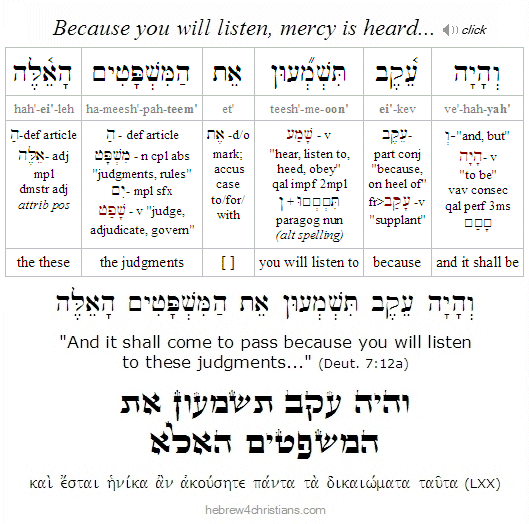
In our Torah reading for this week (i.e., parashat Eikev), Moses continues his farewell address to Israel by saying, "And because (עֵקֶב) you listen to these rules and keep and do them, the LORD your God will keep with you the covenant and the love that he swore to your fathers" (Deut. 7:12). Note that the word eikev (עֵקֶב), often translated "because," literally means "heel," which recalls Jacob (יעקב) the "heel-holder" who wrestled with the pain of his past to learn to bear the name Israel (יִשְׂרָאֵל), the "prince of God" (Gen. 32:28). And like Jacob, we must grapple to believe that the covenant of God's love and acceptance is for us, too... The Sassover rebbe interpreted the opening verse of our Torah portion, "And because you will listen..." (וְהָיָה עֵקֶב תִּשְׁמְעוּן) as, "and it shall be when your heel is ready to take a step, you will listen to your heart." This is the step of faith. As you begin to walk with God, you will come to know yourself as a child of the great King. Likewise regarding the related verse in the Torah, "Because Abraham heard my voice" (עֵקֶב אֲשֶׁר־שָׁמַע אַבְרָהָם בְּקלִי), the sages read, "Abraham heard the word 'down to his heel'" (Gen. 26:5). Like Abraham, we will hear God's voice as we walk with him by faith...
The portion begins: "ve'hayah eikev..." (Deut. 7:12). Here translators differ about how to understand the Hebrew. The JPS version, for instance, renders this as "and if you listen," whereas others render it as, "and because you listen..." The former translation makes the blessing seem conditional upon obedience, whereas the latter reading affirms that obedience leads to blessing... The Hebrew word eikev (i.e., עקב, "heel," "step"), however, refers to action, and therefore it may be regarded as a prophecy expressing faith that the blessing which God swore on oath will be fulfilled. May it be so for us, chaverim...
Click to learn the opening words of the parashah:
|
|
|
|
Blessing before Torah Study:
|
|
|
|
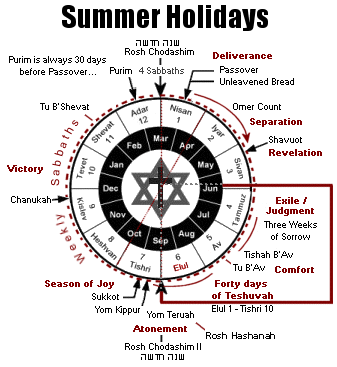
The first mention of Tu B'Av is found in the Mishnah, where Shimon ben Gamliel is quoted as saying, "There were no better (i.e. happier) days for the people of Israel than the Fifteenth of Av and Yom Kippur, since on these days the daughters of Israel go out dressed in white and dance in the vineyards. What were they saying: Young man, consider whom you choose to be your wife... (Taanit, Chapter 4).
Since it is the "last" festival of the Jewish year, prophetically Tu B'Av pictures our marriage to the Lamb of God (Seh Elohim), the LORD Yeshua our beloved Messiah. On a soon-coming day those who belong to the LORD and are faithful to follow His ways will be blessed with the unspeakable joy of consummating their relationship with Him. This is heaven itself - to be in the Presence of the LORD and to be His beloved (Rev. 19:6-9).
Tu B'Av begins Tuesday, July 28th after sundown and runs through the following day.
|
|
|
|
|
|
|
|
|
|
|
|
|
|
|
 |
|
|
|
The Last Seven Sabbaths of the Year....
|
|
|
|
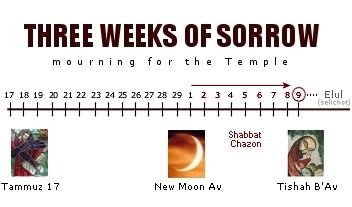
The weekly haftarah portion (i.e., reading from the Prophets) is usually thematically connected with the weekly Torah portion; however, beginning with the 17th of Tammuz until the end of the Jewish year, the connection changes. First we always read three prophetic portions of rebuke leading up to the fast day of Tishah B'Av.
Three Weeks of Sorrow:
- Divrei Yirmiyahu ("The words of Jeremiah...") - Jer. 1:1–2:3
- Shim'u Devar Adonai ("Hear the word of the LORD") - Jer. 2:4–28; 4:1–2
- Chazon Yeshayahu ("The vision of Isaiah...") - Isa. 1:1–27
After the fast of Tishah B'Av, however, and for the next seven weeks leading up to Rosh Hashanah (i.e., the new year), we read selections of comfort that foretell of the future redemption of the Jewish people and the coming Messianic Era.
Seven Weeks of Comfort:
- Nachamu, Nachamu Ammi ("Comfort, comfort, my people") - Isa. 40:1-26
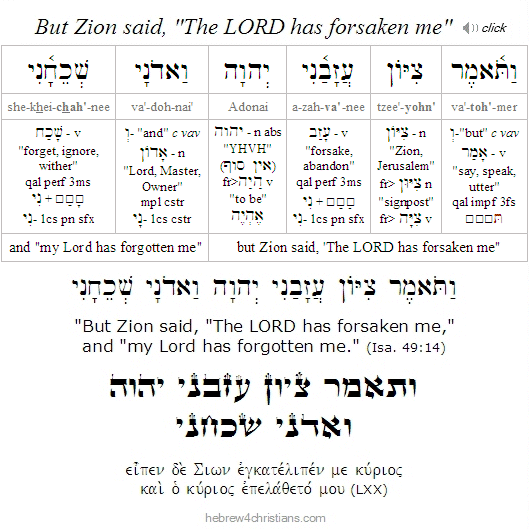
- Va'tomer Tziyon ("But Zion said...") - Isa. 49:14-51:3
- Aniyah So'arah ("O afflicted and storm-tossed") - Isa. 54:11–55:5
- Anochi, Anochi hu ("I, even I am He...") - Isa. 51:12–52:12
- Rani Akarah ("Sing, O Barren one...") - Isa. 54:1–10
- Kumi Ori ("Arise and shine..." - Isa. 60:1–22
- Sos Asis ("I will greatly rejoice...") - Isa. 61:10–63:9
Shabbat Va'tomer Tzion
As noted above, the second of the "Seven Weeks of Comfort" leading up to Rosh Hashanah is called Va'tomer Tzioyn (וַתּאמֶר צִיּוֹן, "But Tzion said..."), which reminds us to never to lose hope for thefuture of Zion (Jerusalem).... "Can a woman forget her nursing child, that she should have no compassion on the son of her womb? Even these may forget, yet I will not forget you. Behold, I have engraved you on the palms of my hands; your walls are continually before me" (Isa. 49:15-16). The Haftarah concludes by Isaiah saying that the LORD will comfort the Mountain of Zion by making it like the Garden of Eden, with joy and happiness within her, along with thanksgiving and the sound of song.
Click to learn the Hebrew text:
Note: The Month of Elul begins in a few weeks (i.e., on Wednesday, August 12th this year), which initiates the 40 day period of preparation for the Jewish High Holidays. This means that Rosh Hashanah will begin in about six weeks (i.e., Friday, September 11th at sundown). During the time leading up to the High Holidays, it is customary to engage in cheshbon ha-nefesh ("soul searching") and to derive comfort that God is forgiving and loving to those who sincerely turn to Him. The sages chose the seven "Haftarot of comfort" to encourage us to make our hearts ready for the upcoming High Holiday Season.
|
|
|
|
Blessing before Torah Study:
|
|
|
|
 |
|
|
|
 |
|
|
|
Some terms:
|
|
|
|
- Parashah is the weekly Scripture portion taken from the Torah. Each parashah is given a name and is usually referred to as "parashat - name" (e.g., parashat Noach). For more information about weekly readings, click here.
- Aliyot refer to a smaller sections of the weekly parashah that are assigned to people of the congregation for public reading during the Torah Reading service. In most congregations it is customary for the person "called up" to recite a blessing for the Torah before and after the assigned section is recited by the cantor. For Shabbat services, there are seven aliyot (and a concluding portion called a maftir). The person who is called to make aliyah is referred to as an oleh (olah, if female).
- Maftir refers to the last Torah aliyah of the Torah chanting service (normally a brief repetition of the 7th aliyah, though on holidays the Maftir portion usually focuses on the Holiday as described in the Torah). The person who recites the Maftir blessing also recites the blessing over the Haftarah portion.
- Haftarah refers to an additional portion from the Nevi'im (Prophets) read after the weekly Torah portion. The person who made the maftir blessing also recites the blessing for the Haftarah, and may even read the Haftarah before the congregation.
- Brit Chadashah refers to New Testament readings which are added to the traditional Torah Reading cycle. Often blessings over the Brit Chadashah are recited before and after the readings.
- Mei Ketuvim refers to a portion read from the Ketuvim, or writings in the Tanakh. Readings from the Ketuvim are usually reserved for Jewish holidays at the synagogue.
- Perek Yomi Tehillim refers to the daily portion of psalms (mizmorim) recited so that the entire book of Psalms (Tehillim) is read through in a month. For a schedule, of daily Psalm readings, click here.
- Gelilah refers to the tying up and covering the Sefer Torah (Torah Scroll) as an honor in the synagogue.
- Divrei Torah ("words of Torah") refers to a commentary, a sermon, or devotional on the Torah portion of the week.
|
|
|
|
 |
|
|
|
Related Topics:
|
|