|
|
 |
|
|
|
|
Weekly Torah Reading
|
|
|
|
Parashat Ki Teitzei ("When you go out")
|
|
|
Click on the links to display the Scriptures:
|
|
|
|
|
|
|
|
Torah Reading Overview
|
|
|
|
In last week's parashah (Shoftim), Moses defined a system of justice for the Israelites and pointed to the coming Messiah who would be the rightful King of Israel. In this week's portion, he returns to the immediate concern of the conquest of the Promised Land by providing a number of specific laws and instructions to be enforced regarding civil life in Israel.
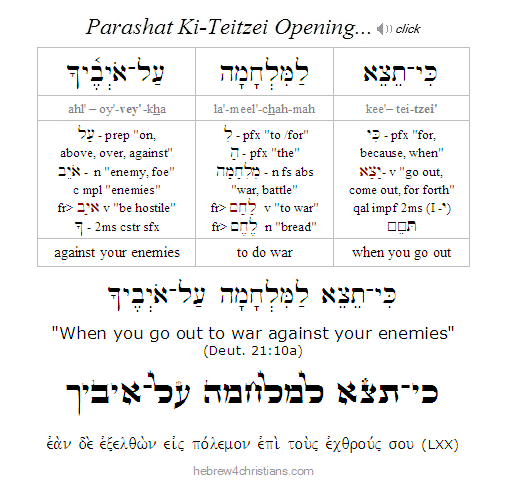
The parashah begins:
|
|
|
|
|
|
|
|
Jewish tradition identifies no less than 74 of the Torah's 613 commandments in Ki Teitzei (the most of all the Torah portions), covering a wide assortment of rules related to ethical warfare, family life, burial of the deceased, property laws, the humane treatment of animals, fair labor practices, and proper economic transactions for the people living in the Promised Land.
|
|
|
|
|
Specific topics addressed in this week's portion include treatment of females captured in war, the legal rights of the firstborn, the case of a "rebellious son," and many other subjects concerning Jewish law. A general outline of the parashah follows:
- The Beautiful Captive (21:10-14). The parashah begins with a discussion of what has been called eshet yefat-to'ar (אשֶׁת יְפַת־תּאַר), a woman of "beautiful form." If an Israelite soldier captured a female prisoner of war whom he found attractive, he was forbidden to marry her immediately, but was to have her head shaved, her nails cut, her clothes changed, and she must undergo a one month mourning period. If, after this period, the man still wanted to marry her, she was brought before the Bet Din (law court) and the judges would ask her if she was willing to convert and obey the Torah of Moses and to become a member of Israel. If she agreed, then the soldier was allowed to marry her; otherwise, he must release her from captivity.
- Inheritance Rights of the Firstborn (21:15-17). The first born son (i.e., bechor: בְּכוֹר) is to inherit a double portion from his father, regardless of the status of the mother.
- Stubborn and Rebellious Son (21:18-21). A stubborn and rebellious son (i.e., ben soreir u'moreh: בֵּן סוֹרֵר וּמוֹרֶה) who does not heed his father or mother and does not obey them even after they discipline him is to be stoned to death.
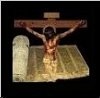
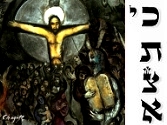
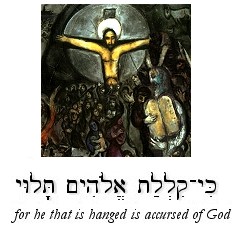
- A Man Hanged on a Tree Is Cursed (21:22-23). The Law of Moses allowed that someone who was to be executed could be hung (or impaled) and exposed "on a tree" (עַל־עֵץ), perhaps based on the precedent set earlier in the desert (Num. 25:4). According to the Talmud (Nezakim: Sanhedrin 6:4:3), the Great Sanhedrin (סַנְהֶדְרִין גְדוֹלָה) decided that "a man must be hanged with his face towards the spectators" upon a wooden stake, with his arms slung over a horizontal beam. It should be noted that while this is technically not the same thing as the gruesome practice of Roman crucifixion, the reasoning based on this verse was apparently used to justify the execution of Yeshua (Mark 15:9-15; John 19:5-7; 15). The exposed body was required to be buried before sundown to keep the land from being defiled (Deut. 21:22-23). Besides the shame and degradation of this manner of death, the one so executed would be unable to fall to their knees as a final act of repentance before God, thereby implying that they were under the irrevocable curse of God.
In this connection, we should note that Yeshua was falsely charged with blasphemy before the corrupt Sanhedrin of His day (Matt. 26:65; Mark 14:64; John 10:33) - an offence that was punishable by stoning (Lev. 24:11-16). However, since the Imperial Roman government then exercised legal hegemony over the region of Palestine, all capital cases were required to be submitted to the Roman proconsul for adjudication, and therefore we understand why the Jewish court remanded Yeshua and brought him to be interrogated by Pontius Pilate. Because Roman law was indifferent to cases concerning Jewish religious practices (i.e., charges of blasphemy), however, the priests further slandered Yeshua by illegitimately switching the original charge of blasphemy to that of sedition against Rome. The Sanhedrin undoubtedly rationalized their duplicity because the Torah allowed for an offender to impaled or "hung on a tree" (Num. 25:4), and since they were unable to do carry out this judgment because of Roman rule in the area, they needed Pilate to condemn him to death by crucifixion (Matt. 27:31; Mark 15:13-4; Luke 23:21; John 19:6,15). Note that crucifixion is mentioned elsewhere in the Talmud (Nashim: Yevamot 120b) regarding whether a widow can remarry if her husband had been crucified, as well as by the Jewish historian Josephus. The Talmud furthermore alludes to the death of Yeshua where Yeshua is said to have been crucified on "eve of Passover" (Nezekin: Sanhedrin 43a).
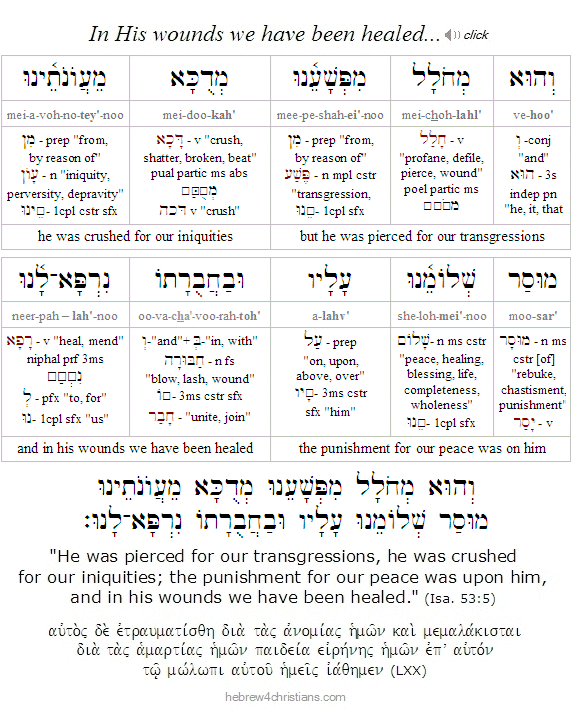
The apostles of Yeshua understood the connection between this provision in the Torah and the salvation of the LORD as a way of explaining how the substitutionary death of Yeshua satisfied God's wrath for sin on our behalf (there was no way to impute sin without also imputing its penalty). Therefore the Apostle Paul wrote, "The Messiah redeemed us from the curse of the law (קִלְלַת הַתּוֹרָה) by becoming a curse (קְלָלָה) for us - for it is written, "Cursed is everyone who is hanged on a tree" (Gal. 3:13). The Apostle Peter also had this in mind when he wrote: "The God of our fathers raised Yeshua, whom you killed by hanging him on a tree" (Acts 5:30; cp. Acts 10:39-40); and, "He himself bore our sins in his body on the tree, that we might die to sin and live to righteousness. By his wounds you have been healed" (1 Peter 2:24). And of course the prophet Isaiah foretold of the sacrfice of the "Suffering Servant" centuries before the advent of Yeshua:
וְהוּא מְחלָל מִפְּשָׁעֵנוּ מְדֻכָּא מֵעֲוֹנתֵינוּ
מוּסַר שְׁלוֹמֵנוּ עָלָיו וּבַחֲבֻרָתוֹ נִרְפָּא־לָנוּ
ve·hoo me·cho·lal mee-pe'·sha·ei'·noo me·doo·ka me·a·vo·no·tey'·noo
moo·sar she·lo·mei'·noo a·lav oo·va·cha·voo·ra·to neer·pa- la'·noo

"But he was pierced for our transgressions, he was crushed for our iniquities,
the correction of our peace was upon him, and by his wound we are healed"
(Isa. 53:5)
 |
- Miscellaneous Instructions (22:1-12). One should return all lost articles to their rightful owners, thus loving your neighbor as yourself (Lev. 19:18; 34). To promote safety, one should build a railing around his roof. Sha'atnez (שַׁעַטְנֵז) is any fabric made of wool mixed with linen (כִּלְאָיִם), and is prohibited to be worn. A Jew should also wear Tzitzit on the four corners of his garments.
- Laws regarding Sexual Immorality (22:13-20). A man who falsely accuses his bride of being unfaithful to him before their marriage is to receive lashes and a fine. If the charges prove correct, however, the wife is to be stoned. If a woman commits adultery, both she and the man involved are to be killed. Fornicators should be stoned to death, though victims of sexual assault are to be spared while the perpetrator should be killed. One should not marry his father's wife.
- Those Excluded from the Assembly (23:1-7). Neither Ammonites nor Moabites were allowed to join the assembly of the LORD.
- Various Additional Laws (23:8-25:16). Moses gave a number of additional laws that are to be observed as part of the new Jewish society, including rules about maintaining the purity of the camp; prohibitions about returning an escaped slave; the duty to pay a worker on time; the proper treatment of a debtor and the prohibition against charging interest on a loan; the laws of divorce; the penalty of 39 lashes for transgression of a Torah prohibition; and the procedures for yibbum (יִבּוּם), or "levirate marriage," of the wife of a deceased childless brother. The degrading chalitzah (חֲלִיצָה) ceremony ("removing of the shoe") is explained for the case of a brother-in-law who is unwilling to marry the wife of his deceased brother.
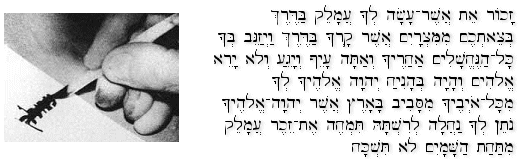
- Remembering Amalek (25:17-19) The parashah ends with the people being instructed to remember the deeds of Amalek who attacked the Jews when they were weak. They are told that they must "blot out the remembrance of Amalek from the earth." To this day, a sofer (scribe) will test his quill by writing the word "Amalek" and then crossing out the word with one bold stroke and then vigorously scraping both the stroke and the offending name from the parchment:
|
|
|
|
The perpetual enemy of God is called "Amalek" (עֲמָלֵק), a name that begins with Ayin (symbolizing the eye) and whose value (in gematria) is 240 -- the same value for safek (סָפֵק), the Hebrew word for doubt. Amalek therefore suggests "the eye of doubt," or even "the severed eye" (the Hebrew verb מָלָק means "to chop" or "sever" in reference to the "eye" of Ayin). Unbelief is a spiritual blindness that makes it impossible to see the path of blessing....
Unlike the doubtful Amalek, we walk in emunah (faith) with ayin ha-tovah ("the good eye") of trust. And we must be unflinching in our devotion to the truth, chaverim.
|
|
|
|
|
|
|
|
|
|
 |
|
|
|
Haftarah Reading Overview
|
|
|
|
The Haftarah of Ki Teitzei is called the fifth of the "Haftarot of Consolation," offering encouragement to Israel even in the face of exile.
In this beautiful and poignant reading, the LORD compares the children of Israel to a wife who has long been barren. According to the sages, God tells the "Wife of His youth" to sing out with joy, for soon she will have a hard time keeping track of all her children! Many will return by means of a mighty wave of repentance that will sweep over the world when Jerusalem is finally redeemed and the Mashiach reigns in Israel.
Though the LORD hardened Israel for a season (Rom. 11:25-29), His love for her is sure, and all His promises will be established. In the End of Days all Israel will be saved, in times "like the days of Noah." But just I God swore that the waters of Noah should no more go over the earth, so He has sworn that Israel will be regathered and restored:
כִּי הֶהָרִים יָמוּשׁוּ וְהַגְּבָעוֹת תְּמוּטֶנָה
וְחַסְדִּי מֵאִתֵּךְ לא־יָמוּשׁ
וּבְרִית שְׁלוֹמִי לא תָמוּט
אָמַר מְרַחֲמֵךְ יְהוָה
kee he-hah·reem yah·moo·shoo ve·ha·ge·vah·oht te·moo·te·nah
ve·chas·dee me·ee·tekh loh yah·moosh
oo·ve·reet she·loh·mee loh tah·moot
ah·mar me·ra·cha·meikh Adonai
"For the mountains may depart and the hills be removed,
but my steadfast love shall not depart from you,
and my covenant of peace shall not be removed,"
says the LORD, who has compassion on you"
(Isaiah 54:10)
|
|
|
|
|
|
|
Brit Chadashah Overview
|
|
|
|
The two passages from the Brit Chadashah show that both the LORD Yeshua and the Apostles reaffirmed the teachings of the Torah regarding sexual immorality. Adultery and a lustful heart seriously endanger the soul and can lead one to eternal perdition.
Blessing:
|
|
|
|
 |
|
|
|
|
|
Related Discussion:
|
|
|
|
|
|
|
Hebrew Audio Files:
|
|
|
|
|
Click the following links to hear the desired chapters read from this week's Torah:
|
|