|
|
 |
|
|
|
|
Weekly Torah Reading
|
|
|
|
Parashat Beshalach ("when he sent away")
|
|
|
Click on the links to display the Scriptures:
|
|
|
|
|
|
|
Crossing the Sea...
|
|
|
|
Last week's Torah portion (Bo) told how the Pharaoh refused to listen to Moses' pleas for freedom, even after experiencing the greater power of YHVH as revealed in the multiple signs and wonders shown in Egypt. Finally the plague of the death of the firstborn caused Pharaoh to relent, and the LORD instituted the sacred time of Passover to commemorate the power of His deliverance by the blood of the lamb.
Parashat Beshalach opens:
|
|
|
|
|
|
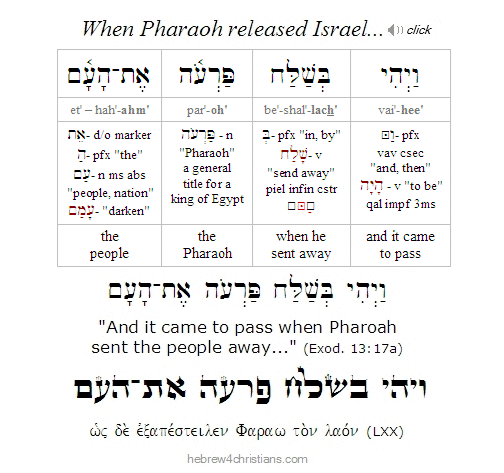
When Pharaoh let the people go, God did not lead them by way of the land of the Philistines, although that was near. (Exodus 13:17a)
|
|
|
|
After the Israelites finally left Egypt, the LORD did not lead them along the most direct route to the land of Canaan (through territory occupied by the Philistines), but rather toward Yam Suf - the Sea of Reeds. The LORD led the way for the Israelites in a Pillar of Cloud (עַמּוּד עָנָן) by day and a Pillar of Fire (עַמּוּד אֵשׁ) by night, and had them "turn back" from Etham toward Egypt to encamp before Baal-Tzefon (בַּעַל צְפן) - an Egyptian idol - by the Red Sea, so that Pharaoh would be led to believe that the Israelites were lost in the wilderness (according to midrash, this idol - the only one that remained undestroyed after God sent the tenth plague upon Egypt - was intentionally spared by God in order to "bait" Pharaoh into thinking that the God of Israel was powerless over him).
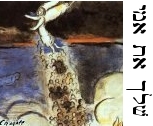
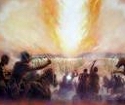
After Pharaoh learned of Israel's position, however, he hardened his heart yet again, and led his army to force the Israelites to return to their life of bondage. When the Egyptian calvary caught up to them, the Israelites were trapped against the sea, and the people were terrified that they were to be slaughtered. God then moved the Pillar of Cloud so that it stood between the Egyptians and the Israelites. The Cloud grew black and the Egyptian cavalry could no longer see the Israelites. Meanwhile, a Pillar of Fire appeared in front of the people, lighting their way. Moses then raised his staff and a strong east wind blew and divided the waters, forming a wall of water on the right and left, and the Israelites began to cross safely.
|
|
|
|
|
|
According to Midrash, the sea formed a "tent" over the heads of the Israelites, protecting them on all sides. Moreover, the waters divided into twelve tunnels, one for each tribe. The walls of the water were perfectly clear, like translucent glass, so that the tribes could see one another as they crossed.... Another midrash says that all of the waters of the earth split at the same time as the Sea of Reeds - including rivers and lakes around the world.
|
|
|
|
|
At any rate, by daybreak all of the Israelites had safely reached the other side, and the Pillar of Cloud lifted. The Egyptians then began to follow in pursuit, but the ground beneath them turned to mud and the wheels of their chariots became stuck (this is considered retribution for forcing the Israelites to make bricks of mortar without straw). As the Egyptians attempted to retreat, Moses stretched out his staff and the wall of waters collapsed over them. The Israelites watched in awe as the waters engulfed all of Pharaoh's mightiest warriors. There were no survivors.
Once the Israelites saw that their tormentors were destroyed, Moses and Miriam led the people in the "Song of the Sea," a spontaneous hymn of praise and thanks to the LORD. (Josephus reports that the Israelites armed themselves with weapons that were salvaged on this occasion). Miriam led Israel in a dance of victory, "Sing to the LORD, for he has triumphed gloriously; the horse and his rider he has thrown into the sea."
Hebrew Lesson
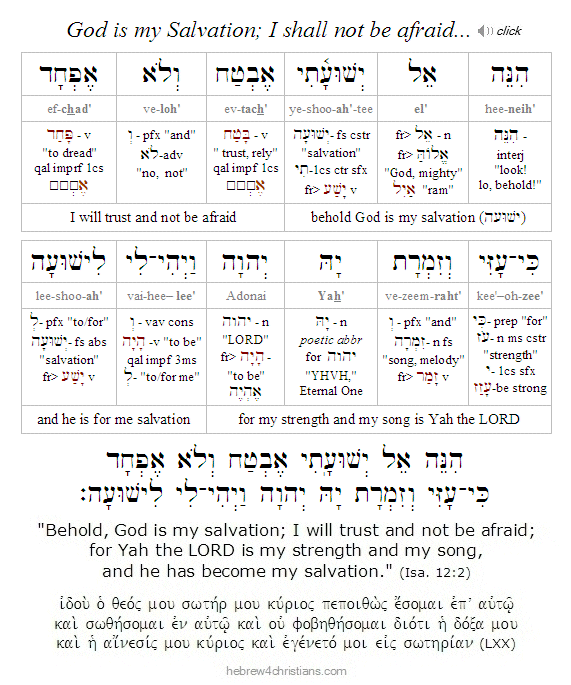
Isaiah 12:2 Hebrew reading (click):
 |
The LORD then led the people away from the sea, into the desert. Soon, however, the bitter reality of their journey in the wilderness eventually caused the people to complain to Moses. After three days without finding water, the Israelites finally arrived at Marah ("bitter"), a place where the water was undrinkable. The people complained and Moses asked the LORD for help. The LORD then showed Moses a tree which he was to throw in the bitter waters to make them "sweet" (i.e., suitable for drinking). There the LORD told Israel He would be their Healer (Adonai Rofekha). From Marah the people traveled south to an oasis named Elim (אֵילִמָה) where there were "twelve springs of water and seventy palm trees." Perhaps Elim was a foretaste of olam haba, the world to come, when healing will be for all Israel as well as for the 70 nations of the earth (Rev. 22:2).
Hebrew Lesson
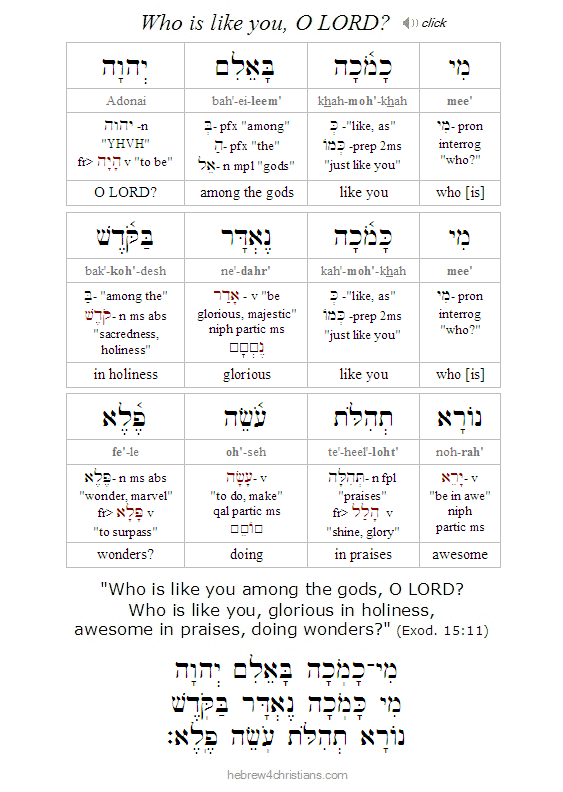
Exodus 15:11 Hebrew reading (click):
 |
Exactly one month after the Exodus (i.e., Iyyar 15), the LORD led the Israelites from Elim into the deeper part of the desert, to midbar Sin (מִדְבַּר־סִין), a desolate region that was about midway to Sinai going southeast (Exod. 16:1). About this time the matzah that the Israelites brought with them ran out. The lack of food made them wish they had died among the "fleshpots" of Egypt. The people again began to complain to Moses. After Moses prayed, the LORD declared that He would cause "bread to rain" from heaven and would test whether the Israelites would obey His torah. In the evening, quails came to the camp, providing the people with meat; in the morning, the ground was covered with manna (bread from heaven). The Jews were commanded to each gather no more than an omer (approximately four pints) of manna per day; however, on the sixth day, they were told to gather a double portion so that they would have it on Shabbat, when work was prohibited (a foretaste of the Ten Commandments).
According to midrash, when Moses first instructed the people to gather a double portion on Friday to prepare for Shabbat, Dathan and Abiram wanted to prove him a liar and rose early Shabbat morning to secretly scatter manna on the ground. However, the birds came and ate it all up and when the Israelites went out to gather manna, they could not find any (an old custom in synagogue is to scatter bread on Shabbat Shirah, in memory of the birds). Another midrash says that the double portion of manna that fell on Friday had a better taste and smell than the manna that fell on the other days. It also would not rot like any leftover manna collected on other days. The manna was said to have had no taste, but was entirely a product of aroma (the Mem and Nun are both nasal letters in Hebrew): If a person was righteous, the food was said to taste heavenly, but if they were unbelieving or complaining, it was said to taste entirely bland. Aaron later preserved a small quantity of manna in a jar, as a testimony for future generations.
As the people continued traveling through the desert, they arrived at Rephidim (near Mt. Horeb) and complained that they were running out of water. Some even threatened to stone Moses to death. Moses then asked the LORD for help and was instructed to take the leaders outside the camp to watch him strike a rock with his staff (according to Midrash, God wanted witnesses to confirm that there had been no well there all along). When he did, fresh water flowed forth and the people were refreshed. The name of the place was called "Massah and Meribah" (מַסָּה וּמְרִיבָה) - "testing and arguing" - because there the Israelites tested God and argued with Moses. Note that 40 years later, at Kadesh, Moses would strike the rock twice (Num. 20:7-11), a sin that dishonored the true Rock, Mashiach (1 Cor 10:1-5), and would cost him entry into the land of Promise.
The parashah ends with the unprovoked attack of a warlike and nomadic tribe called the Amalekites while Israel camped at Rephidim (Amalek may have been a grandson of Esau and chief of an Edomite tribe (Gen. 36:12, 16), though he is also described as "first among the nations," perhaps predating the time of Abraham (Gen. 14:7, Num. 24:20)). Joshua (יְהוֹשֻׁעַ), Moses' assistant, was put in charge of the defense of Israel. Moses ascended a hilltop with Aaron and Hur (thought by some to be Miriam's son from Caleb). As the battle raged, whenever Moses held up his hands, the Israelites prevailed, but when he tired, they began to lose. Aaron and Hur then had Moses sit down and held his arms up for him. By sunset, Joshua had defeated the Amalekite armies. The LORD then vowed to one day wipe out the descendants of Amalek. (To this day, the soferim blot out the name Amalek to test their quill before writing a Torah scroll, and the Amalekites are regarded as the perpetual enemies of Israel. Some regard Haman, Hitler, and other anti-Jewish people as "Amalekites"). To commemorate the victory, Moses built an altar and called it Adonai Nissi (יהוה נִסִּי), "The LORD is my Standard (or Banner)," in commemoration of his raised arms as a sign for God's sustenance of Israel (note that "hand upon the throne (עַל־כֵּס)" [v. 17:16] could be rendered as "hand upon the standard" (עַל־נֵס) through copyist error).
The LORD commanded Moses to record the incident and impress its occurrence upon Joshua (who would lead the people into the Promised Land). Because of their treachery in attacking the Israelites, the tribe of Amalek (a type of "carnal man" or lower nature) was to be totally destroyed and its memory eradicated.
Hebrew Lesson
Exodus 17:16 Hebrew reading (click):
 |
|
|
|
|
|
Haftarah Reading Overview
|
|
|
|
The Haftarah for parashat Beshalach concerns the leadership of the prophetess Deborah (דְּברָה), during the murky period of history when the judges (שֹׁפְטִים) ruled Israel.
It was Deborah's practice to sit beneath a certain palm tree (תָמָר) between Ramah and Bethel where the people would come to seek justice and a verdict from heaven. One day she sent for a man named Barak (בָּרָק), telling him that the LORD commanded him to take an army of ten thousand to Mount Tabor (הַר תָּבוֹר) where he would rout the Canaanite army of King Jabin. Barak, however, refused to go unless she accompanied him. She agreed, but foretold that because of this, Sisera (the chieftain of the Canaanite army) would be felled by the hand of a woman and not by Barak.
Deborah then went to Kadesh and Barak assembled an army of 10,000 Israeli warriors. When Sisera heard the news, he arrayed 900 iron chariots and a large Canaanite army to meet them at Mt. Tabor. As Deborah had foretold, the LORD routed the armies of Sisera and no Canaanite soldier escaped the edge of the sword; however, Sisera escaped on foot and hid himself in the tent of Yael (יָעֵל), a Kenite woman (i.e., a descendant of Moses' father-in-law Jethro, the Midianite). When Sisera fell asleep exhausted, Jael drove a tent peg through his temple and he died. The Israelites then went on from the main battlefield into the territory of King Jabin, razing the inhabitants until King Jabin himself was killed.
On the day of their victory, Deborah and Barak sang a song of victory to the LORD (commonly referred to as the "Song of Deborah"). Because of Deborah's courageous leadership, Israel then experienced quiet for 40 years.
|
|
|
Brit Chadashah Overview
|
|
|
|
|
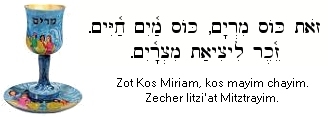
There are a number of parallels between the Torah portion and the selection from the Gospel of John. For example, Yeshua's power over water (i.e., walking on water) alludes to the miraculous crossing of the Sea of Reeds; Yeshua calling Himself the "Living Bread" and the "Bread of Life" alludes to the giving of the manna; and Yeshua's statement that all who believe in Him shall never thirst alludes to the miraculous flow of water at Rephidim, and so on. Indeed it is fascinating to note that the Apostle Paul correlated this life-giving Rock (renamed the "Well of Miriam" in later Jewish tradition) with the Messiah (1 Cor. 10:4). In other words, Yeshua Himself was the Source of Life for the Israelites as they wandered in the wilderness of Sinai. He was the Living Waters then, just as He is today.... The Cup of Miriam we use at our Passover Seder, then, commemorates the Presence of Yeshua as the Jews trekked their way to the Promised Land. Paul draws further analogies to warn the Corinthians against the sin of idolatry (1 Cor. 10:1-5).
 |
אָנכִי לֶחֶם חַיִּים הַיּרֵד מִן־הַשָּׁמַיִם
אָדָם כִּי־יאכַל מִלֶּחֶם הַזֶּה וָחַי לְעוֹלָם
a·noh·khee · le'·chem · cha'·yeem · ha-yo·reid · meen - ha-sha·ma'·yeem:
ah·dam · kee - yoh·khal · mee·le'·chem · ha·zeh, va·chai · le·oh·lahm

"I am the living bread that came down from heaven.
If anyone eats of this bread, he will live forever" (John 6:51)
Download Study Card
Blessing:
|
|
|
|
 |
|
|
|
|
|
For Further Study:
|
|
|
|
|
|
|
Hebrew Audio Files:
|
|
|
|
|
Click the following links to hear the desired chapters read from this week's Torah:
|
|