|
On the Biblical calendar the month of Adar (אֲדָר) is the last month of the year counting from Nisan (though on the civil calendar it is the sixth month counting from Tishri). The month usually falls during February/March on the secular calendar. Adar has 29 days in ordinary years, though it has 30 days during "leap years," that is, on years with an additional month added to the Jewish calendar. When this happens, Adar is appended by an additional month called Adar Sheni ("Second Adar"), Adar Bet ("Adar Two"), and sometimes Ve'adar ("Additional Adar"). Confused? Always consult a good Jewish calendar!
The 14th day of the last month of the year (i.e., either Adar or Adar Sheni) marks the festive holiday of Purim, which is always celebrated a month before Passover (Megillah 1:4). During both Purim and Passover we celebrate God's deliverance of His people, and therefore Adar is considered one of the happiest of the months of the Jewish year. As it is written in the Talmud, "When Adar comes, joy is increased" (Ta'anit 29a).
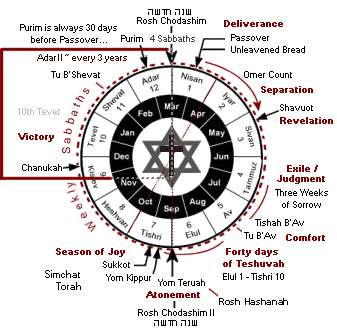 |
Like the month of Elul (i.e., the month that precedes Rosh Hashanah and the New Year in the fall), the last month of the Biblical calendar is traditionally a time to make "New Year's Resolutions" and to turn away from sin before the start of the New Year of spring (i.e., Rosh Chodashim). The month of Adar is therefore a season given to us each year to begin preparing for the holiday of Passover.
Determining a Jewish Leap Year
A Jewish leap year contains 54 weeks, but a non leap year has only 50 weeks (a leap-year adds an additional month (called Adar II) to the usual 12). To determine whether a given Jewish year is a leap year, you will need a calculator that includes the mod() function. Enter the Jewish year and then perform mod 19. If the result is either 0, 3, 6, 8, 11, 14, or 17, then it is a Jewish leap year. For example, 5775 mod 19 is 18, and therefore it is not a Jewish leap year....
The Four Sabbatot (four Sabbaths)
Traditional Judaism defines a "special Sabbath" as one that precedes (or coincides with) a Jewish holiday during the year. Four special Sabbaths occur just before the start of spring (i.e., Nisan 1), two before Purim and two before Passover. Collectively, these four Sabbaths are called "The Four Shabbatot" and additional Torah readings (Arba Parashiyot - four Torah portions) are read that relate to these two holidays. The names of these Sabbaths are Shabbat Shekalim, Shabbat Zakhor, Shabbat Parah, and Shabbat HaChodesh. For more information about special Sabbaths, click here.
The Date for Purim
The holiday of Purim is celebrated on the 14th of Adar, the day after Haman's roll of the dice indicated that the 13th of Adar was most "propitious" for the extermination of the Jews. It is celebrated on the day after since it was on this day that the Jews successfully fended off their enemies and experienced the joy of deliverance (in Israel, Purim is observed a day later still (i.e., on Adar 15th) and is called Shushan Purim). The reason for these different dates of the festival of Purim is that the Jews of Shushan waged war on both the 13th and the 14th of Adar and observed the 15th as a day of festivity and rejoicing, but in the other provinces the Jews waged war on the 13th and observed the 14th as the day of rejoicing. Jews in Israel identify with the Jews of Shushan, and hence its celebration is called "Shushan Purim."
Since Purim must occur in the month immediately preceding Passover, on leap years (i.e., years when there is an additional month of Adar inserted into the calendar), Adar I is considered the "extra month," not Adar II. In such a case, Purim is celebrated on the 14th of Adar II (called Adar Sheni), while the 14th of Adar I is called Purim Katan ("little Purim"), a minor holiday. Likewise, anniversaries of important occasions that occurred in Adar of a non leap year are observed a month later, during Adar II, during leap years....
|