|
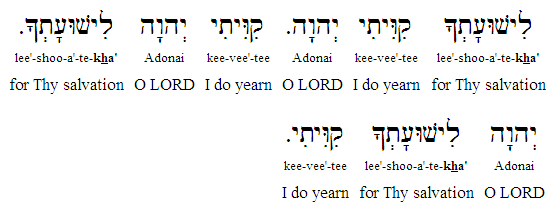
"For Thy salvation I do yearn, O LORD; I do yearn, O LORD, for Thy Salvation.
O LORD for Thy salvation I do yearn."
Orthodox Jewish Views of Resurrection
"Those who are born are destined to die, and those who die are destined to live" (Pirkei Avot, 4:22).
The concept of the bodily resurrection of the dead goes back to primordial Jewish history, perhaps to Chavah's (Eve) reaction to the death of her son Hevel (Abel) but certainly to Abraham's faith that God would raise Isaac from the dead after offering him up as a burnt offering (Genesis 22:1-14; Hebrews 11:17-19).
Among Orthodox Jews it is maintained that the resurrection of the dead will occur in the Messianic age, when the righteous dead will be brought back to life and given the opportunity to experience the perfected world (in Israel) that their righteousness helped to create. The wicked dead will not be resurrected.
Those buried outside of Israel will somehow be transported to the land, though it is preferable to be buried in the land of promise. This explains why Joseph wanted his bones to be taken from Eygpt to Israel (Hebrews 11:22). (The Midrash (Devarim Raba 11:9) says that Moses was buried outside of Israel, so that at the time of the Messiah, he will serve as a "merit" to make things easier for everyone else buried outside the land to come.) Cremation is considered to be heretical, since the destruction of the bones (and especially the "luz bone") makes the reconstitution of the body somehow more difficult.
Faith in the bodily resurrection of the dead is a major doctrine of Orthodox Judaism. In fact, the second blessing of the Amidah (Gevurot), recited no less than three times a day by observant Jews, clearly references the resurrection of the dead.
Christian Views of Resurrection
The resurrection of the dead (techiyat ha-metim) is of paramount importance for the Christian faith, and faith in the bodily resurrection of Yeshua from the dead is a touchstone of saving faith. The Scriptures make clear that Yeshua is the true Passover Lamb of God (שֵׂה הָאֱלהִים) whose sacrificial death and shed blood causes the wrath of God to "pass over" (pasach) those who are trusting in Him (John 1:29, 3:36; Acts 8:32-36; 1 Cor. 5:7-8; 1 Pet. 1:18-20, etc.). Worthy is the Lamb who was slain! (Rev. 5:12). But while the sacrifice of Yeshua gives us atonement (כַּפָּרָה) with God, the resurrection of the Messiah (i.e., techiyat ha-Mashiach: תְּחִיַּת הַמָּשִׁיחַ) justifies His work of salvation on behalf of the sinner and forever vindicates the righteousness of God.
Why the Resurrection?
- The resurrection reveals that God accepted the sin offering of Yeshua on our behalf (Isa. 53; Heb. 9:11-14; 1 Pet. 1:18-20; 2:21-25; 2 Cor. 5:21). When God raised up Yeshua from the dead, He "absolved" the Substitute of the sins He bore. The sin imputed to Him was "left in the grave," so to speak, and the resurrection therefore confirms Yeshua's triumphant word, tetelestai: "It is finished" (John 19:30; Matt. 27:50). The resurrection declares that the King of all kings has pardoned you and constitutes proof that God has accepted Messiah's payment for your sins.
- The resurrection is God's vindication of His Son, His message, and His work (Acts 2:23-24, 32-33, 36). The resurrection demonstrates that Yeshua is indeed the Savior of the world and God the Son (Rom 1:3-4). Yeshua was "declared with power to be the Son of God by his resurrection from the dead." This vindication is a response of God's righteousness. Because the Messiah willingly humbled Himself to become our vicarious sin-offering, God raised Him from the dead and exalted His Name forever (Phil. 2:9-11; Acts 4:12). The vindication of Yeshua declares that you are likewise vindicated on account of His merit...
- The resurrection is evidence of eternal life. "We know that Messiah being raised from the dead will never die again, death no longer has dominion over Him. The death He died to sin once for all, but the life He lives, He lives to God" (Rom. 6:9-10). It sometimes seems as if death is ever-present and that the universe itself is a cosmic graveyard, but Yeshua has overcome the power of death as evidenced by His resurrection from the dead. Indeed, Yeshua has given new life to life itself - He has become the "Author of Eternal Salvation" for those who obey Him (Heb. 5:9). You receive eternal life (חַיֵּי עוֹלָם) through the resurrected life of Yeshua - from the living LORD of Glory -- not from a dead Savior! Moreover, the resurrection is a logical corrollary of Yeshua's indestructible life. He is YHVH come in the flesh -- the Word of God (דְּבַר אֱלהִים) that is the creative Source of the universe. Yeshua our Messiah is called the Aleph and the Tav (הָאָלֶף וְהַתָּו), "the first and the last" (הָרִאשׁוֹן וְהָאַחֲרוֹן). These are clearly divine Titles that belong to YHVH (יהוה) alone (Isa. 41:4, 44:6, 48:12; Rev. 1:1,17-18; 22:13). The very life of God cannot die, and the resurrection is therefore a necessary corrolary of God's existence...
- The resurrection demonstrates God's victory over death (Acts 2:24-32). Yeshua did not suffer the natural process of corruption (i.e., decomposition of the body). His body did not "return to dust," i.e., the very curse given to Adam and Eve (Gen. 3:19; Psalm 16:10). "And God raised Him up again, putting an end to the agony of death, since it was impossible for Him to be held in its power" (Acts 2:24). God the Father vindicated Yeshua by raising His body from the "dust of death," thereby overcoming death's grip on humanity. Now the "dead shall live and their bodies shall rise from the dust" to sing for joy (Isa. 26:19). The resurrection of Yeshua is prophetic of the day when you shall likewise shall be transformed, "in the twinkling of an eye," from corruptible to incorruptible life (1 Cor. 15:52).
- The resurrection fulfills various prophecies. I give only a partial list here. The Akedah of Isaac (Gen. 22) was a prophetic picture of the gospel message itself. Not only did Abraham offer his "only begotten son" upon the altar of Moriah, but he believed in Isaac's resurrection (Heb. 11:17-19). There are various midrashim that claim that Isaac actually was actually killed upon the altar and his blood became part of the altar's ashes. Abraham then received him back from the dead.

The prophet Job believed in the resurrection of his Redeemer (Job. 19:25). King David foresaw the Messiah's resurrection when he wrote: "For you will not abandon my soul to Sheol, or let your holy one see corruption" (Psalm 16:10, cp. Acts 2:29-33). This was in keeping with the prophecy that the line of David would continue forever (2 Sam. 7:12-16; Psalm 2:6; 89:27; 110:1; Isa. 9:6-7; Dan. 7:14). Isaiah the prophet stated that the Messiah would be a "light to the nations" and have worldwide impact (Isa. 49:6). The prophet Jonah was regarded as "sign" or picture of the Messiah (Matt. 12:39-40; 16:4) and the prophet Hosea likewise alluded to the resurrection (Hosea 6:1-2). And of course Yeshua repeatedly foretold of His death, burial, and resurrection (Matt. 16:21; 20:18-19; Mark 8:31; 9:31; John 2:19-22). "Destroy this temple [i.e., His body] and in three days I will raise it up."
- The resurrection imparts God's justification in response to our faith. Yeshua "was delivered for our offenses and raised again for our justification" (Rom. 4:25). Abraham's faith was the basis of his justification before God (Gen. 15:5-6, Rom. 4:19-20; Heb. 11:17-19). Believing that God raised Yeshua from the dead imputes justification to the soul (Rom. 10:9). Our justification is achieved by the Messiah's victorious resurrection (Rom. 4:25; 5:18). Faith in the resurrection implies that we believe that the death of Yeshua fully accomplished the work of atonement. "He shall lay his hand on the head of the burnt offering, and it shall be accepted for him to make atonement for him" (וְנִרְצָה לוֹ לְכַפֵּר עָלָיו / Lev. 1:4). We are literally saved "by His Life," that is, the resurrected life of the Messiah (Rom. 5:10). The reality of our justification, as attested by the resurrection, gives us boldness to come before God without fear of judgment (Heb. 4:16).
- The resurrection reveals God's love and grace. If Yeshua was not raised from the dead, our faith would be empty of real hope (1 Cor. 15:13-19). Apart from the resurrection, the sacrificial death of the Messiah would not result in reconciliation and love. "For if while we were enemies we were reconciled to God by the death of His Son, much more, now that we are reconciled, shall we be saved by His life" (Rom. 5:10). Because of the resurrection, God has "blessed us with every spiritual blessing in heaven" and adopted us as His children (Eph. 1:3,5; 5:1). God Himself is now our Advocate and Helper (Rom. 8:31-34). The exalted Messiah now lives to make intercession for us (Heb. 7:25, 9:24; 1 John 2:1). We are more than conquerors because of the greatness of our risen Lord and Savior (מוֹשִׁיעַ)!
- The resurrection is part of the Gospel message itself (1 Cor. 15:3-4). We were dead in our transgressions and sins, eternally lost apart from Messiah's death, burial, and resurrection (Eph. 2:1-10). The resurrection represents "the power of God unto salvation" (Rom. 1:16). As the Apostle Paul wrote, "... to be found in him, not having a righteousness of my own that comes from the Torah (תּוֹרָה), but that which comes through trusting in Messiah (אֱמוּנַת הַמָּשִׁיחַ), the righteousness that comes from God based on faith (הַצְּדָקָה מִמְּקוֹר אֱלהִים בָּאֱמוּנָה), so that I may know Him and the power of his resurrection..." (Phil. 3:8-10). The Gospel is far more than "Jesus died for my sins." No, there simply is no "gospel" message (בְּשׂוֹרָה) apart from the living reality and overcoming power of the resurrected LORD!
- The resurrection is your eternal life (חַיֵּי עוֹלָם) in the Messiah. "I am the resurrection and the life; he who believes in Me shall live even if he dies, and everyone who lives and believes in Me shall never die. Do you believe this?" (John 11:25-26). Yeshua is the "God of the living" (Matt. 22:23-33) who imparts an ontologically new kind of life: "Because I live, you shall live also" (John 14:19). This is not a renewed life, but rather an entirely new, supernatural, and resurrected life (Phil 3:10). Paul also had a personal encounter with the resurrected Messiah on the road to Damascus that radically changed his direction (teshuvah). If anyone is "in the Messiah" he is called briah chadashah (בְּרִיאָה חֲדָשָׁה), a "new creation." The old has passed away, behold - all things are made new (2 Cor. 5:17). The resurrection of Yeshua restores all of creation by means of His faithful obedience as the "Second Adam" (Rom. 5:12-19; 1 Cor. 15:45). Our union with the Messiah in His death, burial, and resurrection enables us to "walk in newness of life" (Rom. 6:4). The very power that raised Yeshua from the dead dwells in you (Rom. 8:11). The miracle of new life is "Messiah in you - the hope of glory" (Col. 1:27). Ultimately the goal of salvation was not simply to save us from the power of sin and death, but to unite us with God in eternal love.
- The resurrection represented Yeshua's re-ascension to the right hand of the Throne of God. His incarnation was His infinite descent into the realm of "no reputation" (i.e., kenosis, "emptying") by taking on the form of a servant who suffered as a criminal (Phil. 2:7-8). "Though he was crucified through weakness, yet He now lives by the power of God" (2 Cor. 13:4). His resurrection amounted to a reinvestment of His original glory: "Therefore God has highly exalted him and bestowed on him the name that is above every name" (Phil. 2:9). Yeshua came as a Lamb -- he was born to die as our Sacrifice -- yet He is now the Risen King of Glory (מֶלֶךְ הַכָּבוֹד) with all authority in heaven and earth (Phil 2:9-11; Matt. 28:18). The Apostle John's vision of the resurrected LORD reveals His glory as God Almighty, the LORD of all possible worlds (Rev. 1:13-18).
- The Resurrection likewise reveals that Yeshua is the LORD of Satan. Every knee shall bow to Him - including the knee of the devil... Yeshua triumphed over the powers of darkness at the Cross by openly disarming them (Col. 2:14-15). The evil one mistakenly thought he had vanquished the Messiah at Calvary, but he misjudged the divine plan and the nature of the Savior. Yeshua came to destroy the works of the devil (Heb. 2:14, 1 John 3:8). The very malice used to accuse us was the means by which Yeshua overruled the devil. His resurrection vindicated God's judgment and established Yeshua as the LORD over the "law of sin and death" (תּוֹרַת הַחֵטְא וְהַמָּוֶת). Because Yeshua's life is indomitable, He emerged victorious when he had been seemingly "conquered" at the Cross. His resurrection "turned the tables" on the evil one by conquering and undoing the power of death in return.... The resurrection assures us that the devil, sin, and death can have no real power over us, since they have no power over the Messiah, who bore them for us but triumphed. For the follower of Yeshua, ein od milvado (אֵין עוֹד מִלְבַדּוֹ), there is no real power apart from God.
- Likewise, the resurrection demonstrates that God is LORD over the law's judgment of sin (and therefore death). Yeshua's death as our Sin-bearer before the Law's verdict was answered by the power of the resurrection (Col. 2:13-14). "The sting of death is sin, and the power of sin is the law" (1 Cor. 15:56). Once Yeshua made satisfaction for sin and obeyed the Law, He rendered death powerless. God's love overcomes the law's verdict (and God's wrath) by bearing it on our behalf. Yeshua's victory over the law is the victory of God's ransoming love. The resurrection ensures that the sacrifice made by God to God was one where justice and mercy kiss (Psalm 85:10). We are now free to serve God according to the "law of the Spirit of Life in Yeshua" (תּוֹרַת רוּחַ הַחַיִּים בְּיֵשׁוּעַ) -- apart from the "law of sin and death" (תּוֹרַת הַחֵטְא וְהַמָּוֶת) -- by means of the resurrection power of God's life within our hearts.
- The resurrection makes us alive together with the Messiah. Because of Yeshua, we are able to live on a different level of reality, free from the law of sin and death (Rom. 7:4, 8:2). We have a new covenantal connection with God. "And you who were dead in trespasses and in the uncircumcision of your heart, God made alive together with the Messiah by having forgiven us all our trespasses, having canceled the handwriting which was standing against us with its regulations; this He set aside, by nailing it to the cross" (Col. 2:13-14). The record of our sin is canceled, set aside, and nailed to the cross. By doing all these things God has made us alive with Yeshua. This is "the exceeding greatness of his power (גְּבוּרָה) toward us who believe, according to the working of his mighty power that he worked in Messiah when he raised him from the dead and seated him at his right hand in the heavenly places" (Eph. 1:19-20). God has "made us alive together with the Messiah" (συνεζῳοποίησεν τῷ χριστῷ) through the resurrection (Eph. 2:5; Col. 2:13). Our union (oneness) with the Messiah means that we are "married to Him" in the spirit. "Likewise, my brothers, you also have died to the law through the body of Messiah, so that you may belong to another, to him who has been raised from the dead, in order that we may bear fruit for God" (Rom. 7:4). We are "raised with him through faith in the powerful working of God, who raised him from the dead" (Col. 2:12).
- The Resurrection demonstrates that the LORD Yeshua is Judge of the Living and the dead (שׁפֵט הַחַיִּים וְהַמֵּתִים, see John 5:22; Acts 10:42; 2 Cor. 5:10; 2 Tim. 4:1; 1 Pet. 4:5). His first coming was to bear our sins as the sacrificial "Lamb of God," but His second coming will be to judge the world (John 5:28-29; Rev. 20:13-15; Rev. 21:6-8). The idea that Yeshua is "meek and mild" was true in His role as our Suffering Servant, but when He returns to earth, He will be carrying a sword (Rev. 19:15).
- The resurrection foretells of the destiny and future glorification of the believer. "Because I live, you also shall live" (John 14:19). The resurrection ultimately restores us to a condition of eternal righteousness and innocence in olam haba, the world to come. It is therefore the ultimate expression of tikkun olam, the repair of the world, since even the creation "groans" and laments for the completion of salvation (Rom. 8:22). Creation is weeping for our future salvation! The Messiah's resurrection was the "firstfruits" of many that will likewise experience the glorified state (Rom. 8:23, 1 Cor. 15:20). "Beloved, we are God's children now; it does not yet appear what we shall be, but we know that when He appears we shall be like Him, for we shall see him as He is" (1 John 3:2). The goal of salvation was to reconcile the world back to God in love. In the glorious end, יִהְיֶה הָאֱלהִים הַכּל בַּכּל / yihyeh ha-Elohim ha-kol bakol: "God will be all in all" (1 Cor. 15:28).
- The resurrection of Yeshua demonstrates that God is LORD over all. Only the Master of the Universe can resurrect the dead; only God Almighty can swallow up death in victory, and only Yeshua has conquered the grave (1 Cor. 15:54-55). Indeed, all other world religions were founded by people who are now rotting in their graves. Yeshua's resurrection demonstrates that He is LORD and His word is truth (Matt. 24:35; Luke 21:33). We can find courage to face hardship and even death because we know that this world is merely a corridor to the world to come. The dead in Messiah will be resurrected, and those who remain and are alive at His coming will be changed and receive new, glorified bodies (1 Thess. 4:13-18). The resurrection guarantees that those who believe in Yeshua will likewise be resurrected to experience eternal life.
- The resurrection of Yeshua means that He is present for you right now. He is not indifferent to your suffering or "too busy" to be bothered by your struggles. On the contrary, He is "sympathetic to our weaknesses" (συμπαθῆσαι ταῖς ἀσθενείαις ἡμῶν) and will help us through the trials (nisayonot) of life (Heb. 4:15). We therefore can come boldly before Him to find grace (χάρις) for our need (Heb. 4:16). Note that the word translated "boldly" in this verse (παρρησίας) means that we can speak freely to God from the center of our hearts -- without fear or shame. Our Savior knows who we are and we do not need to affect an outward show of righteousness in order to obtain His help... The Lord draws near enough to touch us when we draw near to Him (James 4:8). Only a risen and loving Savior can help you through the pain, frailties and temptations of this life.
The resurrection of Yeshua is not an "academic" or speculative question to be considered in purely rational terms, but rather is a matter of eternal life or death. How we choose to respond to its message determines our destiny. Everything turns on whether we awaken to the risen reality and Presence of Yeshua in our lives. Without Him we are hopeless; with Him we are more than conquerors (1 Cor. 15:14; Rom. 8:37).
Some people attempt to provide empirical "proof" of the resurrection, though strictly speaking this will always be insufficient. After all, the very guards at the tomb who witnessed the sight of the angel rolling away the stone later conspired with the religious establishment to suppress the message of the resurrection (Matt. 28:2-4, 11-15). Even Yeshua said that personally witnessing someone coming back from the dead would be insufficient for teshuvah (Luke 16:30-31). No, we do not see the resurrection of Yeshua through the eyes of the flesh, but rather through the eyes of faith. We believe in order to see; we do not see in order to believe... It is the inward testimony of the Holy Spirit (i.e., argumentum Spiritus Sancti), the "dragging" of the sinner to behold the glory of Yeshua, that leads to eternal life.
God loves us with "an everlasting love" (i.e., ahavat olam: אַהֲבַת עוֹלָם) and draws us to Himself in chesed (חֶסֶד, i.e., His faithful love and kindness). As it is written: אַהֲבַת עוֹלָם אֲהַבְתִּיךְ עַל־כֵּן מְשַׁכְתִּיךְ חָסֶד / "I love you with an everlasting love; therefore in chesed I draw you to me" (Jer. 31:3). Note that the word translated "I draw you" comes from the Hebrew word mashakh (מָשַׁךְ), meaning to "seize" or "drag away" (the ancient Greek translation used the verb helko (ἕλκω) to express the same idea). As Yeshua said, "No one is able to come to me unless he is "dragged away" (ἑλκύσῃ) by the Father (John 6:44). God's chesed seizes us, takes us captive, and leads us to the Savior... Spiritual rebirth is a divine act, "not of blood nor of the will of the flesh nor of the will of man, but of God" (John 1:13). God is always preeminent.
Paradoxically enough, many people do not want life, at least on God's terms... They are content to trifle their lives away and collude in the deception of the world. But when someone is called by the Lord, it is usually when they are at the point of brokenness and need for a miracle. God alone is the One who gives salvation: לַיהוָה הַיְשׁוּעָה / "salvation belongs to the LORD" (Psalm 3:8). It does not come through logical arguments but through personal encounter with the risen Savior... Yeshua alone is the One who says "Kumi" to awaken the dead from their sleep (Mark 5:41; John 6:40).
Faith in the death, burial and resurrection of Yeshua for your sins is central to salvation itself. It is your "lifeline" to heaven, since it represents and embodies the Presence and Reality of your Advocate and Mediator before God. Yeshua is alive! Today He hears your heart's cry. He is able to help and all-powerful. He suffered and died for your inner peace and healing, just as He now "ever lives to make intercession for you" (Heb. 7:25). He is your compassionate Advocate (παράκλητος, lit. "one called alongside") who stands by your side in the heavenly courtroom, defending you from accusation and commending you before God (1 John 2:1). Yeshua is your only High Priest and Lover of your soul. Even more: The very power that raised Yeshua from the dead now dwells in you (Rom. 8:11). The miracle of new life is "Messiah in you - the hope of glory" (Col. 1:27). Yeshua will never leave you nor forsake you (Heb 13:5): He "sticks closer than a brother" (Prov. 18:24), and He is coming again to complete the work of salvation on your behalf. In short, there simply is no "gospel" message apart from the resurrection! The resurrection is the victory of God's plan of salvation -- His everlasting vindication over the powers of darkness -- for your life. Satan was powerless to stop the resurrection from occurring, so now his strategy is to either cause you to doubt it, or better yet, to forget about it altogether... We must remember that we are all engaged in a life-or-death struggle against the forces of evil and their lies. We are in the midst of an ongoing spiritual war. Nothing is more important than your understanding of the Gospel message, since spiritual truth is the only thing that can liberate people from the power of sin and give eternal life (John 8:32; 14:6; Rom. 10:13-14).
Note: For more information about the resurrection of Yeshua, please see the article on Reshit Katzir.
|
|