|
Our Torah portion this week begins with the LORD instructing Aaron to light the seven lamps of the menorah (מְנוֹרָה) so that they would give light "toward the face of the menorah" (אֶל־מוּל פְּנֵי הַמְּנוֹרָה). The sages understood this to mean that the seven lamps must all be "turned" toward the central stem (or shaft), which is regarded as "the face of the menorah" (Exod. 25:37; Num. 8:4).
The menorah itself was formed mikshah (מִקְשָׁה), that is, beaten from a single piece of pure gold (זָהָב טָהוֹר) that weighed 3,000 shekels of silver (nearly 100 pounds). It was a highly decorative work that had seven branches (with seven lamps), nine flower blooms, eleven fruits, and twenty two cups, all that were "one" with its substance (Exod. 25:31). The central shaft held the light of the shamash (servant lamp), and served as the base for the other branches. According to the Talmud, the menorah measured eighteen tefachim (i.e., "palms") in height (from the base to the start of the lamps), or roughly 5.25 feet. It is called the "lamp of God" (נֵר אֱלהִים) in the Scriptures (1 Sam. 3:3).
 |
The sages link the design of the menorah with the Torah, which is regarded as the source of Divine light in the world. The instructions for making the menorah were given earlier, in the Book of Exodus (Exod. 25:31-40), when the pattern (i.e., tavnit: תַּבְנִית) was revealed to Moses while he was at Sinai (Exod. 25:40; Num. 8:4). The divine lampstand had seven branches, twenty-two "goblets" (flower cups), eleven "knobs" (buds), and nine flowers. According to the Talmud, the menorah measured seventeen "handbreadths" (tefachim) in height and nearly 100 pounds in pure beaten gold.
Some of the ancient commentators linked these numbers associated with the description of the Menorah with the five books of the Torah as follows:
- Seven branches (i.e., kanim: קָנִים, from קָנֶה, a "reed" or "stalk"). Unlike modern depictions of the menorah, it is thought that the branches were all straight (yashar), not curved. In that sense, the menorah itself resembled a tree, just as the Torah is referred to as a Tree of Life (עֵץ־חַיִּים):

The branches were made of beaten gold from the same piece as the main shaft or trunk line. According to Maimonides, the central lamp faced the Holy of Holies. A three-stepped platform was placed in front of the menorah for kindling the wicks.
The "tree of life" itself is based on plant-light analogy. The sages link the root/branches with the first verse of Genesis, which begins with 7 words. Genesis is the "root" from which the Torah grows. The vision of Zechariah (see below) revealed seven "pipes" leading to each of the seven branches. Note that the 7x7 image is a symbol of perfection.
- Seven lamps (i.e., nerot: נֵרוֹת). The menorah had seven lamps, one lamp on top of the middle stem and one on top of each of its six branches. Each lamp was made of the same gold used to form the rest of the menorah. The lamps were "boat shaped" with pointed ends that faced the center lamp. The center lamp, however, resembled a basin. Each lamp had a cover on it with a hole in the middle for the oil. The wicks were positioned by either bending them toward the center or by clamping them down between the bowl and the cover. The lamps themselves were lit daily, "from evening until morning," from right to left (Exod. 27:21). According to the Talmud (Shabbat 22b), each lamp held about 9 ounces of the purest olive oil, sufficient to burn throughout the night. Wicks were created from worn-out garments of the priests.
- Nine Flowers (i.e., perachim: פְּרַחִים) These were ornamental parts intended to beautify the menorah. According to Targum Yonathan, the flowers were similar to roses. The flowers appeared at the top of each branch, just before the lamps (the other two occurred on the main stem, including one at the base of the menorah). According to Tosofot, all the ornaments of the menorah measured one tefach in height (i.e., 3.5" or the width of a handbreadth), except for the combined flower/cup/apple that appeared on the stem at tefach 6. The sages connect the flowers with the Book of Leviticus (which begins with 9 words).
- Eleven Fruits (i.e., kaftorim: כַּפְתּוֹרִים) These were ornamentations that protruded on the shaft and the branches, at the top, just before the lamps themselves. The branches would extend outward from the top of the three fruits on the main stem, and also appeared at the top of each branch as well. The Talmud (Menachot 28b) states they were shaped like apples. They are sometimes likened to the "buds" that develop into fruit. All of the fruits had almond decorations engraved on them. The sages connect the buds with the Book of Exodus (the first verse of which begins with 11 words).
- Twenty-two Cups (i.e., gevi'im: גְבִעִים). The "goblets" or "flower cups" were really chalice-like containers used to hold larger quantities of liquid that resembled almond buds (Exod. 25:33; Jer. 35:5). They are likened to "stems" that supply the liquid for the blossoms and fruit. They support the buds as a "vascular" system of the tree symbolism. According to Rashi, the cups resembled long and narrow tubes rather than flower cups. There were three cups located at the top of each branch, and an extra cup located lower on the main stem. There are 22 letters of the Hebrew Alphabet - considered the "building blocks" used in Divine Revelation. The sages link the flower cups (and letters of Torah) with the Book of Deuteronomy (the first verse of which begins with 22 words).
- Seventeen Handbreadths (i.e., tefachim: טְפָחִים). This refers to the height of the menorah. The first three tefachim were the base itself. The other elements (cups, buds, and flowers) were then placed up the tree. The sages connect the height of the menorah with the Book of Numbers (the first verse of which begins with 17 words).
- One base (i.e., yarech: יָרֵךְ) with three legs. The base was either square or rectangular in shape and made of hammered pure gold. A flower that adorned its top (Exod. 25:31; Num. 8:4). The exact dimensions of the base are not stated. The Talmud (Menachot 28b) says that the base had three legs that rose three tefachim high (i.e., approx. 10.5"), and therefore represents the triunity of God.
The menorah symbolizes light, growth, unity, and the Tree of Life (i.e., unity of Torah). All its parts were formed from a single piece of pure gold (זָהָב טָהוֹר) that was "beaten" or "hammered" into shape (Exod. 25:36). This is a symbol of the divine substance (gold has a hint of the color of blood combined with the pure white). Note further that the menorah sat upon a three-legged base - a hint of hashilush ha-kadosh (the triune nature of the Godhead that is the Root of all reality). This is another image of the concept of echdut - unity in plurality found in the Torah. Just as the many parts of the Mishkan were put together to form "one Tabernacle" (הַמִּשְׁכָּן אֶחָד), and the prophet Ezekiel was told to join together two sticks to form "one tree" (עֵץ אֶחָד, see Ezek. 37:17), so the many parts of the menorah were likewise fashioned to form "one menorah" (Exod. 25:36, 26:6). The Torah itself is made up of five separate Books, but it is nevertheless one Torah, just as the children of Israel were divided into Kohanim (priests), Levites, and Israelites, though together they form one nation... Yeshua likewise taught us there would be one flock culled from both Jews and Gentiles, having one Shepherd (John 10:16).
Again, the menorah was to be made by hammering the single piece of solid gold into shape (Exod. 25:36). Note that the word translated "hammered" or "beaten" (מִקְשָׁה) comes from the word for "difficult" in Hebrew (קָשֶׁה). The midrash states that the method for constructing the menorah was very difficult for Moses to comprehend, so the LORD first showed him one in the fire and told him: "This is how you will make it." Moses was unable to do so, however, so the LORD told him to take a block of gold and have Betzalel (the carpenter from Judah) throw it into the fire. After a flash of dazzling light, a menorah came out formed by God Himself. In other words, the pronoun "he" in the phrase "so he made the menorah" is said to refer to God, not Moses (Num. 8:4). Another image of "hammered" gold suggests that it is shaped and refined through pressure and testing.
The light from the menorah was a spiritual light. It was not seen from the outside of the Mishkan, but only while inside the holy chamber. It enabled service to God to be performed and was not light used for profane purposes. Notice that the six lamps faced the central lamp -- a picture of Yeshua, the Light of the World whose arms and legs were "hammered" for our sins.... He is the suffering servant (shamash) who lightens everyone in the world. The central shaft held the light of the shamash (servant lamp), and served as the base for the other branches. Since the radiance of the menorah symbolized the Divine light, and this light is the radiance of Yeshua (John 8:12; 1 John 1:5), the menorah pictures our Messiah, the Tree of Light and the great Servant of the LORD. Our lives stem from our connection with Him, since he provides us with support, sustenance, and illumination from the oil of the Holy Spirit (John 15:1-5). Yeshua is the great Servant of the LORD, the Light of Life; the one who is likened to hammered pure gold, who sustains and upholds our lives.
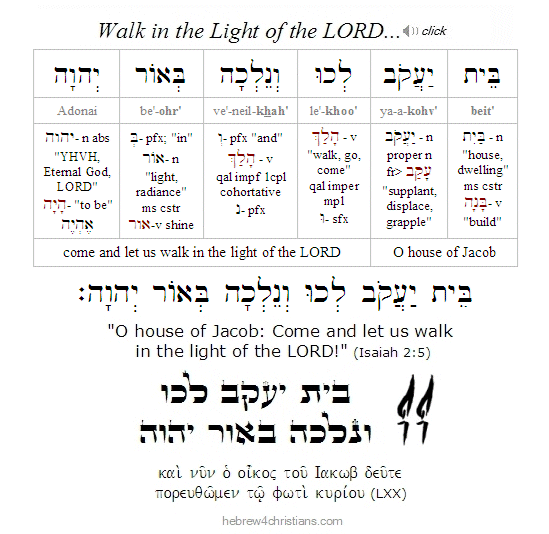
Yeshua is the Light of the LORD (אוֹר יי). As it is written, "God is our light and our yeshuah, our salvation" (Psalm 27:1; 1 John 1:5). He alone is the Light of the world (אוֹר הָעוֹלָם), the Shamash (שַׁמָּשׁ) who descends to ignite the "light of life" (אוֹר הַחַיִּים) within all who will believe. Our Savior is the Radiance (זוֹהַר) of the glory of God (Heb. 1:3), the Fire of God's holy countenance. The one who has the Son has life, but the one who refuses this life is spiritually dead. May we all walk in the Light of His countenance; "O house of Jacob, come, let us walk in the light of the LORD" (Isa. 2:5).
Zechariah's Vision....
In the prophet Zechariah's great vision of the menorah (Zech. 4:1-10), seven "pipes" (מוּצָקוֹת) led to each of the seven lamps - 49 pipes in all - indicating the perfection of the Spirit of God and recalling the Jubilee holiday of Shavuot (Zech. 4:2). Two olive trees stand next to the menorah, one on the right, and one on the left (Zech. 4:2-3). The two olive trees may picture the the kingship and the priesthood united in the Person of Yeshua our Messiah, or they may refer to Israel and the ekklesia, respectively. Zechariah then exclaims, "This is the word of God to Zerubavel: 'not by might or power, but by my Spirit, says the LORD of Hosts'" (Zech. 4:6). Note that the passage ends with the statement, "he shall bring forth the top stone (הָאֶבֶן הָראשָׁה) with shoutings of 'Grace, grace, unto it' (Zech. 4:7), a clear picture of the crowning glory of our Messiah and great High Priest, Yeshua...

The Scriptures declare that God is light, and Yeshua is the true Light of God (1 John 1:5; John 1:9). The light of the menorah, the symbol of Divine Light, was only visible before the holy place of sacrificial atonement. The light itself came from the burning of pure and beaten olive oil - a symbol of anointing and the Holy Spirit (רוּחַ הַקּדֶשׁ). It was kindled by the hand of a man of peace and humility. Likewise, when we are given light to behold the sacrifice of Yeshua for our atonement (כַּפָּרָה), we are filled with the divine light (John 8:12; 1 John 1:7, Eph. 5:8). When we come to the cross, we can behold the truth of God's unfailing love that draws us to be united with Him.
בית יעקב
לכו ונלכה באור יהוה
beit · Ya·a·kohv:
le·khoo · ve·neil·khah · be·ohr · Adonai

"O House of Jacob:
Come, let us walk in the light of the LORD"
(Isa. 2:5)

<< Return
|