|
GOD USES SUFFERING IN OUR LIVES to teach us the truth. After all, who among us would have genuinely turned to Him without its effect? The Lord repeatedly uses affliction to call us back to Him. It's His tool for prompting us to do teshuvah – repentance. Indeed, can there be any worse punishment in this life than to be untouched by need, suffering and testing? Can anything be more tragic than to be forgotten or overlooked by God? No, affliction is a blessing in disguise. As A.W Tozer once wrote, "It is doubtful whether God can bless a man greatly until He's hurt him deeply."
Of course affliction is just the starting point, the prerequisite for all that follows. It's the "price for admission" into God's school. And the very first lesson to be mastered is that 1) there is a God and 2) you are not Him. Should you forget the lesson, you will be revisited with affliction to help you begin again. In this way suffering is like a "guardian angel" or a personal tutor who keeps you focused on the truth. You simply cannot move forward in God's school apart from complete surrender.
When we genuinely accept that God defines the truth for our lives, we realize that affliction is sovereignly given to us so that we can learn abide in Him without constraint. As Soren Kierkegaard once wrote, "God's education consists in leading one to being able to do freely what at first one had to be compelled to do." The idea of "law" is transformed to that of grace.
Life is a "school" for the soul. God is the Teacher, we are "disciples" (i.e., תַּלְמִידִים, "learners"), and affliction is our divinely appointed tutor. Many of us are slow to learn, but God is patient with those whom He disciplines. The goal is to never lose sight of what's most important, which is God Himself. If you find yourself in a place of resistance, then you are confronted with the decision of whether or not you will trust the Teacher. The key lies in surrendering to God's will by submitting to His rule over all things. Yielding to God's will is the path of serenity and inner peace.
May the Lord keep you in perfect peace as you set your mind on Him (Isa. 26:3).
Hebrew Lesson
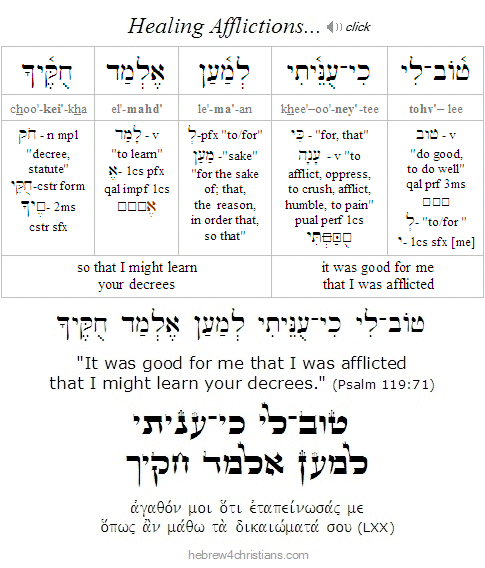
Psalm 119:71 reading (click):
An Afterword:
Affliction is the humbling process by which God teaches us His decrees (חֻקִּים, chukkim), but it should be noted that such decrees are not always "rational." Indeed the very word chukkim refers to laws given that do not make "rational sense." The divine decrees supersede or transcend the claims of logic and reason, and indeed, human reason must submit to God's authority. We believe in order to understand -- not the other way around. Reason cannot "demand" an explanation from God, and should it refuse to submit, the mind will be at war with the heart, leading to further affliction. This disunity of the person leads to a state of inner contradiction and eventually to the disintegration of the soul. The way of healing in this case is to make a decision to submit to God's loving authority -- despite the antinomies presented by human rationality. (This is not to say that we are to engage in "wishful thinking" or to squelch honest questions about our faith. No, we must "work through the issues" and be willing to think hard -- and sometimes even question what we believe. That said, we must eventually come to a place of decision, especially since the suspension of judgment (in order to potentially avoid error) is itself a decision.)
On the other hand, submitting to God's teaching leads to a life of collision with worldly culture. This leads to a constant state of paradox. Living by emunah (אֱמוּנָה, faith) is "already-not-yet," a constant mediation between time and eternity, of freedom and necessity, which, according to the "wisdom of this world," is regarded as absurd. Naturalism or humanism wants to abolish paradox through reductionism but the life of the spirit lives in a state of ongoing tension and paradox. Faith affirms that underlying the surface appearance of life is a deeper reality that is ultimately real and abiding. It "sees what is invisible" (2 Cor. 4:18) and understands (i.e., accepts) that the "present form of this world is passing away" (1 Cor. 7:31). The life of faith therefore calls us to live as toshavim - sojourners - who are put at a "distance" from the world of appearances. We ache with a divine "homesickness." We lament the state of this world and its evils. We gnaw with hunger for love and truth to prevail in the world. In this way faith itself is cause for yet further affliction because it finds itself alone among the crowd and its diversions.
A lot more could be said on this subject, of course, but I hope this "meditation" will provoke you to think through some of the issues for yourself, chaverim.
<< Return
|