|
Do you have a Jewish heart? If you say that you love the "LORD God of Israel" (יהוה אֱלהֵי יִשְׂרָאֵל) -- and it's clear that the LORD God of Israel loves the Jewish people -- it follows that you should likewise love the Jewish people (see Deut. 7:6-8; 14:2; 2 Sam. 7:23-24; 1 Kings 8:53; 10:9; 1 Chron 17:20-21; Isa 43:1-3; Jer. 31:31-37; Ezek. 36:24-28; Rom. 11:1-2;11:28; Hos. 11:1-11, etc.). After all, the LORD Yeshua is called מֶלֶךְ הַיְּהוּדִים / melech ha-Yehudim: the "King of the Jews" (Matt. 2:2, 27:11, etc.), and the very term "Mashiach" [i.e., "Christ"] is a regal term denoting the anointed King of Israel. Christians who pray to "Jesus Christ" are really praying to Yeshua as the anointed King of the Jews... And one day (very soon) Yeshua will indeed return to Jerusalem, the "City of the Great King" (Matt 5:35), to assume the throne of David and complete the redemption originally promised to the Jewish people (Zech. 12:1-13:1; 14:1-9, Ezek. 37:12-14, etc.). God will prove faithful to ethnic Israel. To deny this is to radically question God's faithfulness to the "Church." Indeed, let me say this as plainly as I can: Churches or teachers who claim that God has abandoned ethnic Israel are directly impugning the credibility of the Gospel message itself. Yes, it's that serious of an issue...
The physical descendants of Abraham are called בָּבַת עֵינוֹ (bavat eino), the "pupil of God's eye" (Zech. 2:8), a term of endearment God uses for no other nation on earth. Indeed, the LORD has never abandoned His original covenant people but will yet choose them for His Name's sake (Isa. 14:1). The church has not replaced Israel in God's redemptive plan but is merely "grafted in" to the original "root" of Israel. "Remember," Rabbi Paul warns, "it is not you who support the root, but the root supports you" (Rom. 11:18).
Did you know that the Brit Chadashah (בְּרִית חֲדָשָׁה), or "new covenant," is described in only one place in the entire Old Testament? Here is the relevant passage:
Behold, the days are coming, declares the LORD (יהוה), when I will make a new covenant (בְּרִית חֲדָשָׁה) with the house of Israel and the house of Judah, not like the covenant that I made with their fathers on the day when I took them by the hand to bring them out of the land of Egypt, my covenant that they broke, though I was their husband, declares the LORD. For this is the covenant I will make with the house of Israel after those days, says the LORD: I will put my Torah (תּוֹרָה) into their inmost being and inscribe it upon their hearts; I will be their God, and they will be my people. No longer will they need to teach one another and say to one another, "Heed the LORD"; for all of them, from the least of them to the greatest, shall heed Me -- declares the LORD. For I will forgive their iniquities, And remember their sins no more. (Jer. 31:31-4)
Many Christian theologians stop here and ignore the surrounding context of this passage, namely, the remarkable promise that ethnic Israel would continue to exist as a unique people as long as the laws of nature are in operation:
Thus saith the LORD (יהוה) who gives the sun for a light by day and the ordinances of the moon and of the stars for a light by night, Who stirs up the sea into roaring waves, Whose name is LORD of Hosts (יהוה צְבָאוֹת שְׁמוֹ): If these laws should ever be annulled by Me -- declares the LORD -- only then would the offspring of Israel (זֶרַע יִשְׂרָאֵל) cease to be a nation (גּוֹי) before Me for all time (כָּל־הַיָּמִים). Thus said the LORD: If the heavens above could be measured, and the foundations of the earth below could be fathomed, only then would I reject all the offspring of Israel (זֶרַע יִשְׂרָאֵל) for all that they have done -- declares the LORD. (Jer. 31:35-37)
From this passage it is clear that the continuation and perpetuity of the physical descendants of Israel (zera' Yisrael) is to be reckoned as sure as the very "laws of nature" that are upholding the physical universe. In other words, so long as there is a sun shining during the day and moon and stars during the night, Israel will continue to be a nation (goy) before the LORD for all time (kol-hayamim). Using another analogy, it is as likely for someone to accurately measure the extent of the heavens and earth than it is to suppose that the LORD will cast off all of the seed of Israel. Note especially the last qualifying clause of this verse, "for all they have done," indicating that the unconditional faithfulness of the LORD is not based on the conditional behavior of national Israel.
Have you seen the sun, moon or stars today? If so, you can be assured that the ethnic nation of Israel retains a place in God's plan. The gift and the calling of God is irrevocable (Rom. 11:29).
Why Bless Israel?
Since this may be a new idea to some of you -- especially if you have been involved in churches that teach the false doctrine known as "Replacement Theology" (i.e., the idea that the church "replaces" Israel as the recipient of covenantal blessings) -- I'll list a few reasons why Christians should love and support the physical descendants of Abraham, the Jewish people:
- The Nature of the Abrahamic Covenant. The covenant given to Abraham, Isaac, and Jacob is בְּרִית עוֹלָם (brit olam), an everlasting covenant that is unconditional in nature. It is not, as supposed by some, conditioned upon obedience to the terms of the Sinai covenant, since the covenant given to Abraham (i.e., the "Covenant Between the Parts" / בְּרִית בֵּין הַבְּתָרִים given in Gen. 15:9-21) precedes the Mosaic covenant by 400 years (Gal. 3:17). Moreover, the covenant made with Abraham was in response to his faith and was initiated solely by the grace by God (this idea is supported in both Romans Chapter 4 and in Paul's argument that there is a "deeper Torah" than the Lawcode given at Sinai (Gal. 3:17-18)).
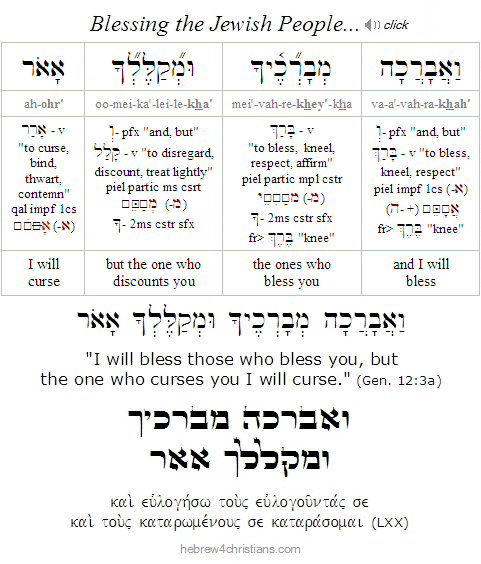
Note that the grammar of Genesis 12:3 implies that God desires to bless the multitudes through Abraham: "I will bless (all) those who bless you (plural), but him (singular) who speaks lightly of you (i.e., קָלַל, from kal, meaning "light") I will ensnare (אָרַר). In other words, whoever regards the unconditional Abrahamic covenant lightly will be ensnared and confounded by the LORD God of Israel... This is a serious warning to those who hold to "replacement theology" by regarding the "covenant between the parts" made to Abraham as conditional or otherwise something kal, light, insignificant...
- The Example of Yeshua, the first disciples, and Paul. The gospel message itself is "to the Jew first, and also to the Gentile" (Rom. 1:16). It is first of all a new covenant made with the "lost sheep of the house of Israel" (Matt. 10:5-6). Yeshua Himself focused on reaching the Jewish people with His message of ge'ulah (redemption) and had His followers focus their missionary activities on reaching the Jews. The apostle Paul never disavowed his Jewish ancestry and was burdened for the salvation of Israel throughout his ministry (Acts 20:16). For more on this, see the article entitled, "Torah Awareness."
- Gratitude to the Jewish People. We owe the Jewish people a debt of gratitude for the blessings we have received from them. As Yeshua clearly said, "Salvation is from the Jews" (John 4:22). Through Israel the promises and the covenants were given, and Yeshua Himself was a Torah-observant Jew descended from the tribe of Judah. And the new covenant is a Jewish covenant made with the Jewish people. Non-Jews can be made partakers of this covenant but that in no way transfers the original terms of the covenant itself. We simply cannot properly interpret the message of the "New Testament" without appreciating its radically Jewish character and focus. For more on this, see "Israel and the Church: What's the Relationship?"
- Trust in God's Faithfulness. God's promise to Israel stands forever, and He will never abandon His people Israel -- no more than He will abandon the church. The gifts and election of God are irrevocable (Rom. 11:28). God revealed the mystery of Israel's temporary fall to the Apostle Paul (Rom. 11), but this will last only until the all of the Gentiles called by the LORD have become partakers of the new covenant blessings, and then כָּל־יִשְׂרָאֵל יִוָּשֵׁעַ / kol-Yisrael yivashea: "all Israel shall be saved" (Rom. 11:26). Paul further stated concerning ethnic Israel, "regarding the gospel, they are enemies of God for your sake; but regarding election, they are beloved for the sake of fathers" (Rom. 11:28).
- Israel's (Central) Place in Prophecy. God has promised to restore national Israel in the last days (Amos 8:14-5), and we are contemporary witnesses to this miracle. The fact that Israel has been regathered to their ancient homeland after nearly 2,000 years in the Diaspora is a sign and a wonder to the world that bespeaks of God's faithfulness. It is a "super sign" that God's promises are true and we can trust in His word (Ezek. 37:21). עַם יִשְׂרָאֵל חַי - Am Yisrael Chai: "The people of Israel live!" We are now told to "comfort God's people" (Isa. 40:1-2) and to help regather the remnant of the Diaspora to their original homeland (Isa. 49:22-23). Israel will also be the focal point at the time of the return of Yeshua, since He will return there to set up His kingdom. All of the promises made to national Israel in the Tanakh will then be literally fulfilled, again demonstrating the faithfulness of the LORD God of Israel. God still loves the Jews and has a promised future for ethnic Israel. This future is not "incidental" to the plan of God but is central, since both the "Old Testament" and the "New Testament" writings presuppose a glorious future for the Jewish people.
- The World to Come. In the olam habah (the world to come) we will all serve a Jewish LORD and worship in a new Jerusalem. There the names of the twelve tribes of Israel will be inscribed on the city gates (Rev. 21:12) and we will enjoy communion with the patriarchs and heroes of the faith (Heb. 11).
- Honoring God's Promises. God says He will bless those who bless Abraham and curse those who curse him (Gen. 12:3). This same statement is made concerning Abraham's descendants (see Gen. 26:3-4; 27:29; 28:13-15). This is a mysterious fact of Scripture that must be accepted by faith. Blessing Abraham and his descendants honors the God of Abraham, Isaac, and Jacob - the very LORD whom Christians claim as their God and the Father of the Jewish Messiah Yeshua (Exod. 3:15). Moreover, we are commanded to "pray for the peace of Jerusalem" (Psalm 122:6) and are told that we shall prosper if we do so.
God is faithful to Israel
The LORD has not cast off His original covenant people Israel, and neither should we, if we indeed are those who sincerely love the Jewish LORD and Messiah! God's faithfulness to national Israel is a testimony of His faithfulness to us, as followers of His Son. Should God abandon Israel and the unconditional promises He made to Israel, what makes you think He would not abandon the church and the promises He has made to us? I'll say it again: those who say that the LORD God of Israel has abandoned the Jewish people are undermining the credibility of the Gospel message itself!
How can I bless Israel?
An obvious way to help the children of Israel is to provide a donation for the poorest of the land. Perhaps you did not know that Israel has over 20% of its population living under the poverty level, including 720,000 children? You can help "do it unto the least of these my brethren" (Matt 25:40) by donating to Meir Panim, a food shelf in Israel, or to Bridges for Peace, a Christian relief agency in Israel. Click on the logos below to learn more:

Finally, supporting ministries (such as Hebrew4Christians) that seek to respectfully and sensitively reach out to the Jewish community with the good news of the Messiah is a wonderful way to help meet the spiritual needs of God's original covenant people.
Hebrew Lesson
Genesis 12:3a reading (click):
|
|